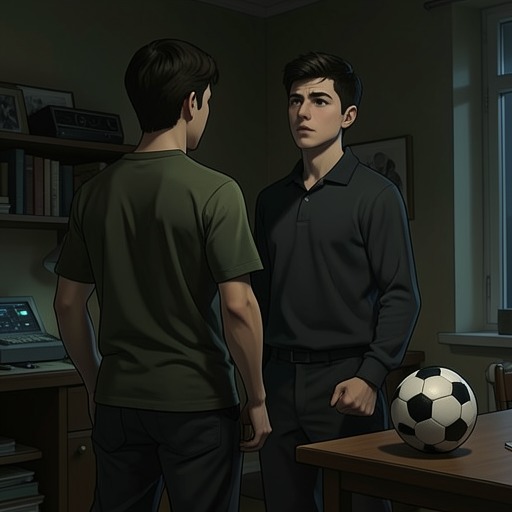
Alex’s limited-edition Nike soccer ball
Kevin the Star StrikerAlex’s limited-edition Nike soccer ball is both a prized object and a turning point in the Wild Soccer Bunch’s story. Presented by Alex’s father when Alex is confined to his room, the ball gives a forbidden passion a material form: its rarity and brilliance tempt Alex back toward the soccer field, while its first use in the house transforms a domestic punishment into the beginning of his return.
Appearance and Ownership
At One Woodlawn Avenue, Alex wakes to find his father standing in his room with a brand-new soccer ball. It is dark black, gleaming, and identified as a Nike limited edition. Alex’s father emphasizes that only 5,000 of these balls exist in the world and frames it as the right beginning for a new collection. The description makes the ball conspicuously different from an ordinary piece of sports equipment. It is scarce, expensive, and associated with collecting as much as with play, an object whose value can be measured both by its market rarity and by the intensity of Alex’s attachment to soccer.
The ball also arrives against a sharply unequal background. Kyle is wealthy, while Joey cannot afford cleats, sometimes lacks even a jacket, and lives with his unemployed mother in a van. Larry, meanwhile, works at the lemonade stand beside the soccer field despite having once nearly become a professional soccer player. Against those circumstances, the limited-edition Nike ball signals Alex’s access to resources that other players in the Wild Soccer Bunch do not have. Yet the ball does not remain merely a luxury possession: its decisive importance comes from what Alex does with it and what it makes possible for the team.
The Ball and Alex’s Soccer Ban
Alex receives the ball while under severe punishment. His father has grounded him for ten days and imposed a complete soccer ban; Alex watches through the living-room window as three garbage bags filled with his soccer equipment are carried toward a garbage truck. He had spent more than five years saving for that equipment, so the punishment threatens not only his immediate freedom to play but also the material history of his devotion. The new Nike ball therefore enters a scene in which soccer has apparently been removed from Alex’s life.
Alex’s father makes the ball conditional on courage. He suggests that Alex may be “chicken” and insists that his son does not back out. The challenge changes the object’s function. It is no longer simply a collector’s prize or a gift from a parent; it becomes a test addressed directly to Alex’s identity as a soccer player. Alex grabs it and storms out of his room, translating the father’s provocation into movement before the game has even begun.
The Globe-Kicking Incident
The ball’s arrival follows Alex’s earlier destruction of the globe in his living room. While playing with the globe beside the window, Alex decides that a complete soccer ban cannot be accepted. He removes the screws holding the globe to its stand, sends the equator onto the hardwood floor, and kicks the North Pole. He repeatedly fires the globe against the wall, lifts it with his knee, and attempts a bicycle kick, striking the coast of Madagascar before the globe shoots toward the wall like a cannonball.
The contrast between the globe and the Nike ball gives the new object a charged place in the episode. The globe is not designed for play, but Alex converts it into a substitute soccer ball because his father has confiscated the real equipment. The limited-edition Nike ball then replaces that improvised object at the moment Alex chooses action rather than resignation. His father’s gift does not simply soothe the punishment; it helps expose the contradiction inside it. Soccer is forbidden, yet the very object placed in Alex’s hands encourages him to prove that the ban cannot extinguish his desire to play.
Alex phones Danny while intently looking at the new ball. Danny argues that there is no point in going outside, but Alex resists, fights with himself, and finally answers that there is a point. The ball is thus present at the exact moment of decision. It does not act independently of Alex, but it materially concentrates the pressure of the scene: the father’s challenge, Alex’s anger at the ban, the memory of the confiscated equipment, and the prospect of returning to the team all converge around it.
Role in the Decisive Match
Alex takes the ball from his father and leaves the house, rejoining the Wild Soccer Bunch for the match against the Unbeatables. The object’s significance then shifts from private possession to collective play. In the opening attack, Kevin passes to Alex, Alex plays back to Tyler, and Tyler sends the ball onward to Danny. The sequence places Alex inside a coordinated chain rather than treating the rare ball as a possession that belongs to one player alone.
The match becomes a long reversal. After the Unbeatables build a seven-goal lead, Alex contributes to the Wild Soccer Bunch’s first goal when Kevin passes back under pressure and Alex strikes the ball toward the goal. Octopus blocks it with his chest but is carried into the goal with the ball. Later, after the score reaches seven to four, the Wild Soccer Bunch’s training on muddy ground allows them to move more effectively than their opponents. Kevin, Danny, Joey, Tyler, and Diego contribute to the comeback, and the score rises to nine to nine.
At that stage, the ball’s importance is no longer tied to Alex’s individual defiance alone. The team’s survival depends on passing, restraint, and trust. Kevin has wanted to score the tenth goal himself and loses possession by refusing to pass, so Larry removes him and sends Roger onto the field. Roger misses an early winning opportunity, while Kyle prevents the Unbeatables from scoring with a diving save and then steers another attempt around the post. The game finally turns when Roger, despite Kevin’s warning, strikes the ball into the net. The Wild Soccer Bunch win, carry Roger across the field, and recognize him as their hero.
The victory does not make Alex the sole owner of the match’s meaning. His ball is folded into a collective achievement in which the final hero is Roger and the decisive defensive intervention belongs to Kyle. That distribution matters: the rare object helps bring Alex back to the field, but the game proves that no single player, possession, or reputation can win without the team’s interconnected actions.
Narrative Significance
The limited-edition Nike soccer ball materializes the conflict between adult control and youthful identity. Alex’s father uses it to challenge his son, but Alex receives the challenge as permission to recover the part of himself that the ban has tried to suppress. The ball’s rarity also intensifies the irony of the situation: an object suitable for a collection becomes valuable because it is played with, carried into danger, and placed within the unpredictable economy of a team match.
Its meaning is built through contrast with the other objects and conditions surrounding the players. Alex’s ball stands against the garbage bags of confiscated equipment, the dismantled globe, Joey’s worn sandals, Larry’s ruined stand, and the ordinary obstacles of poverty, weather, and parental punishment. It begins as a marker of privilege and personal desire, then becomes an instrument of participation. By the time the Wild Soccer Bunch celebrate their victory, the ball has helped convert a private act of rebellion into a shared return to the soccer field.