Asthma
Kevin the Star StrikerAsthma is one of the most important bodily conditions in the story because it repeatedly interrupts Diego’s identity as the team’s “tornado” while never reducing him to illness. His attacks make the danger of soccer immediate and physical: breath, stamina, fear, and the expectations of teammates all meet in his body. At the same time, Diego’s efforts to reach the field show how fiercely he wants to remain part of the team, even when his health and his mother’s caution stand in the way.
Diego’s Two Speeds
Diego is described as the team’s tornado. When asthma attacks him, however, he becomes “just a regular left forward”; when he is playing at his best, he is faster than a tornado. The contrast establishes asthma as a recurring interruption rather than a complete identity. Diego’s ability is real, but it is conditional: the same body that can overwhelm opponents with speed can also suddenly struggle for breath.
This contrast gives Diego’s soccer a distinctive rhythm. His talent appears in bursts, and every return to full strength carries the possibility of another interruption. The narrative therefore makes his athleticism inseparable from uncertainty. Diego is not simply the strongest player who must defeat a weakness; he is a player whose ordinary experience of competition includes monitoring whether his body will allow him to continue.
Illness, Care, and Deception
During the fight to return to the soccer field after winter, Diego is already recovering from the flu. Because of that illness, he and Roger are not grounded or banned from soccer, but Diego still has to prove that his temperature is below his mother’s required limit of 99 degrees. His mother tells him that he cannot play unless the thermometer shows less than 99 degrees, treating the reading as a condition for safe participation.
Diego responds by placing an ice cube under his tongue before taking his temperature. The trick produces an absurdly low reading of 91.5 degrees, making him appear almost hypothermic rather than feverish. He runs out before his mother can protest, convinced that he has solved the problem. The episode shows both his determination and the danger created by competitive urgency: instead of accepting medical supervision, he tries to manipulate the test that stands between him and soccer.
His mother remains unconvinced. When Diego returns home, she is still waiting with the thermometer, and he realizes that she has been prepared to check him again. This time he has no ice cube under his tongue. The temperature rises toward the crucial 99-degree mark, turning the household into a struggle between parental care and Diego’s desire to play. His later attempt is even more extreme: he secretly takes three ice cubes from the freezer and puts them in his mouth before practice, then swallows them when his mother appears. The comedy of the scene does not erase the underlying conflict. Diego treats his body as something that must be made to pass a test, while his mother treats the same body as something that must be protected.
Asthma at the Occupied Field
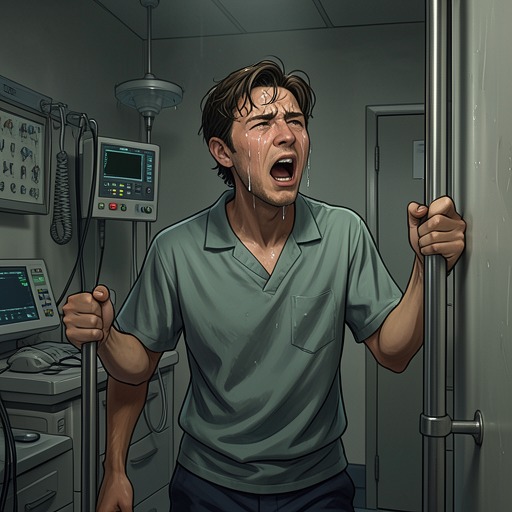
When the team discovers that the soccer field has been taken over by the Unbeatables, Diego is found sitting at the center mark, wheezing in fear and fighting back an asthma attack. The field appears empty, but his reaction makes clear that the threat is already present before the opposing players visibly reveal themselves. His asthma becomes part of the scene’s suspense: the team does not merely face a hostile group; it must also respond to a teammate whose breathing is failing under pressure.
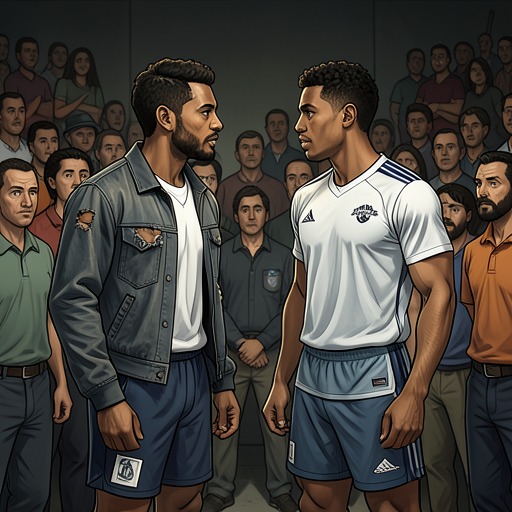
Later, when Diego arrives before the field during the confrontation with the Unbeatables, he is still breathing heavily. He tells the others that he “just took off,” and they realize that he is having another asthma attack, this time not because of grass. The attack follows exertion and urgency rather than a simple environmental trigger. Diego has forced himself to run toward the field, and the effort exposes the cost of his decision.
His condition also changes the balance of the match. When the team is already under severe pressure, Diego gasps that playing seven against six would be unfair because Kyle is absent. The remark is practical and loyal, but it also reveals how precarious the team’s available strength has become. Diego is trying to defend the team’s fairness while struggling to breathe himself.
Fear as Strength
Asthma gives concrete meaning to the conversation about fear between Diego and Larry. Diego asks what the team is supposed to do about its fear, and Larry answers that fear is not merely an obstacle: “Your fear is your strength.” The statement applies especially sharply to Diego, whose fear is not abstract. He has experienced breathlessness on the field, knows that his body can fail him, and still continues to approach the game.
Larry’s training turns fear into something the players must recognize rather than deny. In the mud-field exercise, the mud represents the fear and unsteady knees caused by opponents such as Mow-down, Juggernaut, and Kong. For Diego, that lesson includes the physical fear of an asthma attack as well as the fear generated by larger, more aggressive players. The team is not trained to pretend that vulnerability does not exist. It is trained to move while vulnerability is present.
That idea challenges the Unbeatables’ model of strength. Their intimidation depends on making fear look like proof of weakness. The Wild Soccer Bunch gradually learns another definition of courage: not the absence of fear or bodily limitation, but continued participation, mutual trust, and action that takes those realities seriously.
From Attack to Comeback
The first half of the decisive match shows the harshest consequences of Diego’s condition. The team forgets Larry’s training, falls far behind, and Diego is eventually exhausted enough to drop down at the edge of the field. The players feel as if their legs are made of lead, and their collapse is reflected in the score, which reaches five to zero in favor of the Unbeatables.
The match changes after the team regains its collective rhythm. During the comeback, rain softens the ground into mud, but the team has practiced on similar terrain for twelve days. Diego then forgets his asthma and becomes the Tornado again, contributing to the sequence that carries the team into the lead. The wording does not suggest that the illness has been cured. Instead, it marks a temporary return of the athletic identity that asthma repeatedly interrupts.
That return matters because it is collective rather than solitary. Diego does not win by proving that his body is identical to an unaffected player’s body. He contributes within a team whose passing, training, and trust make room for his fluctuations. His recovery on the field is one part of a broader comeback in which no single player can sustain victory alone.
Significance
Asthma functions as both a physical reality and a test of the team’s ideas about strength. It limits Diego, creates genuine danger, and forces him to negotiate with his mother, his teammates, and the demands of competition. Yet the story repeatedly refuses to let the condition become the final word about him. Diego can be frightened, wheezing, exhausted, or medically restricted and still remain a vital soccer player.
The condition also helps shift heroism away from invulnerability. Diego’s courage lies partly in his reckless attempts to reach the field, but the larger lesson is more complicated: bodily limits cannot simply be cheated with ice cubes, ignored through bravado, or defeated by a single burst of speed. They must be recognized within relationships of care and trust. By placing Diego’s attacks alongside the team’s fear, the narrative makes vulnerability a shared condition rather than a private shame, and turns the players’ eventual success into a victory built not on perfect bodies but on coordinated, imperfect ones.