Be Wild!
Kevin the Star Striker“Be Wild!” names the Wild Soccer Bunch’s governing spirit: unruly, defiant, loyal, and inseparable from soccer. The expression does not simply celebrate recklessness. Across the story, it develops into a way of resisting exclusion, admitting fear without surrendering to it, trusting teammates, and transforming a group of children into a functioning team.
Identity and Meaning
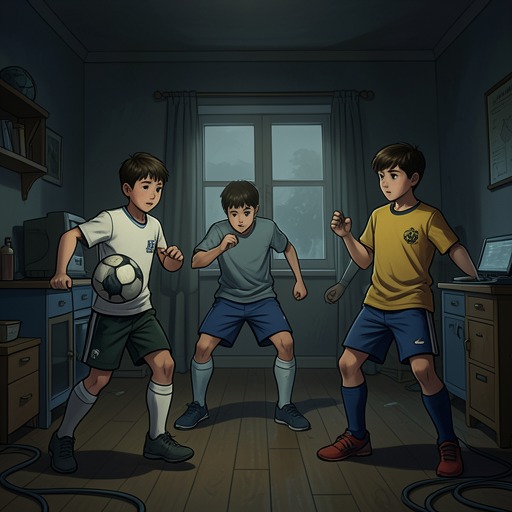
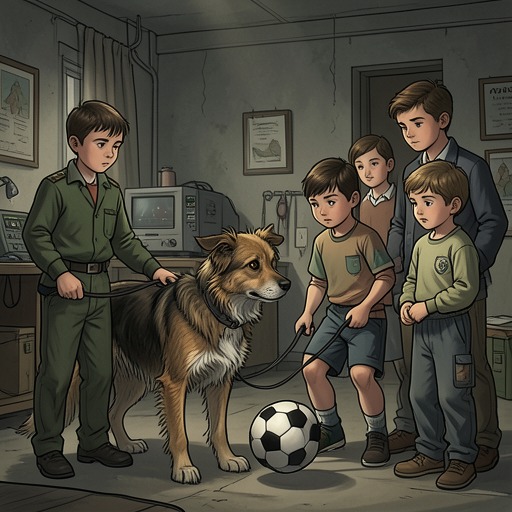
The phrase first defines the Wild Soccer Bunch against the safer image of a children’s team. Kevin introduces the group as eleven friends and a cute dog only to reject that description as inadequate. The team is presented as more than pleasant children who enjoy playing soccer: its members are “dangerous and wild,” and Sox is more than merely cute. In this formulation, wildness is a chosen identity, a claim to intensity and seriousness in a world that might otherwise dismiss the children’s game.
That identity is collective but not uniform. Danny is valued as the world’s fastest right forward and as Kevin’s best friend, while Tyler is the team’s number 10, its “brains and heart,” because he never gives up. Kyle is described as a natural, born goalkeeper, even though his father wants him to become a golf professional or tennis ace. The phrase therefore gathers different talents and loyalties into one public name rather than reducing the group to a single playing style.
From Private Spirit to Public Defiance
“Be Wild!” acquires its sharpest political meaning when Mickey the Bulldozer and the Unbeatables seize control of the soccer field. Mickey declares that the field belongs to his group alone and orders the Wild Soccer Bunch to leave. His language turns possession into law: the opposing team is excluded not because it has lost a match, but because Mickey claims the authority to decide who may play.
Kevin answers that imposed rule with a challenge. He gives the Unbeatables two weeks before the Wild Soccer Bunch returns to contest the field through soccer. The wager is precise: if the Unbeatables win, the field remains theirs; if the Wild Soccer Bunch wins, the Unbeatables must leave and the field becomes theirs “once and for all, forever.” The expression’s wildness is thus not empty noise. It becomes a speech-act of resistance, using a child’s challenge to reopen a space that stronger boys have closed by force.
The conflict also reveals competing forms of masculine authority. Mickey performs domination through size, insults, threats, and the claim that fear has no place in his world. He calls Larry a fraud and attempts to discredit the coach before the team. The Wild Soccer Bunch initially answers with anger and bravado, but its eventual strength depends on a different standard: honest speech, mutual trust, passing, persistence, and the willingness to acknowledge vulnerability.
Fear, Honesty, and Trust
Larry gives the expression its most important ethical dimension. When Kevin finally admits that he is frightened, Larry does not treat the confession as failure. He asks the players to decide what kind of coach they want and insists that trust must run in both directions: the team must trust Larry completely, and Larry must trust the team completely. Without that reciprocal commitment, the players cannot beat the Unbeatables.
Diego then asks what the team should do with its fear. Larry answers that fear is precisely what gives the Wild Soccer Bunch a chance: “Your fear is your strength.” The statement revises the meaning of being wild. Wildness is not the absence of fear, and it is not the performance of invulnerability represented by Mickey. It is the capacity to carry fear into action while remaining connected to teammates.
The expression consequently joins honesty to courage. The team cannot become stronger by pretending that Mickey’s violence is harmless or that the coming match is merely an ordinary game. It becomes stronger when fear is spoken, shared, and placed inside a structure of trust. “Be Wild!” therefore names a communal discipline as much as an emotional mood.
The Battle Cry in Action
The phrase becomes a ritual when Larry counts to three after the players complete their passing exercise. For the first time, the team forms a circle and, without discussion, shouts “ONE, TWO, THREE WILD!” The cry marks a change from separate players practicing beside one another to a group acting with a shared rhythm. Its power comes from repetition, timing, and simultaneous voices rather than from any individual speaker.
The ritual is immediately tested. Mickey imitates Sox’s bark and appears with Humungous, Mow-down, Juggernaut Jim, Octopus, Rick the Grim Reaper, and Kong, surrounding the team from all sides. The interruption makes the battle cry more than a celebratory slogan: it is an answer to intimidation. Later, when the Wild Soccer Bunch is losing badly, Mickey has scored five goals in seven minutes and the players are bruised, frightened, and staring at the ground. The arrival of Larry and Roger restores the possibility of resistance, but the decisive renewal comes when the team again roars “ONE, TWO, THREE WILD!” and stands shoulder to shoulder before breaking into coordinated play.
The following sequence demonstrates what the cry produces. Kevin passes to Alex Alexander, who plays the ball back to Tyler; Tyler sends a precise pass toward Danny, and Danny links the move to Joey. The Unbeatables are temporarily paralyzed by the speed of the combination, although Octopus stops Kevin’s shot with his extended tentacles. After Mickey scores again, the Wild Soccer Bunch attacks through Tyler, Danny, Kevin, and Alex Alexander. Alex Alexander’s shot carries Octopus into the goal, giving the team its first score. Julian Fort Knox then reawakens as an all-purpose defender, stopping Kong and initiating Joey’s attack before Kevin scores with his famous flip-over bicycle kick. The battle cry is therefore confirmed by movement: it becomes passing, recovery, defense, and collective response rather than a substitute for skill.
Recurrence and Narrative Significance
The expression recurs as a compact summary of the book’s central contrast. The Unbeatables possess the field through exclusion and physical intimidation; the Wild Soccer Bunch seeks to reclaim it by accepting the risk of confrontation while preserving cooperation. Mickey’s version of strength depends on making others small, calling them “measly midgets” and treating the match as a slaughter. The Wild Soccer Bunch’s version depends on making each player available to the others.
“Be Wild!” also looks beyond the immediate team. The later account of Zoe shows that the Wild Soccer Bunch is not yet fully open-minded: the boys resist welcoming a girl even though Zoe is soccer-crazy and dreams of becoming the first woman to play for the United States men's national soccer team. This continuation complicates the expression’s promise. Wildness can challenge authority, but it can also harden into a new boundary if the group confuses its own identity with permanent exclusion. The phrase remains valuable precisely because the story tests whether its ideals of courage and belonging can grow beyond the original group.
As a recurring expression, “Be Wild!” finally converts attitude into belonging. It begins with Kevin’s insistence that the team is more dangerous and serious than outsiders imagine, passes through the challenge to the Unbeatables, is ethically reshaped by Larry’s demand for honesty and trust, and reaches its fullest form in the synchronized battle cry. Its decisive significance lies in that transformation: wildness becomes not chaos, but the shared courage to return to the field, stand together, and keep playing when fear, injury, and defeat appear to have already decided the result.