Body-Contact-Is-Allowed Rule
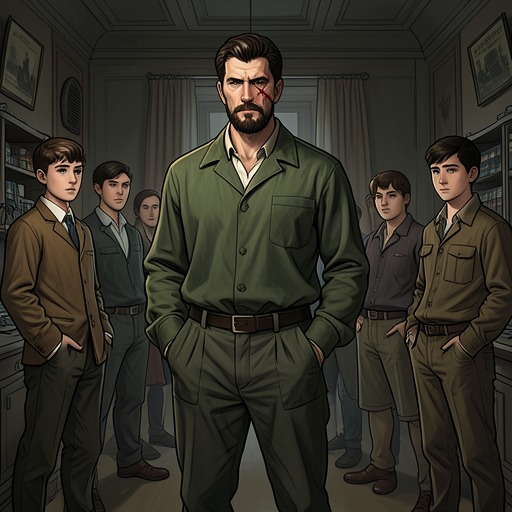
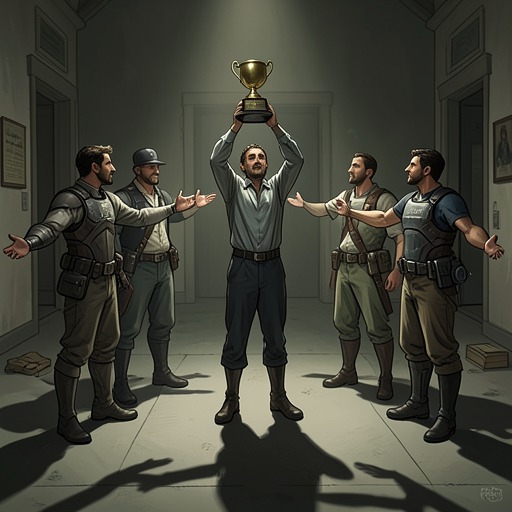
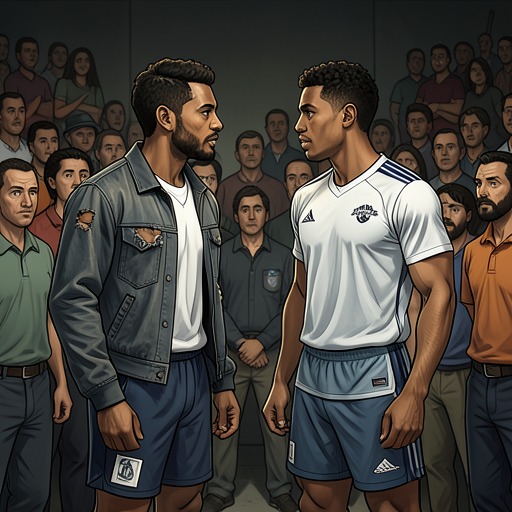
Kevin the Star StrikerThe Body-Contact-Is-Allowed Rule is Mickey the Bulldozer’s decisive distortion of soccer’s order: during the challenge between the Wild Soccer Bunch and the Unbeatables, he declares that bodily force is permitted, converting ordinary competition into a spectacle of intimidation and unequal physical power.
Definition and Authority
The rule appears when the Unbeatables are already treating the soccer field as their exclusive territory. Mickey has announced that the field belongs only to them, while Kevin answers by giving them two weeks before the Wild Soccer Bunch returns for a formal challenge: victory will determine who may keep the field. The match therefore carries stakes beyond the score. It is a struggle over belonging, authority, and the right to establish the conditions of play.
Mickey also claims that the challenged side may choose the weapons, presenting the arrangement as a traditional principle of duels. He then selects conditions that favor the Unbeatables: the Wild Soccer Bunch must play with the sun in their eyes, and the game will continue until one team scores ten goals. The Body-Contact-Is-Allowed Rule belongs to this same structure of manipulated fairness. It is presented as a legitimate match condition, but its practical purpose is to make the Unbeatables’ greater size and aggression decisive.
Enforcement During the Match
The rule is enforced openly rather than through a neutral referee. After Danny runs at Humungous, Mow-down, and Juggernaut Jim, Juggernaut Jim blocks him so completely that Danny collides with him, bounces off, and falls, while Juggernaut Jim simply takes the ball. The incident already shows the physical imbalance of the contest: contact is not an accidental by-product of play but a method by which the larger players stop the Wild Soccer Bunch’s attacks.
The clearest application comes when the Grim Reaper pushes Tyler to the ground. Kevin immediately identifies the action as a foul. Mickey rejects that interpretation and states, “Body contact. Totally allowed.” The short declaration does more than excuse one challenge. It reclassifies injury as acceptable play and makes Mickey, rather than any impartial authority, the source of the match’s law.
The consequences are immediate. Tyler is doubled up in pain and holds his ribs. Julian Fort Knox reacts angrily, accepting the condition on its own terms, but when he charges toward Mickey and tries to reach the ball first, Mickey’s elbow strikes him in the right eye and sends him to the turf. The rule thus produces a chain of injuries: Tyler’s damaged ribs, Julian Fort Knox’s severely discolored eye, and Kevin’s scraped knee are visible evidence of a game whose physical terms have been turned against the challengers.
Relation to Unbeatables’ Power
The rule is consistent with Mickey’s broader identity as the central force of the Unbeatables. He is described as the toughest and coolest boy in the neighborhood, surrounded by other intimidating players, and he appears at the field as a figure whose authority is backed by a group. His power comes from both his body and his ability to make his version of reality prevail. Calling the field the Unbeatables’ property and calling fouls permissible are connected acts: in each case, Mickey converts force into law.
The rule also explains the brutal rhythm of the opening phase of the match. After only seven minutes, Mickey has scored five goals himself, while the Wild Soccer Bunch lie on the grass. Julian Fort Knox’s eye is darkgreenblueviolet, Tyler is holding his ribs, and Kevin is tending his scraped knee. The score and the injuries are therefore inseparable. The Unbeatables’ apparent superiority is not created by skill alone; it is produced by conditions that allow their physical dominance to interrupt the other team’s play.
Challenge and Reversal
Although the rule initially traps the Wild Soccer Bunch inside the Unbeatables’ chosen order, it does not settle the larger dispute. Joey responds to the humiliating start by insisting that the last laugh has not yet been decided. Larry and Roger then arrive, and Roger changes the terms of the confrontation by proposing an additional condition: the losing team must repair Larry’s lemonade stand.
That proposal reveals the difference between Mickey’s rule and the Wild Soccer Bunch’s counterstrategy. Mickey’s condition makes pain and intimidation count as ordinary sport. Roger’s condition attaches responsibility and consequence to defeat. The contest is no longer only about which group can overpower the other; it also concerns what each group will be required to repair after its claim to superiority has failed.
Narrative Significance
The Body-Contact-Is-Allowed Rule dramatizes the collapse of the game’s protective boundary. A soccer match should create a temporary, shared order with recognizable limits, but Mickey uses the language of sport to authorize conduct that would ordinarily be punished as a foul. The field becomes a miniature political space in which the strongest group attempts to define both ownership and legality.
At the same time, the rule exposes competing models of masculine identity. Mickey equates courage with aggression, laughter at pain, and the refusal to recognize another player’s vulnerability. The Wild Soccer Bunch initially answer with anger and bravado, yet their coach Larry later argues that fear can become strength, while the team depends on trust and coordinated play. The contrast suggests that winning need not require imitating Mickey’s violent authority. The rule is powerful because it reveals exactly what the Unbeatables’ dominance demands—and why the Wild Soccer Bunch must eventually contest not only the score, but the meaning of fair play itself.