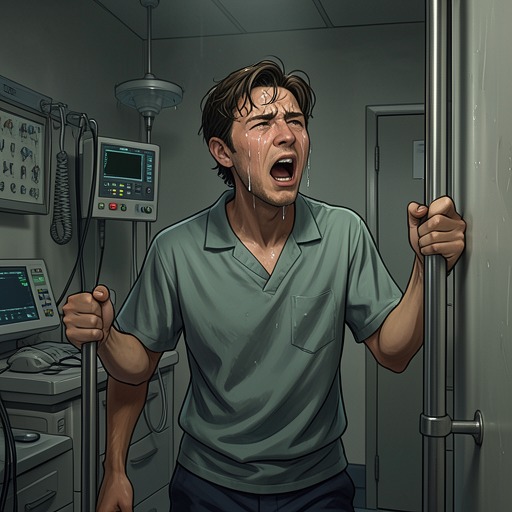
Fever
Kevin the Star StrikerFever is the bodily condition that turns Diego’s impatience to play soccer into a contest between childish ingenuity, parental care, and the limits of the body. It briefly seems beatable through an ice-cube trick, but its return exposes the deception and sends Diego to bed, leaving the Wild Bunch short-handed at crucial moments. The condition therefore functions not merely as a plot obstacle but as a recurring test of Diego’s identity as the team’s Tornado: he wants to prove that nothing can stop him, while the narrative repeatedly shows that illness can.
First Fever and the Ice-Cube Trick
Diego is absent from the Wild Bunch’s great effort to return to the soccer field because he is in bed with the flu. Unlike Roger, who is grounded or banned from soccer after the winter-related destruction caused by the team, Diego’s absence has a different cause: he is sick. Even so, his illness does not make him passive. At 11 St. Charles Street, he stands in the kitchen while his mother watches the thermometer and imposes a clear condition: the reading must be below 99 degrees, or there will be no soccer.
Diego considers the rule unfair because he had been required to attend school the previous day with a temperature of 100 degrees. His mother distinguishes school from soccer, but Diego responds by treating the thermometer as something to be defeated rather than as a reliable report of his physical condition. He places an ice cube under his tongue, cools the reading, and hands the thermometer to his mother with a mischievous grin. The device registers 91.5 degrees, making him appear not merely free of fever but close to hypothermia. Believing that he has escaped the restriction, Diego runs into the street and becomes the first member of the group to reach the soccer field.
The episode gives Fever a double meaning. It is an actual illness, but it is also the condition Diego tries to conceal in order to preserve his place in the team. His trick reveals his resourcefulness and impatience, yet it also establishes the danger of treating determination as a substitute for recovery. The same body that seems to have been liberated by the false reading is still vulnerable, and the narrative soon makes that vulnerability impossible to ignore.
The Fever Is Exposed
Later that day, Diego returns to the kitchen and finds his mother still waiting with the thermometer. Her persistence shows that she has not accepted the morning’s suspiciously low reading. Diego recognizes the situation before the second test is complete: this time there is no ice cube under his tongue, and the thermometer’s numbers climb steadily toward the decisive threshold.
When the reading reaches 100 degrees, his mother sends him to bed. Diego protests that he needs a doctor from the Chicago Fire, believing professional treatment could restore him quickly, but his appeal fails. His mother’s order is definite, and he goes to bed despite insisting that she does not understand what matters most in life. The scene reverses the earlier escape. In the morning Diego manipulates the measurement and rushes toward soccer; at noon the unaltered measurement overrules his wishes and returns him to illness.
The recurrence also changes the moral shape of the condition. Fever is no longer something Diego can dismiss as an inconvenient technicality. His mother’s care is expressed through surveillance, the repeated temperature check, and enforced rest, while Diego experiences that care as a sentence separating him from the field. The conflict is therefore not between a courageous player and an arbitrary rule alone. It is between Diego’s desire to remain useful to the team and the evidence of a body that needs protection.
Effects on the Wild Bunch
Diego’s illness continues to affect the team after the initial return to the field. During the ninth day of practice, Kevin reports that the fever has finally caught up with Diego and that there are no more ice cubes available because his mother has defrosted the freezer. The detail is comic, but its consequence is serious: Diego cannot keep manufacturing a false recovery, and the team must practice without one of its important players.
His absence intensifies the Wild Bunch’s internal problems. Kevin becomes increasingly frustrated with Josh and Roger, whose mistakes repeatedly lead to goals for the opposing side, and he demands that they leave the team. Diego’s fever is not the sole cause of this crisis, but it helps create the shortage of reliable players against which Kevin measures his teammates. Illness thus enters the team’s tactical and emotional life: the desire to field only the strongest players grows partly from the pressure created when Diego is unavailable.
Fever also contrasts with the team’s public language of invincibility. The Wild Bunch presents itself as dangerous, wild, and impossible to stop, yet Diego can be stopped by a thermometer and a mother who refuses to accept a falsified result. The contrast gives the state a recurring structural purpose. It punctures the boys’ boast that sheer will can overcome every obstacle, even while Diego’s refusal to surrender keeps drawing him back toward the game.
From Fever to Asthma and Return
When Diego finally appears in front of the soccer field again, Kevin greets him as though he has recovered from the flu. Diego is breathing heavily and admits that he has not truly gotten over it. Asked how he escaped, he explains that he simply took off, but the group then realizes that he is having an asthma attack. The fever has therefore not ended in a clean restoration of health. Diego’s attempt to outrun confinement produces another physical crisis, shifting the narrative from temperature and infection to breath and respiratory distress.
This transition preserves the central pattern established by Fever. Diego keeps choosing movement over rest, but the body answers that choice with a more immediate warning. The team’s concern becomes physical rather than merely competitive: his difficulty breathing makes his condition visible in a way the deceptive thermometer reading concealed. The scene also separates courage from invulnerability. Diego’s bravery lies in his determination to return, but the narrative does not treat that determination as proof that he is well.
Nevertheless, Diego ultimately re-enters the collective action. During the match against the Unbeatables, the team’s comeback gathers force in the rain and mud. After the score reaches seven to four, the Wild Bunch uses its twelve days of practice on muddy ground to move more effectively than its opponents. Diego forgets his asthma and becomes the Tornado again, contributing to the ninth goal as the team takes control of the game. His return does not erase the earlier illness; it shows how the memory and pressure of Fever accompany his renewed participation.
Narrative Significance
Fever makes Diego’s relationship with soccer concrete. He does not merely claim that he wants to play; he risks deception, disobeys the limits imposed by illness, and accepts the consequences when the thermometer reveals the truth. His fever also exposes the dependence beneath the Wild Bunch’s mythology of toughness. The team needs Diego’s speed and energy, but Diego needs the team’s field, training, and recognition enough to endanger his own recovery in order to reach them.
At the same time, the condition complicates the book’s idea that fear and weakness can become strength. Larry later tells the team that fear is their strength, but Diego’s illness suggests a related and more bodily lesson: strength does not mean possessing an invulnerable body. It means confronting the fact that the body can fail, that other people may have to impose limits, and that returning to the group is meaningful precisely because absence and vulnerability have made that return uncertain. Fever begins as an apparent interruption to the Wild Bunch’s story and ends as part of the evidence that their eventual victory depends not on being unstoppable, but on continuing together despite physical limits, missed training, and the danger of overconfidence.