Grounding
Kevin the Star StrikerGrounding is the book’s central mechanism of domestic control: parents respond to disobedience, damaged property, or unauthorized soccer with confinement, bans, confiscated equipment, and extended sentences. It is meant to remove children from the soccer field, but the repeated punishment instead exposes how completely soccer structures their friendships, identities, and sense of time. The children do not simply endure grounding; they measure it, challenge it, and turn escape from it into part of the team’s collective adventure.
Definition and Domestic Operation
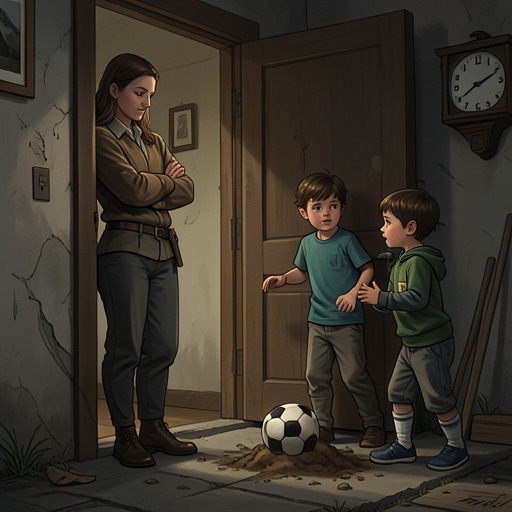
Grounding places a child under direct household restriction, usually forbidding departure from home and often adding a soccer ban. Its enforcement is concrete rather than merely verbal. Danny is grounded for three days, and his soccer ball is taken to the highest living-room shelf, where his mother’s expensive china seems to supervise it. Josh and Julian are banned from soccer for two days; their mother lets the air out of their ball and hides the pump. Kevin and Tyler receive a different form of punishment: they must break open their piggy bank to pay for the lamp in their room.
The punishment also reveals differences among the children’s households. Alex’s family can threaten to dispose of equipment that took him more than five years to save for, while Joey’s poverty and unstable home life make ordinary soccer participation difficult even without a formal sentence. Joey’s mother is unemployed, the two live in a van, and her drinking sometimes keeps him from appearing at all. Grounding therefore belongs to a larger landscape of adult control and unequal resources: for some children it is a temporary household verdict, while for Joey the conditions of home themselves can obstruct access to the game.
Escalation Around Alex
Alex experiences the most dramatic escalation. His father sentences him to ten days of grounding with a complete soccer ban and fills three garbage bags with Alex’s soccer gear, carrying them toward a garbage truck. Alex reads the punishment as an attempt to remove soccer from his life altogether. Unable to accept that possibility, he turns a globe into an improvised soccer object, dismantles it from its stand, kicks it against the wall, and performs a bicycle kick against the coast of Madagascar. The act damages the household’s order, but it also shows why ordinary confinement cannot contain him: even the forbidden world of soccer reappears in the objects around him.
Alex’s punishment grows still harsher after he leaves home to join the team. When he returns through a bathroom window, his father orders him to his room and later extends the sentence to twenty days with a total soccer ban. The consequence is explicitly designed to cover all of spring break. Alex remains silent while his father lectures him about disappointment, respect, and rudeness, but the silence does not signify surrender. From his room, he looks outward toward the team’s impending practice, treating the ban as an interruption that must somehow be overcome rather than as a legitimate end to his soccer life.
Collective Resistance and Evasion
Grounding repeatedly collides with the children’s ability to organize themselves. After the team forms and secures a decisive match against the Unbeatables, the children run home to spread the news, including to Alex. Their celebration immediately encounters his twenty-day sentence. The contrast is sharp: outside, the boys have become a full soccer team with a coach and a scheduled practice; inside, Alex is reduced to a child under household surveillance. The team’s excitement therefore creates a practical obligation to retrieve him, not merely a desire to include him.
The same pattern appears when Danny, Alex, Tyler, Kevin, Josh, and Julian gather outside the house across the street. A small pebble at the window summons Josh, while Julian initially appears to be excluded because Josh jokingly claims that he wet his pants after hearing about the match. Julian’s immediate protest makes clear that fear and prohibition are not the same thing. The children treat one another’s restrictions as obstacles to solve collectively, and the team’s social world repeatedly proves stronger than the boundaries imposed by individual homes.
Grounding also sits beside the team’s wider struggle over the soccer field. The Unbeatables announce that the field belongs only to them and order the other children away. Kevin answers by giving Mickey a two-week deadline for a challenge, wagering the field itself on the result. The formal contest becomes a public alternative to private punishment: instead of allowing adults or stronger children to decide who may play, the Wild Soccer Bunch creates a test in which possession must be proved. Grounding and field exclusion are different forms of restriction, but both make participation a political question.
Punishment Versus the Game
The children’s responses to grounding are not presented as a rejection of responsibility. Kevin and Tyler are required to pay for the broken lamp, and Alex’s actions bring real household consequences. Yet the narrative refuses to treat adult punishment as sufficient to settle the matter. Soccer remains the activity through which the children understand loyalty, courage, skill, and belonging, so a ban removes more than recreation. It threatens the group’s shared identity and the promises attached to the field.
The contrast becomes especially severe when the Wild Soccer Bunch faces the Unbeatables. Mickey chooses the match’s conditions, insists that the challenged team must accept the opponent’s selected “weapons,” demands a ten-goal victory, and declares that body contact is allowed. The result is physical damage: Julian’s eye becomes darkgreenblueviolet, Tyler holds his ribcage after being knocked down, and Kevin has a badly scraped knee while the Unbeatables lead five goals to none. Against this coercive sporting order, domestic grounding can seem comparatively ordinary, but both systems regulate movement and participation through authority. The children’s challenge is to replace arbitrary exclusion with rules that can be shared, contested, and made binding on both sides.
Meaning and Limits
Grounding is therefore both an obstacle and a narrative engine. Each sentence temporarily separates a child from the field, but each separation intensifies the child’s attachment to the team. Alex’s escalating bans expose the limits of punishment directed at a passion that has become an organizing principle of life. Danny’s confiscated ball, Josh and Julian’s deflated ball, and Alex’s threatened equipment all turn soccer objects into instruments of control; the children’s repeated attempts to recover play turn those same objects into signs of persistence.
The state of grounding also sharpens the book’s social contrasts. Larry, who works at the lemonade stand at the soccer field and once nearly became a professional player, becomes the children’s coach and is regarded by them as the greatest coach in the world. Under his guidance, the boys move from isolated children subject to separate household verdicts toward the Wild Soccer Bunch, a team capable of making agreements, accepting consequences, and confronting the Unbeatables. Grounding does not disappear as a fact of childhood, but its power changes when the children acquire a collective purpose.
Its deepest significance lies in that reversal. Adults impose grounding to restore household order, while the children discover that order can also be built through cooperation, promises, and play. The punishments remain painful and sometimes materially destructive, especially for Alex and for children whose homes are already marked by poverty or instability. Nevertheless, grounding fails to erase soccer. It makes the children’s commitment visible, drives them toward one another, and helps transform private disobedience into the shared struggle through which the Wild Soccer Bunch becomes a team.