Kevin
Kevin the Star StrikerKevin is the Wild Bunch’s vocal center and principal on-field showman: he introduces the team, defines its wild identity, and presents himself as both its master dribbler and its most dangerous striker. His importance lies in the contradiction between his extraordinary individual ability and the selfishness that repeatedly threatens the collective game. The decisive lesson of his story is that Kevin can become a reliable team player only when he learns that passing, trust, and shared courage matter more than scoring the final goal himself.
Identity and Introduction
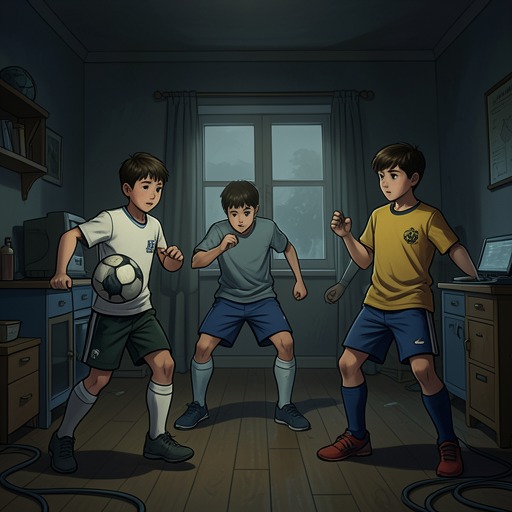
Kevin identifies himself as a member of the Wild Bunch and immediately rejects the idea that the team is merely a group of eleven friends and a cute dog who enjoy playing soccer. He insists that the group is real, dangerous, and wild, making his introduction both a team declaration and a piece of self-portraiture. The same energetic voice that boasts about the team also establishes Kevin as its narrator, speaking with confidence, exaggeration, and intimate knowledge of the players around him.
Kevin describes himself through several grand footballing titles. He is the “master dribbler,” the “Star Striker,” and the quickest assist there is, at least in the praise Larry gives him. Yet Kevin is not blind to the gap between reputation and conduct. He admits that Larry also calls him a ball-hog, selfish, or stubborn when his play confirms those criticisms. His identity therefore contains both a public legend and an uncomfortable private acknowledgment: he is gifted enough to dominate a game, but not disciplined enough to make that gift serve the team automatically.
Skills and Team Position
Kevin’s confidence is grounded in genuine ability rather than empty boasting. He can run around the other players, score repeatedly, and execute a famous “flip over bicycle kick.” In the decisive match, he takes part in rapid passing sequences with Alex, Tyler, Danny, and Joey, attacks through the middle, and scores his third goal to help turn a seven-to-four deficit into a seven-to-seven draw. His performance is central to the Wild Bunch’s comeback, but the match also shows why his talent alone is insufficient.
When the team’s attack becomes effective, Kevin is not merely a finisher. He receives Tyler’s pass after Danny has moved the ball across the field, stands free before Octopus, and chooses to pass backward with his heel when the opportunity demands it. That decision allows Alex to shoot and score. The moment is important because Kevin temporarily suppresses the instinct to claim the goal himself; his technical skill becomes valuable precisely because it is joined to judgment and trust.
Kevin’s attacking brilliance is also tied to danger. After the Wild Bunch takes the lead, he loses the ball because he refuses to pass and wants the tenth goal for himself. Larry removes him from the field, replacing him with Roger. Kevin protests that the substitution could make the team lose, revealing how strongly he equates his own presence with victory. Larry’s decision exposes the flaw beneath Kevin’s confidence: he wants responsibility when it means glory, but has not yet accepted the restraint that genuine responsibility requires.
Relationships and Conflict
Kevin’s closest relationship in the evidence is with Danny, whom he calls his best friend and the world’s fastest right forward. Kevin says that he relies completely on Danny and hopes Danny will continue playing soccer, even while teasing him for being interested in girls. The teasing gives their friendship a lively, competitive tone, but Kevin’s description also reveals dependence. His individual brilliance does not stand alone; it is supported by Danny’s speed and by the movement of the entire Wild Bunch.
Larry is Kevin’s coach and the adult authority most directly capable of challenging his self-image. Kevin once accepts Larry as the greatest coach in the world, but their relationship is not based on praise alone. When Larry tells him that being called the best coach does not make the boys the best soccer players, Kevin answers with mockery and insists that he can run circles around everyone. Larry responds by naming the precise problem: Kevin scores so many goals because he never passes the ball to anyone else.
That confrontation turns Kevin’s boast into evidence against him. Larry does not deny his speed or scoring ability; instead, he distinguishes individual dominance from good football. Later, when Kevin loses possession through selfishness, Larry’s substitution makes the lesson concrete. Kevin’s conflict is therefore not simply with an opponent such as Mickey or the Unbeatables. It is also with the version of himself that believes being the strongest player means being the player who must always finish the action.
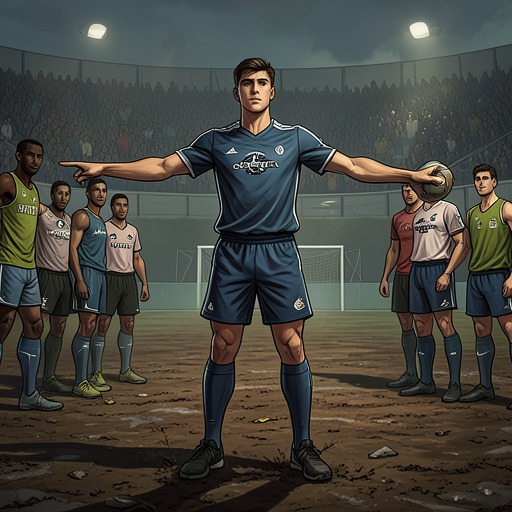
Kevin also encounters the intimidating force represented by Mickey and the Unbeatables. Mickey’s presence turns the soccer field into a scene of physical domination, while Kevin’s response is defiance rather than submission. When Mickey mocks the Wild Bunch and asks whether Kevin is the courageous twerp who challenged him, Kevin answers with an irritated challenge and refuses to be silenced. His courage is real, but at this stage it is expressed mainly as bravado. Against the Unbeatables, he must eventually discover a form of bravery that includes fear, cooperation, and the willingness to surrender personal glory.
The Decisive Match and Change
The final match tests Kevin’s entire character. The Wild Bunch begins under overwhelming pressure, and Mickey scores five goals in seven minutes. The team is physically battered, with Julian injured around the eye, Tyler clutching his ribcage, and Kevin nursing a scraped knee. Even after the Wild Bunch begins its recovery, the match remains a contest between Kevin’s hunger to score and the team’s need to act as one unit.
The turning point arrives through the collective cry, “ONE, TWO, THREE WILD!” Kevin joins the players standing shoulder to shoulder before the attack unfolds through a chain of passes. The sequence makes the team’s identity visible in action: Alex, Tyler, Danny, and Joey all contribute before Kevin takes his shot. Although Octopus saves that attempt, Kevin’s role is no longer that of an isolated star. He is one link in a movement whose force comes from coordination.
The comeback gathers speed in the rain. The soft, muddy ground disadvantages the Unbeatables, while the Wild Bunch benefits from twelve days of practice on that kind of field. Kevin scores his third goal, Danny scores his second, Joey equalizes the match, Tyler helps control midfield, and Diego recovers his attacking force despite his asthma. The sequence distributes achievement across the team, even as Kevin remains one of its principal scorers.
When the score reaches nine to nine, Kevin finally says that he will pass the ball. The statement comes after Larry has taken him off for selfish play and after Roger has missed chances that might have ended the match. Kevin’s promise is therefore pressured and imperfect rather than triumphant. He wants to return to the action, but the game has taught him that victory cannot be secured by his ambition alone. Roger ultimately scores the winning goal, and the Wild Bunch wins. Kevin does not become the hero by taking the decisive shot; he becomes part of a victory in which another player, previously anxious and unreliable in the crucial moment, carries the team to success.
Narrative Role and Significance
Kevin’s narration gives the Wild Bunch its boastful, comic, and emotionally immediate voice. He presents teammates through vivid judgments, celebrates their abilities, and openly exposes his own faults. Because he can call himself the Star Striker while also admitting that he is sometimes selfish and stubborn, his perspective allows confidence and self-criticism to coexist. The result is a portrait of a child who is not transformed by losing his talent, but by learning how to place that talent within a relationship with others.
Kevin’s arc also contrasts two models of sporting masculinity. Mickey embodies intimidation, physical superiority, ridicule, and the fantasy of being unbeatable alone. Kevin initially resembles a smaller, more talented version of that individualistic model: he seeks control, resents correction, and wants the tenth goal for himself. The Wild Bunch’s alternative is not weakness. It includes standing shoulder to shoulder, enduring injury and fear, passing under pressure, and trusting a teammate with the winning opportunity. Kevin’s eventual movement toward that model makes his development the moral structure inside the match’s athletic spectacle.
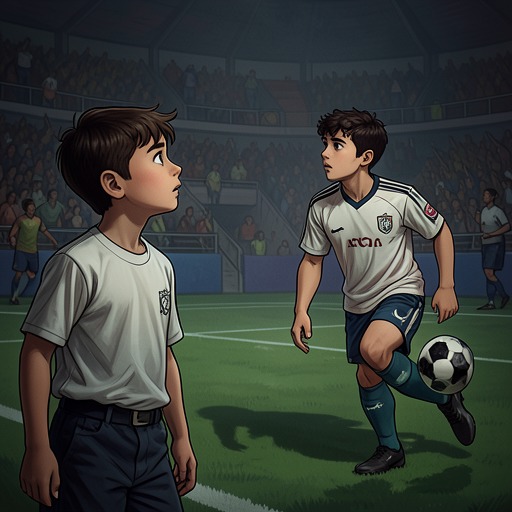
The ending preserves Kevin’s competitive fire while revising what that fire means. He remains a scorer, dribbler, and attacking threat, but the final victory demonstrates that the team does not belong to its loudest or most talented player. Roger is carried across the field as the new hero, while Kevin lies before the goal and watches in disbelief. His position in that image is significant: he is no longer the sole center of glory. The Wild Bunch wins when Kevin’s brilliance becomes one contribution among many, and when the player who once wanted to decide everything learns to recognize a victory he did not personally finish.