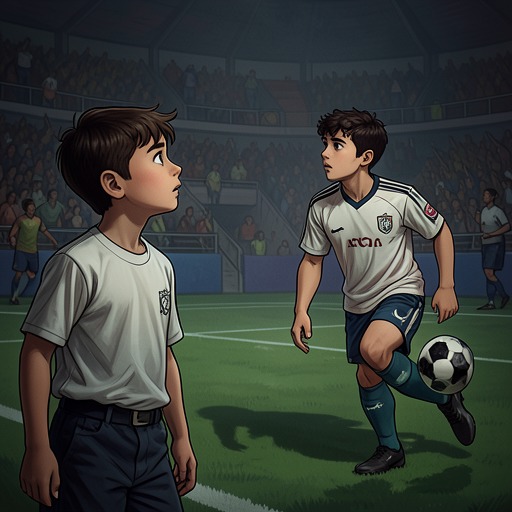
Kevin and Taylor's sibling relationship
Kevin the Star StrikerThe sibling relationship between Kevin and Tyler is one of the Wild Bunch’s emotional and tactical foundations. Their exchanges are full of complaints, tricks, and mock insults, yet beneath that friction lies an unmistakable dependence: Kevin needs Tyler “like the air you breathe,” and the team needs Tyler to turn individual talent into collective play.
Identity and Roles
Tyler is Kevin’s older brother and the Wild Bunch’s number 10. Kevin presents him as a source of everyday aggravation—an older brother who can “drive me crazy”—but immediately places that irritation inside a bond that cannot be discarded. Tyler is not merely a family member who happens to play soccer. On the field, Kevin describes him as the brains and heart of the Wild Bunch machine, and praises the fact that he never gives up.
That dual role gives the relationship its particular force. Tyler’s authority comes both from family seniority and from football competence. Kevin may challenge him at home, but he is proud of Tyler’s importance to the team. The relationship therefore moves between childish rivalry and genuine recognition: Tyler is a pain, but he is also indispensable.
Domestic Rivalry and Mutual Dependence
Their most revealing domestic conflict begins while Kevin is trying to get ready for the soccer field. Tyler takes the spare key from Kevin’s bed, unlocks the hamster cage, grabs Kevin’s soccer ball, and runs out, calling Kevin a slowpoke. Kevin chases him while still putting on his other shoe. The prank turns a simple departure into a contest, but it also shows how naturally the brothers invade one another’s space and assume continued access to one another’s belongings.
Tyler’s theft of the ball has a practical purpose. Because the brothers are grounded after the broken lamp, Kevin cannot simply walk out carrying his soccer ball without provoking their father. Tyler explains that the trick prevents Kevin from openly appearing to disobey the grounding. Kevin initially reacts with disbelief and anger, but privately admits that Tyler is right and that the plan is clever. His spoken judgment remains that Tyler is “a pain,” while his unspoken assessment acknowledges Tyler’s better idea.
The exchange ends not in reconciliation through apology but in the brothers’ familiar language of reciprocal provocation. Tyler gives the ball back and says, “Right back at you,” framing their irritation as part of being brothers. Kevin agrees, throws the ball at Tyler’s chest, and Tyler catches it like a goalie. The gesture preserves the quarrel while converting it into play. Their affection is not sentimental or quiet; it is expressed through challenge, interception, and the confidence that the other person will answer.
Partnership on the Field
Tyler’s importance to Kevin is magnified during the Wild Bunch’s match against the Unbeatables. The team’s attacks repeatedly depend on Tyler’s judgment in midfield. In one coordinated move, the brothers’ teammates pass through Alex, Tyler, Danny, Kevin, and Joey, with Tyler supplying the dream pass that releases Danny down the sideline. In another attack, Tyler carries the ball toward the goal under pressure from Mow-down, Juggernaut Jim, and Humungous Henry, then releases it at the last moment to Danny rather than forcing the play himself.
This footballing pattern clarifies the difference between Tyler and the team’s dominant opponent, Mickey the Bulldozer. Mickey’s power is individual and coercive: he scores five goals in seven minutes and treats superiority as a personal spectacle. Tyler’s power is connective. He reads the field, absorbs pressure, and makes the pass that allows another player to act. Kevin’s pride in his brother is therefore tied not only to skill but to a model of leadership based on persistence and coordination.
The match also tests Kevin’s ability to follow Tyler’s example. As the Wild Bunch mounts its comeback, Tyler continues to control midfield and later scores from halfway down the field when the wind carries his shot beyond Octopus’s reach. His contribution is part of a collective sequence rather than an isolated triumph. The team eventually wins, and the victory confirms the value of the brother whose intelligence and refusal to give up keep the side organized under extreme pressure.
Conflict, Fear, and Masculine Performance
The brothers’ relationship exists within a culture that repeatedly equates soccer with toughness, courage, and masculine status. Mickey the Bulldozer represents the most aggressive version of that ideal: he is feared because of his size, his entourage, his taunting, and his apparent fearlessness. Kevin’s defiance of Mickey is similarly performed through sharp words, including his refusal to be intimidated when Mickey questions the tricks Larry has taught the team.
Yet the Wild Bunch’s path to victory offers a different standard of strength. Diego openly asks what the team should do about its fear, and Larry answers that fear is their strength. The team does not win by pretending that danger and pain are absent. It wins through trust, passing, persistence, and the ability to keep playing while frightened. Tyler’s role embodies this alternative. His importance lies less in solitary domination than in maintaining the team’s structure when pressure threatens to break it apart.
The relationship also reflects the team’s limited openness toward girls. Kevin’s account treats Danny’s interest in girls as surprising and notes that Tyler, even at ten, is not interested in them yet. Later, the anticipated arrival of Zoe the Fearless is framed by the Wild Bunch’s resistance to accepting a girl teammate. These details place the brothers inside a boy-centered sporting world that measures belonging through toughness and football ability, even as the team’s actual success depends on forms of care and cooperation that challenge the hardest version of that identity.
Change and Ending
By the decisive stages of the match, Kevin’s greatest personal obstacle is his desire to score rather than pass. After the Wild Bunch reaches a nine-to-seven lead, Kevin loses the ball because he refuses to pass and wants the tenth goal for himself. Larry removes him and replaces him with Roger. Kevin protests that the decision could make the team lose, but Larry’s choice exposes the difference between individual glory and team responsibility—a distinction Tyler’s play has modeled throughout the game.
The score reaches nine-nine, and the next goal will decide the match. Kevin finally tells Larry that he will pass the ball, signaling a change in his understanding of what the team requires. Roger then misses one chance, while Kyle makes a crucial save to prevent the Unbeatables from scoring. On the next opportunity, Roger ignores Kevin’s shouted instruction, strikes the ball, and scores the winning goal.
The Wild Bunch wins, and Roger is carried across the field as a hero. Kevin remains in front of the goal, stunned that Roger has become their hero, while Larry offers him congratulations. The ending does not isolate Kevin and Tyler as a victorious pair; instead, it places their brotherly bond within the larger lesson of the team. Kevin’s growth comes from accepting that soccer cannot be organized around his own desired finish, just as Tyler’s value has always been expressed through the team’s movement rather than through personal dominance. Their relationship survives because its arguments, jokes, and competitions are all held inside a deeper certainty: each brother belongs to the other, and both belong to the Wild Bunch.