Kong
Kevin the Star StrikerKong’s decisive function in the story is to turn the Unbeatables’ physical intimidation into a visible threat. Known as a monumental figure from the prairies of Mongolia, he helps make Mickey the Bulldozer’s gang appear almost impossible to resist. His presence embodies the brutal version of sporting power that the Wild Bunch must confront and eventually overcome through teamwork rather than superior size.
Identity and Appearance
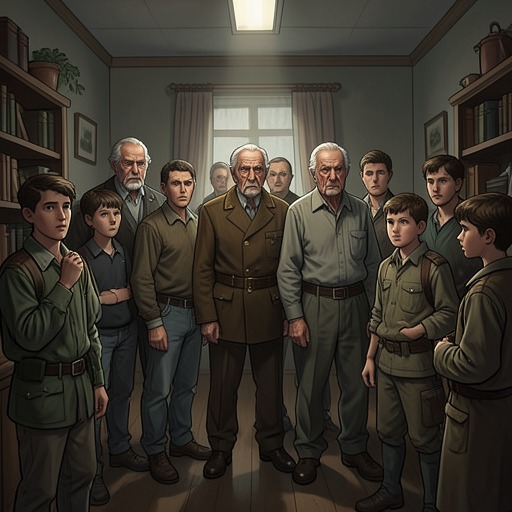
Kong is introduced among the boys surrounding the Wild Bunch at the gate of their soccer field. Kevin describes him as “the monumental creature from the prairies of Mongolia,” the largest-looking presence in an already frightening group. The description is deliberately excessive: Kong belongs to a lineup that includes Humungous Henry, Octopus, Juggernaut Jim, Mow-down, and Rick the Grim Reaper, yet his scale still singles him out. Kevin has heard that Kong is strong enough to rip high-voltage lines apart with his bare hands, a rumor that enlarges him from a powerful boy into a near-mythic neighborhood monster.
Kong’s appearance is therefore established through collective fear and legend rather than personal history. The narrative gives him no family background, private ambition, or independent voice. Instead, his identity is constructed through his body, his reputation, and the reaction he produces in others. He is a “brick wall” behind the Wild Bunch when he and the Grim Reaper block their escape, making the group’s threat spatial as well as physical: Mickey commands from the front while Kong helps seal off the way out.
Enforcer of the Unbeatables
Kong operates as one of Mickey’s principal enforcers. When Mickey demands that the Wild Bunch abandon their soccer field, Kong steps forward and cracks his knuckles with an inhuman bone-cracking noise. The gesture is a silent declaration of violence. It supports Mickey’s mockery without requiring Kong to explain himself, and it makes clear that the threat is not merely verbal. The Unbeatables’ authority depends on the expectation that figures such as Kong can turn refusal into punishment.
His power also reinforces Mickey’s hierarchical position. Mickey is described as the commander who waits while his “soldiers” move into place; Kong is one of the bodies that make this command credible. Even though Kevin emphasizes that none of the other bullies is as strong or as mean as Mickey, Kong remains indispensable to the group’s intimidation. He is the mass behind Mickey’s individual dominance, a reminder that the Wild Bunch is facing an organized gang rather than a single opponent.
Kong appears again when Mickey and the Unbeatables surround the Wild Bunch during their training. Alongside Humungous, Mow-down, Juggernaut Jim, Octopus, and the Grim Reaper, he helps reproduce the same threatening formation seen at the field gate. The repetition matters: Kong’s role is not a single burst of menace but a recurring pattern of enclosure. Whenever Mickey’s group wants to display control, Kong is part of the wall around the Wild Bunch.
Physical Power Versus Team Play
The decisive match initially confirms Kong’s intimidating reputation. He runs past Alex Alexander and then toward Julian Fort Knox, carrying the attack forward through sheer momentum. Yet Julian does not retreat. He hits a press ball against Kong’s foot, forcing Kong to sidestep and stop abruptly. When Kong looks around in disbelief, Julian has positioned himself repeatedly in front of him, becoming the all-purpose defender the team needs. The scene does not claim that Kong has become weak; it shows that strength alone cannot guarantee control of the ball.
Julian’s intervention changes Kong from an unstoppable-seeming obstacle into a problem that can be read, anticipated, and solved. Julian wins the ball and passes it to Joey, whose shot forces Octopus to react. The movement that follows—interception, pass, shot, and continuation—makes the Wild Bunch’s collective technique the direct counter to Kong’s physical authority. Kong’s body still occupies the field, but it no longer determines the play.
Kong remains dangerous later in the match. After Kyle makes a crucial save, Kong takes the follow-up shot while the goalkeeper is still on the ground. The attempt demonstrates that his role is not confined to intimidation; he can also create immediate scoring danger. Kyle must spring up and steer the ball around the post at the last moment. This rescue preserves the Wild Bunch’s chance of survival and keeps Kong associated with the Unbeatables’ capacity to turn one loose ball into a decisive attack.
Conflict with the Wild Bunch
Kong’s conflict with the Wild Bunch is collective and physical rather than personal. He is one of the figures who makes the team fear surrendering its field, and his presence intensifies the question that troubles the players during Larry’s coaching: what can fear mean when the opposing side is larger, stronger, and willing to play without mercy? Larry’s answer is that fear can become strength, but the training only acquires practical meaning when the players learn to move through pressure instead of pretending it does not exist.
The story places Kong within a broader contrast between two forms of masculinity. Mickey’s world values toughness, domination, aggression, and the performance of invulnerability. The Wild Bunch initially responds in the same language, measuring courage by whether a player can withstand the terrifying approach of Mow-down, Juggernaut Jim, or Kong. Larry gradually redirects that standard. The team must acknowledge fear, trust one another completely, pass rather than hoard the ball, and use each player’s particular ability. Kong therefore functions as the physical test of a competitive ideal that the novel ultimately revises: the answer to a bigger opponent is not to become a bigger bully, but to become more connected.
Role in the Match and Narrative Significance
Kong’s importance lies in the contrast between how he is imagined and how he can actually be played. Before the match, rumor gives him almost impossible power; during the match, coordinated action repeatedly limits what that power can accomplish. Julian’s defense disrupts his advance, Joey and the other players turn the recovered ball into attack, and Kyle prevents Kong’s follow-up shot from becoming the winning goal. These reversals do not erase Kong’s menace. They make the Wild Bunch’s achievement more meaningful by showing that the threat remains real while becoming manageable.
As a character, Kong is comparatively flat: the text builds him around size, strength, and intimidation, and it does not provide the private contradictions or unexpected motives that would make him psychologically rounded. That simplicity is functional. Kong is the most concentrated expression of the bodily force that the Wild Bunch cannot match individually. His “brick wall” presence, knuckle-cracking threat, and dangerous shot give physical form to the obstacle facing the team. Once the Wild Bunch learns to move collectively, the wall can be breached—not by denying its weight, but by refusing to face it alone.