Larry
Kevin the Star StrikerLarry is the coach of the Wild Soccer Bunch and the adult who makes the team possible. Though he works at Larry’s lemonade stand and may not have gone far in life, he was almost a professional soccer player, and the boys regard him as the greatest coach in the world. His authority does not come from wealth, status, or an imposing appearance. It comes from knowledge, trust, practical invention, and a refusal to talk down to children who are trying to determine what they can become.
Identity and Place in the Team
Larry occupies an unusual position between adult caretaker and teammate. The boys know that he reeks of beer, yet they still trust his smile and turn to him when the team’s problems seem impossible. He treats them as “real men already,” people capable of deciding their own destiny rather than children who must simply obey. That respect is not sentimental: it also means that Larry expects them to face fear, accept responsibility, and live with the consequences of their choices.
His livelihood is tied to the soccer field through the lemonade stand, a humble workplace that becomes part of the team’s social world. The stand represents both Larry’s limited economic circumstances and his usefulness to the boys. When the Unbeatables destroy it after declaring it a self-service counter, they cut the electrical cords, ruin the refrigerators, and turn the lemonade into sticky syrup. The destruction leaves the rival team without drinks in the midday heat, but it also exposes how vulnerable Larry’s small adult life is to the same aggression that threatens the children’s field.
Coaching Through Trust and Honesty
Larry’s central coaching principle is mutual trust. When Kevin admits that he is frightened, Larry does not accept the confession as a final answer or use it to shame him. He explains that the boys must decide what kind of coach they want: if they want Larry, they must trust him completely, and he must trust them completely. Trust becomes the condition for defeating the Unbeatables, not an ornamental virtue added after technical skill has been mastered.
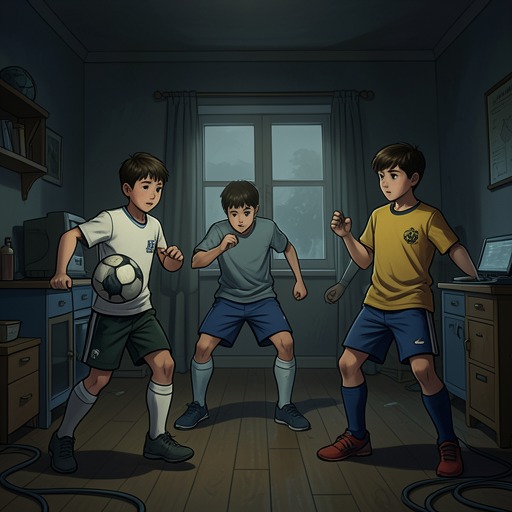
This demand changes the meaning of courage. Larry does not pretend that fear is absent; instead, he asks the players to use it. His training converts anxiety into movement, attention, and cooperation. On the muddy field, he tells them that the water is still too cold for swimming and therefore begins by teaching them how to run. When Julian is intimidated by the large stones, Larry contrasts the heavy boulder with a pebble that is quick, nimble, light, and able to dance. The players then race across the mud, fall into puddles, scrape their knees and elbows, and eventually repeat the exercise blindfolded while moving to the rhythm of a boom box. Larry’s lesson is physical but also structural: a weaker body can overcome a larger obstacle through speed, balance, and intelligence.
His coaching is equally visible in the lakeside passing exercise. The boys cannot yet pass the ball ten times; five passes is usually the limit, and Sox is too fast for them to maintain control. Larry responds by revealing an unexpected reserve of energy. Despite his lame leg, he dances around them and runs alongside them, giving precise instructions: Kevin must pass right, Julian is free, Tyler must move left, and Joey must send the ball to Kyle. When Kyle stands still and Sox catches the ball, Larry applauds rather than humiliates him. Failure becomes information, and encouragement keeps the group practicing instead of allowing embarrassment to break the exercise.
Responsibility Beyond Soccer
Larry’s idea of discipline extends beyond drills and matches. When Kevin and Tyler ask for the return of a soccer ball, their father agrees only on the condition that they take Sox to practice. The requirement connects possession of the ball with care for the dog: the boys had promised to look after Sox every day, so their responsibility cannot be suspended merely because training is inconvenient. Larry’s team therefore grows inside a network of obligations involving animals, parents, equipment, and one another.
The boys’ circumstances also make Larry’s coaching socially significant. Joey’s mother is poor, unemployed, and living with him in a van; Joey cannot afford cleats, sometimes lacks a jacket, and occasionally fails to appear because his mother drinks heavily. Another player’s soccer equipment has taken more than five years to save for before it is threatened with removal during a ten-day grounding and complete soccer ban. Larry’s team is not formed from equal resources. His coaching creates a common practice in which worn clothing, missing equipment, unstable housing, and parental control do not disappear, but do not wholly determine who can contribute on the field.
That principle appears when a boy arrives in a brown wool sweater, checkered pants, and worn sandals and says he has nothing else to wear for soccer. The question of whether he can play is treated as a real obstacle rather than a joke. Larry’s wider importance lies in making participation possible despite such obstacles, while still demanding effort from everyone who enters the team.
Conflict, Defiance, and Moral Authority
Larry’s authority is tested most sharply when Mickey the Bulldozer attacks. Mickey pushes Diego into the mud and advances while the boys recoil, with Grim Reaper and Kong forming a wall behind them. Larry is the only other person on the field, but instead of rushing theatrically into the confrontation, he calmly removes the barricades from his stand. His apparent inaction frustrates Kevin, who wants an adult to rescue them and resents Larry for treating the boys as people who must decide their own destiny.
Yet Larry’s calm is not weakness. Later, when Joey angrily challenges the Unbeatables, Mickey laughs and then turns a threatening stare toward the boys. Larry and Roger appear behind them, and Larry’s poker face meets Mickey’s intimidation directly. Larry says that Joey is right, and the force of the statement makes Mickey instinctively step back. The scene reveals the kind of power Larry possesses: he does not imitate Mickey’s physical aggression, but he refuses to yield the moral ground or permit the boys’ anger to be dismissed.
Larry’s method culminates in the team’s battle cry, “ONE, TWO, THREE WILD!” Before the decisive match sequence, the boys stand shoulder to shoulder and then move as a coordinated unit. The attack travels through Kevin, Alex, Tyler, Danny, and Joey rather than belonging to one star player. Larry’s coaching has made collective action visible in the very form of the play: the team’s identity is spoken together and then enacted through passing.
The Final Match and the Lesson of Passing
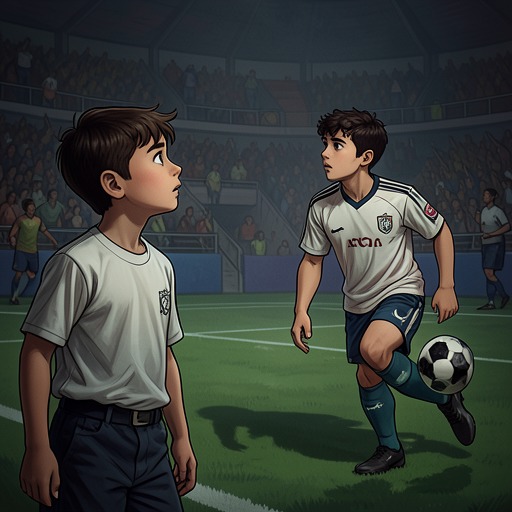
During the comeback against the Unbeatables, Larry continues to coach character as much as technique. The Wild Soccer Bunch falls behind seven to one, then uses the muddy conditions learned during twelve days of practice to recover. Kevin scores his third goal, Danny scores his second, Joey brings the score to seven-seven, Tyler scores from halfway after the wind carries the ball into the goal, and Diego becomes the Tornado again. The boys reach nine goals, but Kevin loses the ball because he refuses to pass and wants the tenth goal for himself.
Larry immediately removes Kevin from the field and replaces him with Roger. Kevin protests and fears that the substitution will cost the team the game, but Larry does not allow individual brilliance to override collective discipline. Roger misses a chance, Mickey narrows the gap, and the Grim Reaper equalizes at nine-nine. Even after Kevin promises that he will pass, Larry continues to wait for the lesson to become action rather than accepting a shouted promise.
The final sequence proves the point. Roger misses another opportunity, Kyle must make a diving save and then steer a follow-up shot around the post, and Roger eventually scores the winning goal. The boys carry Roger across the field, recognizing that the player they once doubted has become their hero. Larry’s victory is therefore not merely the defeat of the Unbeatables. It is the transformation of the team’s idea of excellence: winning belongs to the group, and a goal becomes meaningful when it emerges from trust, persistence, and shared responsibility rather than selfish control.
Narrative Role and Significance
Larry functions as mentor, disciplinarian, protector, and interpreter of the boys’ fear. He is not presented as an idealized adult without flaws; the narrative preserves his beer smell, lame leg, modest work, and uncertain social position. Precisely because he is imperfect and economically ordinary, his authority is earned scene by scene. He can be calm amid Mickey’s violence, inventive in the mud, energetic beside the lake, and uncompromising when Kevin’s selfishness threatens the team.
His coaching also redirects the story’s model of masculine strength. The Unbeatables rely on size, intimidation, and physical domination, while Larry teaches the Wild Soccer Bunch to value nimbleness, honesty, passing, care, and the admission of fear. He does not remove competition from the boys’ world; he gives competition a different grammar. By the time the team wins, Larry’s deepest lesson has become inseparable from the match itself: courage is not the denial of vulnerability, and strength is not the power to stand alone. The team becomes formidable when its members trust the coach, trust one another, and make room for the player who once seemed least likely to succeed.