Larry’s stand
Kevin the Star StrikerLarry’s stand is far more than a place to buy lemonade. Positioned beside the entrance to the soccer field, it is the team’s refreshment stop, meeting point, and recognizable sign that soccer season has begun. Because Larry both works there and coaches the Wild Soccer Bunch, the stand joins the children’s sporting world to the precarious adult world around it. Its destruction by the Unbeatables turns that ordinary structure into the central object of a moral bargain, and its promised repair gives the decisive match consequences beyond the score.
Setting and Function
Larry’s stand stands next to the entrance of the neighborhood soccer field, a small commercial shelter associated with the opening of the season and with the long afternoons the children imagine spending there. Larry works at the lemonade stand even though he did not get far in life and was only almost a professional soccer player; nevertheless, the children regard him as the greatest coach in the world. His position makes the stand a practical extension of his coaching. During breaks, lemonade restores the players, while Larry’s presence gives the field adult supervision, encouragement, and continuity.
The stand also marks the rhythm of the year. In earlier seasons, soccer began on the last day of school, when Larry opened the stand, and the children played for two weeks from morning until evening, returning to lemonade during their breaks. When winter extends into April, the locked stand becomes part of the landscape of disappointment: the children gather on the old bleachers, look across the snow-covered field, and see the stand still shut, with icicles dripping from its gutters into puddles. Its closed condition makes the lost spring break visible. The field is not merely unusable; the familiar place that normally welcomes the players has fallen silent.
Larry and the Children’s Community
Larry’s stand is the point at which the children’s team gathers even when no plan has been made. After the soccer field is occupied and the players are frightened and defeated, they run through the gate past the stand just as Larry gets off his scooter to prepare for the season. Later, when the children are discouraged by their failed attempts to build a team, Larry limps toward them, greets them knowingly, and hands each of them a lemonade. Although he smells of beer, his smile reassures them, and the drink functions as both refreshment and an offer of help.
The stand therefore represents a form of care that is practical rather than polished. The children come from sharply different circumstances: Kyle is rich, while Joey’s mother is unemployed, drinks heavily, and lives with him in a van; Joey cannot afford cleats and sometimes lacks even a jacket. Against these inequalities, Larry’s stand offers a common place where the players meet as teammates. It does not erase poverty or family trouble, but its lemonade and Larry’s attention create a temporary collective world in which the children can belong to the same side.
Destruction by the Unbeatables
The stand becomes a casualty of the Unbeatables’ occupation of the soccer field. When Mickey the Bulldozer realizes that Larry is absent and that there is nothing to drink, he declares the stand a self-service counter. Finding it locked, the Unbeatables do not simply abandon the attempt. They bring an ax, break the structure apart, and cut the electrical cords in the process. The refrigerators die, the lemonade turns into sticky syrup, and Humungous nearly chokes when he greedily drinks from one of the bottles.
The ruined stand exposes the difference between possession and stewardship. The Unbeatables try to treat Larry’s property as an extension of their control over the field, but their violence destroys the resource they want to use. By midday, the rival players are lying around the rubble, overheated and helpless. The stand’s destruction thus rebounds upon its attackers: the act intended to provide them with unlimited refreshments leaves them without usable lemonade and transforms their temporary victory into a visible scene of waste.
The Repair Condition and the Final Match
When the Wild Soccer Bunch and the Unbeatables finally agree to settle the occupation through a match, Roger proposes a condition: the losing team must fix Larry’s stand. This rule changes the contest from a simple struggle for sporting prestige into a test of whether the teams will accept responsibility for damage done to a shared place. The stand becomes the legal and ethical stake of the challenge, while Larry’s absence from the field is answered by a promise made in his name.
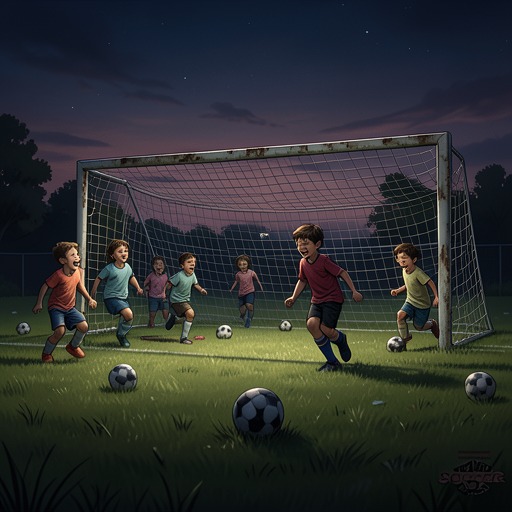
The match itself is narrated as a rapid sequence of passes, goals, saves, and reversals. The Wild Soccer Bunch begin with the repeated battle cry “ONE, TWO, THREE WILD!” and move the ball through Alex Alexander, Tyler, Danny, Joey, and Kevin, but Octopus blocks the first shot and Mickey gives the Unbeatables an early lead. As rain softens the ground into mud, the Wild Soccer Bunch’s twelve days of muddy training become decisive. Kevin completes a hat-trick, Danny scores twice, Joey brings the score level at seven to seven, Tyler scores from halfway when the wind carries the ball into the goal, and Diego returns to his tornado-like form despite his asthma. The lead reaches nine to seven before the Unbeatables recover.
Kevin’s selfishness then threatens both the match and the team’s discipline. After refusing to pass in pursuit of a tenth goal, he is removed and Roger is sent onto the field. The Unbeatables narrow the margin, the Grim Reaper equalizes at nine to nine, and Roger misses an early opportunity. Yet Larry continues to insist that Roger belongs in the contest, while Kyle saves the team with a low-corner nosedive and then redirects a follow-up shot around the post. Roger finally strikes the winning goal. The players carry him across the field, and the victory is immediately connected to Larry: after the Wild Soccer Bunch win, Larry approaches Kevin and offers his hand in congratulations.
Narrative Significance
Larry’s stand gives the soccer field a human center. It is where the children drink, regroup, and receive encouragement; it is also the first casualty of the Unbeatables’ destructive occupation. Because the stand belongs to Larry, its ruin makes the rival teams confront the adult labor that sustains their supposedly carefree games. The children’s soccer world depends on a worker who opens the stand, supplies lemonade, and coaches them, even though his own life has not fulfilled the professional ambitions he once had.
The repair condition completes the stand’s transformation from background object into shared responsibility. The Unbeatables’ contempt makes the place rubble, whereas the Wild Soccer Bunch’s victory promises restoration through an agreed rule. The final triumph therefore means more than defeating an opposing team: it reclaims the field’s communal order and restores the structure that makes the children’s home in soccer possible. Larry’s stand remains modest, but the story gives it the weight of a clubhouse, a livelihood, a refuge, and a physical emblem of the team’s movement from disorder toward solidarity.