Loser Repairs Larry’s Stand Rule
Kevin the Star StrikerThe Loser Repairs Larry’s Stand Rule is the condition that gives the decisive match between the Wild Soccer Bunch and the Unbeatables a restorative stake. Proposed by Roger during the confrontation with Mickey the Bulldozer, it binds victory to responsibility: whichever team loses must repair Larry’s stand, the place associated with the coach who has guided the Wild Bunch despite working there and having once nearly become a professional soccer player.
Origin and Purpose
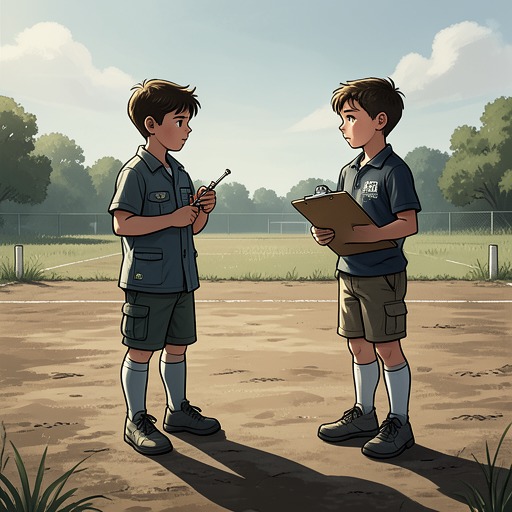
The rule emerges when Roger steps forward to interrupt the escalating confrontation. He does not merely accept a match on the Unbeatables’ terms; he adds a condition that redirects the conflict toward Larry. The defeated side will repair Larry’s stand, so the match becomes a test of whether the winning team can protect and restore the space belonging to its coach rather than simply claim superiority on the soccer field.
This condition also changes the meaning of the opposing teams’ challenge. The Unbeatables initially treat the encounter as an opportunity to intimidate the Wild Soccer Bunch, while the Wild Bunch answer through a formalized contest. By attaching repair work to the result, Roger converts aggression into an obligation that can be settled through a public, intelligible outcome. The rule is therefore both a wager and a compact: it defines what the loser owes and gives the winner a material consequence to defend.
Operation During the Match
After Roger states the condition, Mickey responds with mockery rather than respect, and the Unbeatables return to their side of the field still laughing. The Wild Soccer Bunch answer by forming a shoulder-to-shoulder circle and shouting their battle cry, “ONE, TWO, THREE WILD!” The rule thus stands at the threshold between verbal confrontation and organized play, marking the moment when the dispute becomes a match with agreed stakes.
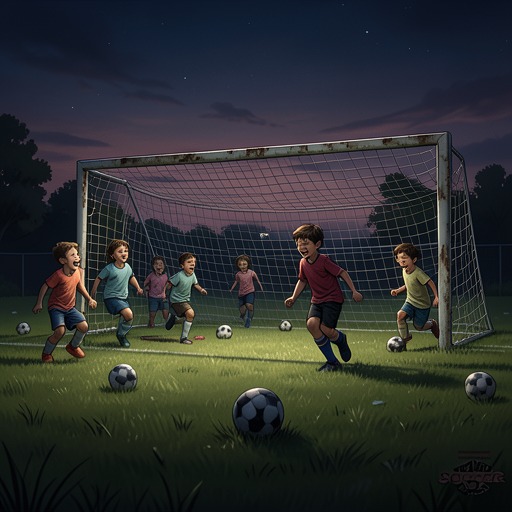
The game itself repeatedly threatens to make the rule decisive. The Unbeatables take a commanding lead, reaching seven goals while the Wild Bunch struggle to score. The match then turns in the rain: the ground becomes soft and muddy, a condition in which the Wild Bunch’s twelve days of practice give them an advantage. Kevin scores his third goal, Danny scores his second, Joey levels the game at seven to seven, Tyler scores from midfield when the wind carries the ball into the goal, and Diego returns to his tornado-like form despite his asthma as the Wild Bunch move ahead nine to seven.
The rule also intensifies the internal discipline demanded by the match. Kevin loses the ball because he refuses to pass while pursuing a tenth goal, and Larry removes him from the field, replacing him with Roger. The Unbeatables narrow the margin, and the Grim Reaper equalizes at nine to nine. With the next goal deciding the game, Kevin finally accepts the passing responsibility he had resisted, but Roger still misses an opportunity before Kyle prevents an immediate winning goal with a desperate save and then redirects a follow-up shot around the post.
Defeat, Victory, and the Rule’s Consequence
Roger ultimately scores the deciding goal. His first hesitant attempts have made him appear to be a possible liability, but his determination eventually carries the ball into the net. The Wild Soccer Bunch win, and the rule’s practical consequence is that the Unbeatables—not the Wild Bunch—owe the repair of Larry’s stand.
The victory changes Roger’s place within the team as well. The players carry him on their shoulders, and Kevin, who had doubted him during the decisive sequence, recognizes that Roger has become a hero. Larry then praises Kevin not only for his dribbling and striking but for producing “the most stubborn assist in the whole wide world.” Kevin and Roger exchange congratulations, embrace, and continue the victory round together. The rule’s result is therefore linked to two forms of repair: the promised physical repair of Larry’s stand and the renewed friendship between Kevin and Roger.
Community Meaning
The rule gives Larry a status beyond that of a coach who issues instructions. His stand is part of the material world the children share, and its repair represents an obligation to the adult who sustains their soccer community. Larry may work only at the lemonade stand and may feel that he did not get far in life, but the Wild Soccer Bunch regard him as the greatest coach in the world. Protecting his stand consequently becomes a way of acknowledging his value.
The condition also contrasts with the economic inequalities surrounding the team. Joey lacks cleats, sometimes lacks a jacket, and lives in a van with his unemployed mother, while Larry’s stand is the modest livelihood and meeting point connected to the field. Against that background, the rule makes the match’s honor concrete. Winning is not only about reputation, and losing is not only humiliation; the result determines who must perform the labor required to restore a shared resource.
Narrative Significance
As a rule, the condition establishes a clear movement from threat to negotiated contest, from contest to consequence, and from consequence to communal restoration. It prevents the climax from ending with an abstract claim that one team is better. The decisive goal settles the score, while the agreed repair obligation gives the victory a social purpose.
The rule also anticipates the book’s broader preference for collective identity over individual display. The Wild Soccer Bunch win through passing, adaptation to the muddy field, Kyle’s rescue, Roger’s persistence, and Kevin’s eventual cooperation. Their triumph is completed not by one star’s isolated performance but by a shared victory whose benefit is measured in the recovery of Larry’s stand and the restoration of broken team relationships. When Mickey retreats over the fence promising revenge, the conflict has not erased its hostility, but the rule has ensured that the match leaves behind a duty rather than only a winner.