Poverty
Kevin the Star StrikerPoverty is presented as a lived condition that reaches into every part of Joey’s participation in soccer: his family lives in a van, his mother is unemployed and drinks heavily, he lacks proper clothing and cleats, and even getting to a match can depend on whether an adult is awake and dependable. The story does not reduce Joey to deprivation, however. His poverty creates real obstacles, but his extraordinary play, determination, and attachment to his teammates make him more than a symbol of hardship. His talent becomes a form of agency within a world that gives him very little material security.
Definition and Material Conditions
Poverty is first defined through the contrast between Joey and Kyle. Kyle is rich, while Joey’s mother is poor and out of work; as a result, Joey and his mother live in a van. The van offers a superficial freedom because it can move from place to place, but the narrative makes clear that this mobility is housing insecurity rather than a carefree lifestyle. Joey cannot afford cleats, and he sometimes lacks even a jacket. His absence from the team is therefore not explained by indifference: sometimes he simply does not have the clothing, equipment, or stable circumstances needed to appear.
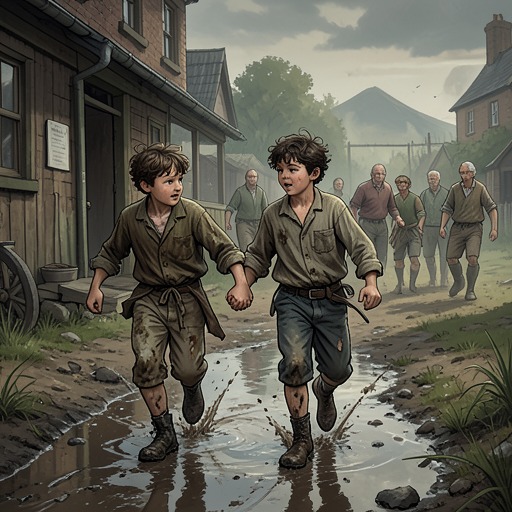
The most concrete expression of this deprivation comes when Joey is invited to prepare for soccer and has to ask what he should wear. His brown wool sweater, checkered pants, and worn-out sandals are his “soccer gear” because he has nothing else. The clothing makes the economic divide visible before Joey even reaches the field. His question about whether he can play reveals how poverty becomes an enforced uncertainty: participation depends not only on ability or desire but also on whether a child possesses the appearance and equipment expected of a player.
Poverty and Family Instability
Joey’s economic hardship is inseparable from unreliable adult care. His mother’s drinking is treated as a recurring fact of household life, and Joey never discusses it openly. Instead, he presses his lips together, with pain visible in his face. The narrative allows the physical gesture to communicate what Joey refuses to explain. Poverty is therefore accompanied by emotional concealment: he tries not to show what is happening at home, even though the strain remains legible to others.
His journey to the soccer field makes that instability especially stark. Joey waits for his mother because she has promised to accompany him to the game, but she does not return until late at night with a strange man. The adults drink and sing, then fight, and his mother throws the man out of the van before taking Joey in her arms. She promises to meet his friends the next day, but the promise is followed by another failure. After driving toward the highway, she stops at a grocery-store parking lot and goes to sleep in the van; the next morning she will not wake up.
Joey waits until it is too late and then tries to wake her, only to be yelled at. His response is strikingly direct and tender: he writes her a letter beginning, “Dear Mom,” and adds, “I love you.” He then leaves the van and makes his own way to the EL station, pacing until a train arrives. The scene shows a child performing the practical labor that a stable household would normally organize for him: managing time, finding transportation, deciding when to leave, and preserving a connection with his mother even while her behavior prevents him from keeping the appointment.
Access to Soccer
The story repeatedly places Joey’s poverty beside the material infrastructure of soccer. Other players can arrive with recognizable gear, while Joey may come in worn sandals or without a jacket. The contrast is not merely visual. Equipment determines who can comfortably enter the sporting world, and family circumstances determine who can get to the field on time. Joey’s delayed arrival at the match is caused by the chain of events in the van, not by a lack of commitment. He finally reaches the EL station, runs to the soccer field, meets Kyle at a corner, and enters with him.
Even the Wild Soccer Bunch’s adult support is shaped by limited means. Larry is the coach, but his ordinary work is at the lemonade stand beside the soccer field, and the narration notes that he may not have gone far in life. His authority comes instead from his near-professional soccer past and from the trust the boys place in him. The team’s training is consequently built from improvised resources and difficult surroundings rather than privileged facilities. Larry turns mud, stones, holes, and fear into exercises, while the soccer field and the damaged remains of his stand reveal how vulnerable the team’s sporting world is to stronger forces.
The contrast becomes sharper when Mickey the Bulldozer and the Unbeatables destroy Larry’s stand after taking over the field. Without Larry, there is nothing to drink, so Mickey declares the stand a self-service counter. The group uses an ax, destroys the structure, cuts the electrical cords, and leaves the refrigerators dead; the lemonade turns into sticky syrup. The episode links poverty to the destruction of small-scale work and community resources. Larry’s stand is not only a place of refreshment but also part of the team’s fragile social infrastructure, and its ruin makes the boys’ already limited sporting environment still more precarious.
Poverty, Skill, and Agency
Joey’s circumstances never become the measure of his ability. When everything at home is not overwhelming him, he plays soccer “like a magician,” as though he had cast a spell on the ball. Kevin, who calls himself the master dribbler and Star Striker, admits that Joey can play even better than him when Joey is fully engaged. This comparison is important because it prevents the narrative from treating Joey as a passive victim awaiting rescue. His poverty restricts his options, but it does not define the limits of his footballing imagination.
That capacity also complicates the story’s class structure. Joey lacks cleats, yet he possesses a form of cultural and athletic knowledge that the better-equipped players cannot simply purchase. His worn sandals become evidence of exclusion, but his play exposes the inadequacy of judging a player by equipment. The team’s shared identity depends on recognizing that ability is distributed independently of wealth, even though access to training, clothing, transportation, and rest is not.
Joey’s poverty also parallels the bodily obstacles faced by other members of the Wild Soccer Bunch. Diego has asthma and may become an ordinary left forward during an attack, although at his best he is faster than a tornado. Larry carries the lasting consequence of a ruined knee, and the team trains against fear and physical intimidation from the Unbeatables. These conditions are not identical, but together they challenge the assumption that a soccer team is made only from uniformly healthy, well-equipped bodies. The boys’ value emerges through adaptation, persistence, and cooperation rather than through an ideal of effortless physical normality.
Narrative Significance
The poverty surrounding Joey gives the soccer story its hardest social edge. The Wild Soccer Bunch is described as a team that eventually becomes united, but the players do not begin from equal circumstances. Kyle’s wealth, Joey’s van, Alex’s costly soccer equipment, and Larry’s precarious lemonade stand establish different relationships to money, housing, authority, and the sport itself. The field can look like a common home, yet the routes by which the boys reach it are unequal.
At the same time, the narrative uses humor, exaggeration, and fast-moving adventure to keep Joey’s hardship from becoming the only story told about him. His mother’s drinking, the van, the missing clothing, the failed promise, and the night spent waiting are painful realities, but Joey remains funny, angry, affectionate, and fiercely loyal. His decision to write that he loves his mother before running for the train captures the complexity of his position more clearly than a simple victim narrative would. He is disappointed without becoming detached, responsible without becoming an adult, and materially deprived without surrendering his claim to the game.
Poverty therefore functions both as an obstacle and as a critique of the supposedly level playing field. The soccer field offers Joey belonging, recognition, and a place where his skill can be seen, but it does not erase the conditions that make arrival difficult. His presence at the match is an achievement produced by persistence and improvisation, not proof that hardship has disappeared. The story’s most important distinction is between equal fellowship among the boys and unequal resources outside the team: the Wild Soccer Bunch can share a ball and a purpose, but Joey still has to cross a van, an absent mother, a missed morning, a train ride, and worn sandals to stand beside them.