Roger
Kevin the Star StrikerRoger is the Wild Soccer Bunch player whose public identity changes most dramatically: Kevin first presents him as an apparently hopeless footballer, yet the final match against the Unbeatables makes him the unlikely author of victory. His story moves from ridicule and fear to responsibility, persistence, and a last-second act that earns the title “Roger the Hero.”
Identity and Introduction
Roger enters the team through Kevin’s openly skeptical narration. Kevin compares Roger’s attempt to play soccer with the absurdity of a blind man believing he could become a photographer, then asks why Roger thinks he can play at all. Kevin is forbidden to say everything he thinks because Danny protects Roger, but even this criticism admits that Roger is unlike anyone else. Roger is therefore established through contradiction: he is the player the team doubts, yet also the teammate whose singular presence Danny considers worth defending.
The nickname “Roger the Hero” does not begin as a settled description of ability. Kevin emphasizes that Roger was not always called that, making the name a promise whose meaning must be earned through later action. The contrast between the mocking label and the eventual result gives Roger a clear arc: the story does not treat heroism as an existing quality that the others merely recognize, but as something produced under pressure.
Fear, Embarrassment, and the Team’s Doubt
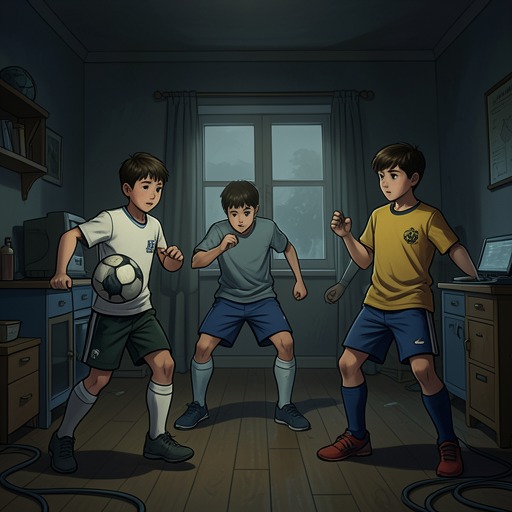
Roger’s vulnerability appears before the decisive match. When he announces that he is going to the soccer field, his enthusiasm and determination abruptly disappear after he discovers that three daughters of his mother’s friends are waiting outside. They force him back into the house like a wall of pink ribbons and lace, and Roger calls to his mother in outrage and embarrassment. The scene places his desire to play against a social humiliation that has nothing to do with the field itself; his obstacle is not only athletic judgment but the fear of being trapped in an identity imposed by adults.
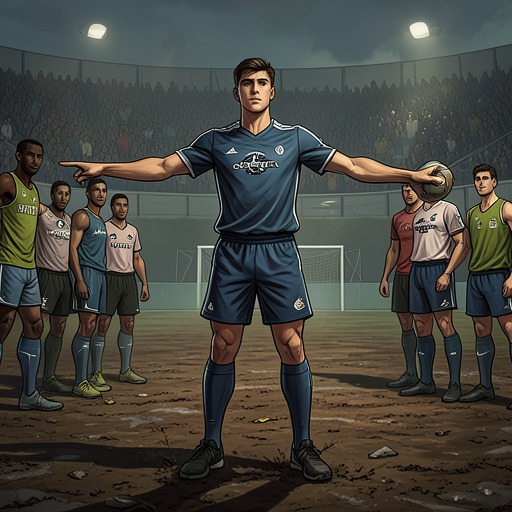
That fear becomes more serious when the Wild Soccer Bunch confronts Mickey the Bulldozer and the Unbeatables. Mickey appears as the intimidating center of a larger group, compared to Darth Vader and surrounded by boys who make him even more threatening. During the match, Kevin, Danny, and the others are frightened and physically overwhelmed. Diego directly asks what their fear means, and Larry answers that fear is their strength. Roger’s later conduct gives that claim its fullest test. Unlike a fearless champion, he hesitates precisely because he understands the consequences of failure.
The Final Match and the Turning Point
The match initially confirms every suspicion about Roger and the Wild Soccer Bunch. The Unbeatables race to a five-goal lead, while the players forget what Larry taught them and feel the absence of their coach. Mickey mocks them from the field, and Roger remains part of a team whose confidence has collapsed. The match then turns through coordinated play rather than individual domination: the Wild Soccer Bunch use their battle cry, “ONE, TWO, THREE WILD!”, exchange passes, and begin to challenge the Unbeatables’ physical superiority.
The comeback is built from specific collective contributions. Kevin scores with his bicycle kick, Alex Alexander’s powerful shot carries Octopus into the goal, Julian Fort Knox recovers his defensive authority, and the rain changes the field into the kind of mud on which the team has practiced for twelve days. Diego forgets his asthma and becomes the Tornado again. The score rises from seven to one to seven to seven, then to eight and nine, but victory remains unstable because Kevin wants the tenth goal for himself. Larry removes him after he refuses to pass and sends Roger onto the field instead.
Roger hesitates. He does not want to become responsible for losing, and he is about to leave the field and return to the bench. Larry orders him to continue, insisting that without Roger the team would have lost long ago. This intervention does not erase Roger’s fear; it gives the fear a place inside responsibility. Roger must enter while the match is still dangerous, after Mickey scores again and the Unbeatables draw within one goal.
The pressure intensifies when Roger misses an opportunity for the winning goal. Kevin wants to curse him, but Larry’s glance keeps him silent. The Grim Reaper then equalizes the match at nine to nine, making the next goal decisive. Roger’s failure has not been hidden or excused: it is shown immediately before his success, so the winning action becomes a reversal rather than a predictable confirmation of talent.
The Winning Goal and Transformation
At the decisive moment, Kevin sees Mickey sliding toward him like a crashing jumbo jet and passes the ball to the right. Roger runs toward it and aims with the wrong foot. Kevin shouts a warning, but Roger does not listen. His determination carries him past the instruction that might have stopped him, and this time he actually strikes the ball into the net.
The goal wins the match. The Wild Soccer Bunch fall over one another, then carry Roger on their shoulders across the field. Kevin remains in front of the goal, unable to believe that Roger has really become their hero, while Larry approaches and congratulates him. Roger’s victory therefore changes more than the score. It changes the team’s interpretation of him, Kevin’s judgment, and the meaning of the nickname that had previously sounded ironic.
Relationships and Narrative Significance
Danny is Roger’s principal defender. Kevin’s account makes Danny’s loyalty conspicuous because it interrupts the team’s ordinary logic of performance: Danny is the world’s fastest right forward and Kevin’s best friend, yet he still protects a player whom Kevin considers impossible to understand as a footballer. Roger’s eventual goal does not simply prove Danny right in an argument; it validates the value of defending a teammate before that teammate can prove himself.
Larry functions as the coach who converts Roger’s weakness into a condition of participation. He does not promise that Roger will succeed, and he does not remove him after failure. Instead, he sends Roger back onto the field when Roger most wants to retreat. The coach’s trust becomes practical rather than sentimental: Roger receives a role, a risk, and the chance to act under the same pressure as everyone else.
Kevin’s narration is central to Roger’s transformation. Kevin initially uses sharp comparisons and insults, but the match forces him to confront the limits of his own judgment. He tries to control the tenth goal, is taken off for refusing to pass, and must then pass to Roger in the critical attack. Roger’s winning shot consequently completes a double correction: Kevin learns to trust a teammate, while Roger proves that a player dismissed as hopeless can decide the game.
Roger’s arc also complicates the book’s model of masculine sporting strength. Mickey represents intimidation, bodily dominance, and public certainty; Roger represents hesitation, exposure to ridicule, and the possibility of succeeding without looking invulnerable. The Wild Soccer Bunch’s victory depends on passing, trust, and the willingness to play despite fear. Roger’s heroism is thus not the disappearance of weakness but a courageous action performed while weakness remains visible.