Roger’s Winning Goal
Kevin the Star StrikerRoger’s Winning Goal is the decisive climax of the Wild Bunch’s match against the Unbeatables. It completes a reversal from apparent humiliation to collective triumph: Roger, who has repeatedly stumbled during the final minutes, scores the next and winning goal after Kevin abandons his chance to become the individual star and passes to him. The goal therefore settles the match at the instant it also changes Roger’s standing within the team.
Causes and Match Situation
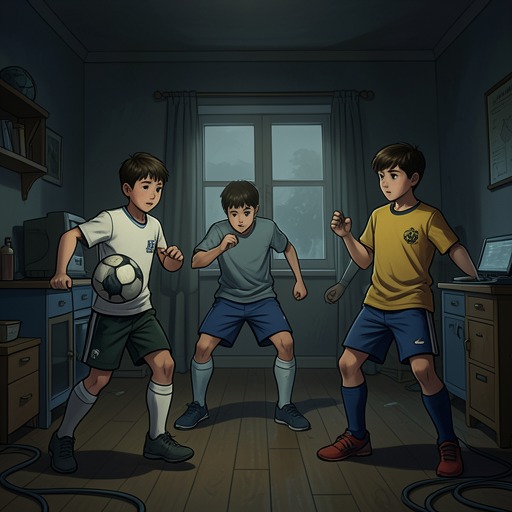
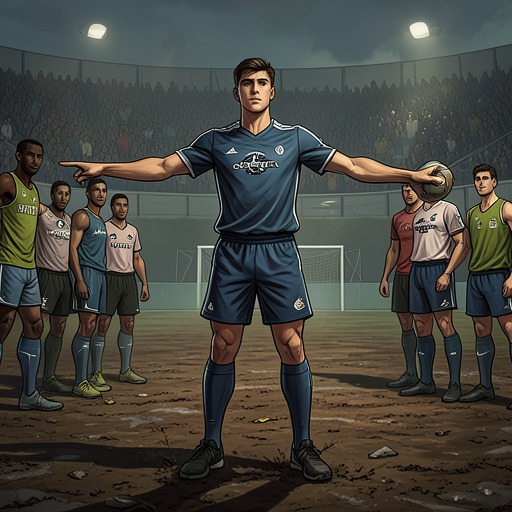
The goal comes after an extraordinary recovery. The Wild Bunch begin the decisive passage far behind, but the match changes through coordinated play, persistence, and adaptation to worsening conditions. The team’s battle cry, “ONE, TWO, THREE WILD!”, launches a sequence in which Kevin, Alex Alexander, Tyler, Danny, Joey, Julian Fort Knox, and the others move the ball through the Unbeatables’ defensive ranks. Later, rain softens the field into mud, a surface on which the Wild Bunch have trained for twelve days. Their preparation allows them to move through opponents who are sliding like ducks, and the score rises from seven to four to seven to seven, then to eight and nine. Kevin scores his third goal, Danny adds his second, Joey equalizes, Tyler scores from halfway when a gust carries the ball into the goal, and Diego forgets his asthma long enough to become the Tornado again. The comeback makes the winning goal possible, but it also creates a new danger: Kevin begins to value the tenth goal as a personal achievement rather than as the result of shared play.
The match reaches nine to nine after the Grim Reaper equalizes. The next goal will decide everything. Before that point, Kevin has already lost the ball because he refuses to pass, and Larry removes him from the field. Roger enters reluctantly, afraid that a mistake will make him responsible for defeat. When Roger misses a chance for a winning goal, Kevin nearly attacks him verbally, but Larry’s look restrains him. Roger then stumbles over the ball again, while Kyle prevents an Unbeatables goal with a diving save and later rises from the ground to steer another shot around the post. The pressure surrounding Roger’s eventual goal is therefore built from both the team’s miraculous recovery and the repeated expectation that Roger will fail.
The Decisive Sequence
The immediate action begins when Julian Fort Knox is injured after colliding with the Grim Reaper during a corner kick. Larry sends Kevin back onto the field to replace him, although Kevin does not want to play defense. He identifies himself as a forward and resists the unfamiliar responsibility, yet the change of position places him at the point where the final passage can be transformed. Roger remains nearby, still carrying the burden of his earlier errors.
Kevin initially responds in the manner that has endangered the team. When Kong approaches, Kevin remembers what Julian would do, slides into the challenge, takes the ball, and drives forward. He dribbles around every opponent who blocks his path, reaches the area in front of the goal, and continues alone. Humungous and the Grim Reaper stand between him and the net, while the Wild Bunch goal is left exposed and Mickey the Bulldozer and Kong are unmarked. Kevin ignores the calls of his teammates because he wants to handle the moment himself and become the star striker.
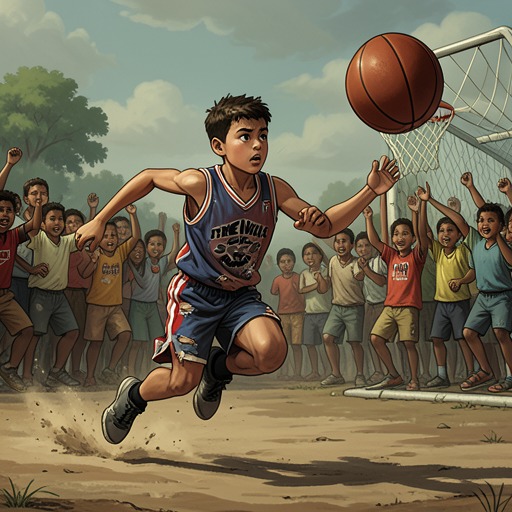
The expected individual finish collapses when Kevin sees the shadow of Mickey the Bulldozer sliding toward him like a crashing jumbo jet. The threat forces an instant decision. Kevin passes sharply to the right, where Roger runs onto the ball. Roger aims with the wrong foot. Kevin protests, “No, not with your left!”, but Roger is too determined to obey. This time he strikes the ball cleanly and drives it into the net. The decisive act is thus not a flawless planned maneuver. It is an improvised exchange produced by danger, mistrust, and sudden cooperation: Kevin gives up the shot he wants, and Roger succeeds with the foot Kevin believes is the wrong choice.
From Liability to Hero
Roger’s goal reverses the meaning of his earlier mistakes. He had hesitated before entering the field because he feared becoming responsible for a loss. He had missed a promising opportunity, stumbled over the ball, and failed again when the match was still undecided. Those failures make the final shot more than a routine finish. Roger’s success is surprising precisely because the narrative has repeatedly associated him with hesitation and error, while the moment itself gives him no time to recover through careful calculation. His determination, not his previous record, governs the outcome.
The goal also corrects Kevin’s idea of heroism. Kevin has scored important goals and possesses the confidence of a forward, but his refusal to pass leaves the team vulnerable. The final play makes him useful because he relinquishes the glory he had been pursuing. His pass is made under the pressure of Mickey the Bulldozer’s attack, yet it is still a decisive act of recognition: Kevin sees Roger’s run and trusts him with the chance. Roger’s left-footed shot then converts Kevin’s self-denial into victory. The heroic identity belongs to Roger in the public celebration, but the goal is structurally collective, created by Kevin’s pass and secured by the team’s preceding defense and recovery.
Celebration and Consequences
The immediate result is announced with the emphatic declaration “WE WIN!” The Wild Bunch collapse over one another in celebration, then lift Roger onto their shoulders and carry him across the field. The movement from repeated failure to physical elevation is unmistakable. Roger is no longer merely the player who might lose the match; he is “Roger the Hero,” the teammate whose action has ended it. The team’s celebration confirms that the victory changes his place among them, not simply the score on the field.
Kevin experiences the triumph from a contrasting position. While the others carry Roger, Kevin lies in front of the goal, unable to believe that Roger has truly become their hero. The image prevents the victory from becoming a simple celebration of Kevin’s athletic identity. He is still present at the decisive scene, but he is not at its center. Larry then appears and extends his hand, offering congratulations. The gesture links the goal to the coach’s larger lesson about trust: the team can defeat the Unbeatables only when its members rely on one another, and the final goal proves that trust through action rather than explanation.
Narrative Significance
Roger’s Winning Goal is the match’s clearest value reversal. The Wild Bunch move from fear, injury, and near defeat to victory; Roger moves from liability to hero; and Kevin moves from possessive individual ambition toward the passing play the team requires. The scoreline records the change as a narrow final advantage, but the emotional and relational shift is much larger. The goal does not erase Roger’s previous mistakes or Kevin’s selfish impulse. Instead, it gives both a new meaning: Roger’s errors make his courage visible, while Kevin’s abandoned shot becomes evidence that a forward’s greatest contribution may be the chance he creates for someone else.
The scene also contrasts Mickey the Bulldozer’s individual dominance with the Wild Bunch’s interdependence. Mickey has scored five goals in seven minutes and later reaches eight for the Unbeatables, presenting power as personal conquest. The Wild Bunch answer that model with a sequence of passes, defensive recoveries, training adapted to mud, Kyle’s saves, and finally Kevin’s pass to Roger. Their victory is not produced by the strongest player overpowering everyone else. It comes when a threatened player chooses connection and an uncertain player accepts responsibility. Roger’s left-footed shot is therefore both the match winner and the final proof of the team’s collective method.