Soccer ban
Kevin the Star StrikerSoccer ban is the enforced exclusion of a child from soccer, imposed by parents or by competing players who claim authority over the field. In the story, it is never a minor inconvenience: removing soccer means confiscating balls, disabling equipment, interrupting friendships, and threatening the children’s shared identity as the Wild Soccer Bunch. The ban therefore becomes both a family punishment and a contested political condition, one that the children repeatedly resist, negotiate, or transform through collective action.
Definition and Domestic Enforcement
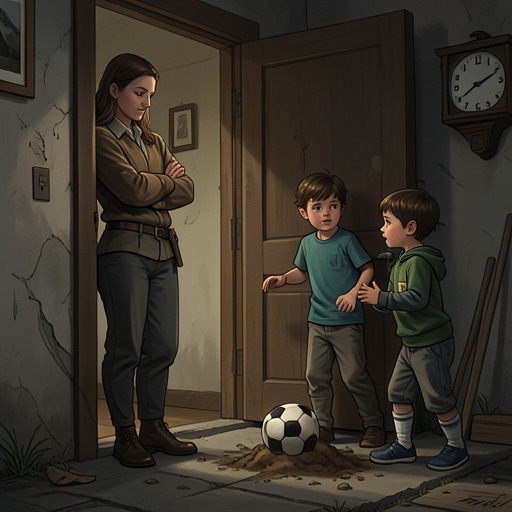
Soccer ban appears first as an ordinary parental sentence after the children’s misbehavior. Josh and Julian are banned from soccer for two days, and their mother enforces the punishment by letting the air out of their soccer ball and hiding the pump. The penalty does not merely forbid them from visiting the soccer field; it physically disables the object through which they play, making the rule tangible and difficult to evade.
The punishments vary according to the child and the family. Danny is grounded for three days, with his ball spirited away to the highest living-room shelf. Kevin and Tyler must slaughter their piggy bank to pay for a broken lamp. Alex Alexander receives the most severe sentence: ten days grounded with a complete soccer ban. His father removes three garbage bags of soccer equipment that Alex spent more than five years saving for and carries them toward a garbage truck. The unequal forms of punishment show that access to soccer is shaped not only by the children’s shared enthusiasm but also by parental authority, household resources, and the value assigned to expensive equipment.
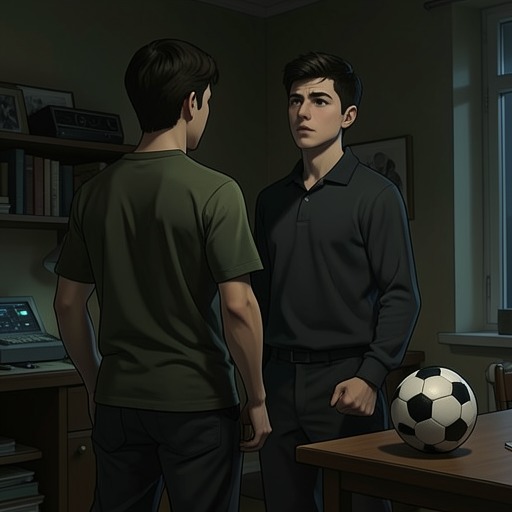
Alex Alexander’s punishment becomes especially extreme when his father later declares that he will spend the whole of spring break in his room. Alex remains silent while his father demands an explanation and extends the confinement. The soccer ban thus becomes part of a wider attempt to control both his movement and his speech: he is denied the field, isolated in his room, and expected to submit without argument.
The Ban and Unequal Access
The effects of soccer ban are intensified by poverty and unstable family circumstances. Joey’s mother is poor and out of work, and they live in a van. Joey cannot afford cleats; he does not even have a jacket and sometimes fails to appear. His exclusion from play is therefore not always an imposed punishment. It can arise from conditions that make participation materially difficult, including inadequate clothing, missing equipment, and the instability caused by his mother’s drinking.
Joey’s situation distinguishes formal prohibition from economic exclusion. When circumstances are fine, he plays soccer “like a magician,” seeming to place a spell on the ball, and he can play even better than Kevin, the self-described master dribbler and Star Striker. The contrast makes the ban’s social meaning clear: lack of cleats or a jacket does not indicate lack of talent. The obstacle lies in the conditions surrounding the player, not in the player’s capacity. Soccer is presented as a shared community, but entry into that community remains vulnerable to money, housing, parental care, and equipment.
Larry, the coach, occupies another point in this network of access. He works at the lemonade stand beside the soccer field and may not have advanced far in life, yet the children regard him as the greatest coach in the world because he was almost a professional soccer player and knows how to teach them. When the stand is destroyed, the damage removes not only a source of lemonade but also part of the practical infrastructure that supports the team. The field, the coach, the refreshments, and the children’s equipment form an interconnected world; interrupting any one of them threatens the whole activity.
From Parental Punishment to Collective Crisis
The bans imposed after the children’s earlier actions take on a larger emotional force during spring break. Alex Alexander is grounded for twenty days, and the other children remain silent at school while their classmates happily discuss their holiday plans. Winter has also defeated them: snow and ice make the soccer field unusable, so even freedom from parental punishment would not restore their game. At the field, the children gather on old bleachers and look over the snowy surface while Larry’s stand remains locked and its gutters drip into puddles. Soccer ban is consequently joined by weather and isolation, producing a collective sense that the season itself has been suspended.
The children nevertheless refuse to accept exclusion as permanent. When Kevin and the others visit Alex Alexander, his father says that Alex will spend all of spring break in his room. The team’s attempt to bring him back into their plans shows that friendship challenges the logic of individual punishment. The children do not treat the ban as a private matter belonging only to each household; they experience one player’s absence as a loss for the entire team.
Roger’s circumstances reveal a different version of the same conflict. His friends are grounded, but Roger is not banned because he was not involved in the same offense. His mother tells him to be glad that he has someone to play with and insists that he stay home while his friends are unavailable. Roger’s freedom is therefore useless without the others. The narrative turns the apparent privilege of avoiding a soccer ban into another form of separation: participation requires teammates, not merely permission.
The Field as a Rival Ban
The Unbeatables transform exclusion into an openly political rule. Mickey the Bulldozer announces that the soccer field belongs to the Unbeatables alone and orders the Wild Soccer Bunch to leave. This is not a parental sentence with a fixed duration; it is an attempted occupation of the children’s common space. The group is excluded from the field by force, while Mickey presents that force as a new order.
Kevin answers by proposing a two-week challenge. For two weeks, Mickey and the Unbeatables may pretend that the field is theirs, but then the teams must play for permanent possession. If the Unbeatables win, they keep the field; if the Wild Soccer Bunch wins, the Unbeatables must leave and the field belongs to the Wild Soccer Bunch forever. The challenge converts soccer ban into a formal contest, replacing arbitrary exclusion with a rule that both sides can recognize, even though Mickey’s domination has already shown how unstable the field’s rules are.
The Unbeatables continue to manipulate the conditions of play. Mickey claims that the challenged side chooses the weapons and decides that the match will be played until one team scores ten goals. He also declares body contact completely allowed after Tyler is pushed down and Julian is struck in the eye by Mickey’s elbow. These conditions turn the match into an extension of the ban: the Wild Soccer Bunch is technically admitted to the field but placed under rules designed to make meaningful participation dangerous. The game’s boundaries remain, yet its fairness has been suspended.
Resistance, Negotiation, and Consequences
Resistance to soccer ban takes several forms. Alex Alexander responds to the attempted removal of soccer from his life by kicking a globe through his living room, treating the round world as a substitute ball and the “complete soccer ban” as something that cannot be obeyed absolutely. The act destroys the globe, but it also reveals the imaginative reach of the prohibition: when real soccer is denied, soccer returns through household objects and violent improvisation.
The Wild Soccer Bunch also resists through honesty and negotiation. Josh explains that Kevin showed Mickey who was boss and that the team must practice hard with Larry to defeat the Unbeatables. Kevin’s defiance creates danger, but it also gives the team a purpose. Later, Kevin and Tyler secure the return of their ball by promising to act honestly and sincerely. Their father conditions the agreement on taking Sox to practice, reminding them that the dog is their responsibility. The recovery of the ball is therefore not a simple victory over adult authority; it is an exchange in which access to soccer is linked to care, accountability, and keeping a promise.
The ban also produces unexpected burdens for the opposing side. After Mickey destroys Larry’s stand to create a self-service counter, the Unbeatables lose access to drinks because the refrigerators die and the lemonade turns into sticky syrup. The soccer field becomes a ghost town, and the Unbeatables lie scattered around the rubble, weakened by the consequences of their own attempt to control the space. Their exclusionary rule damages the shared environment on which their play depends.
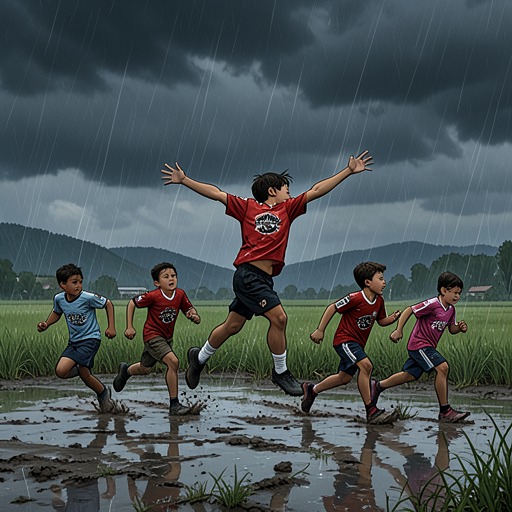
The decisive countercondition comes from Roger, who requires that the losing team repair Larry’s stand. Although the Unbeatables laugh at the proposal, it exposes the moral consequence hidden inside the field dispute: possession cannot be separated from responsibility. The final challenge begins with the Wild Soccer Bunch standing shoulder to shoulder and shouting “ONE, TWO, THREE WILD!” before moving through a rapid chain of passes. The sequence makes collective play the answer to exclusion. Instead of treating the field as the private property of the strongest player, the team reclaims it through cooperation, shared risk, and a willingness to repair what competition has damaged.
Significance
Soccer ban gives the book’s central conflict a concrete form. A parent can remove a ball, empty its air, hide a pump, confine a child to a room, or threaten to throw away years of savings; Mickey can attempt to remove an entire team from its field. Each version separates children from the activity through which they understand friendship, talent, discipline, and belonging.
At the same time, the story refuses to present soccer access as a simple matter of individual will. Joey’s poverty, Alex Alexander’s expensive equipment, Larry’s precarious work at the stand, and the team’s dependence on a usable field show that participation is structured by material and social conditions. The children overcome exclusion not by pretending those conditions do not exist, but by forming a team that shares equipment, coaching, responsibility, and risk. Soccer ban thus becomes a measure of power: whoever controls the ball, the field, the rules, or the conditions of entry can define who counts as a player. The Wild Soccer Bunch’s resistance insists that the field is not truly secure until play is collective, rules are negotiated, and belonging cannot be revoked by strength alone.