The Tennis-Ball Training
Kevin the Star StrikerThe Tennis-Ball Training is the Wild Soccer Bunch’s most punishing and inventive preparation for reclaiming their soccer field from the Unbeatables. Larry replaces the familiar soccer ball with a small, unpredictable tennis ball, turning practice into an exercise in control and collective discipline. The drill exposes the team’s weaknesses, intensifies conflicts among the players, and ultimately teaches them the elevated, improvised style that helps them survive the decisive match.
Causes and Preparation
The training begins under hostile circumstances. The Unbeatables have declared that the soccer field belongs exclusively to them, and Kevin has answered Mickey the Bulldozer with a two-week challenge: the Wild Soccer Bunch will return for a soccer match, with the field at stake. The team therefore has only a limited period to become good enough to defeat opponents who consider themselves unbeatable. Larry treats that deadline as a practical emergency rather than a reason for reassurance.
The immediate dispute concerns the ball. Kevin wants to play soccer that day, especially because the team needs every opportunity to prepare. His father points out that Sox needs him, while Sox sits nearby wagging his tail. The players understand what the gesture means: Sox will attack the ball. Since the dog bites deeper into it whenever it enters play, the team expects their remaining soccer ball to be destroyed. Kevin responds by tying Sox to a tree, despite the dog’s yelps and howls, because his sore muscles and frustration have made him determined to play.
Larry arrives at that moment and takes the soccer ball away. He kicks it to the far end of the field and says, “We won’t need it today.” When Kevin protests, Larry clarifies that he has not forbidden ball work; instead, he produces a tennis ball. The substitution horrifies the players. A tennis ball is not a soccer ball, and its small size and lightness make the familiar game suddenly strange. Roger tries to treat the object humorously, while Danny jokes that the next day’s equipment might be a hard-boiled egg, but the laughter is weakened by exhaustion and resentment.
How the Drill Works
Larry divides the team into two sides: Danny, Tyler, Roger, and Kevin against Alex, Diego, Julian, and Josh. He then tosses the tennis ball onto the soft field. The players already know how to move across the muddy ground, but the tennis ball does not behave like a normal soccer ball. It disappears into clumps of grass, slips between players’ feet, and ricochets off shoes toward the opposing team. Instead of making ordinary soccer easier, the drill strips away their automatic habits and forces them to observe every bounce and touch.
The practice quickly becomes a test of patience as well as skill. The players shout warnings at one another, question each other’s ability, and eventually announce that they have had enough. Some threaten to stop playing altogether. Larry does not soften the exercise. He reminds them that they have only two weeks and that their primary objective is defeating the Unbeatables. His repeated promise is that success with the tennis ball will make every trick with a soccer ball feel like “child’s play.” The method is deliberately indirect: Larry makes the tool more difficult so that the ordinary game will later seem manageable.
The first day ends in failure. The players perform so poorly that the lemonade tastes bitter and they walk home silently, convinced that they will never get the soccer field back. The training is not presented as an immediately encouraging lesson. Its first result is a collective collapse of confidence, as the team measures the gap between its ambition and its current ability.
Breakdown and Turning Point
The next three days intensify the pressure. Heat arrives with mosquitoes that bite the players’ arms, legs, and faces. Sox continues howling for the ball, even when the players take turns sitting beside him, because he wants the object rather than comfort or attention. The team’s irritation spreads through the group. They yell, curse, and blame one another; Kevin even grabs Roger and pushes him into the mud after accusing him of failing to play properly.
The quarrel eventually turns against Larry. The players tell him that the situation is his fault and challenge him to try the drill with his lame leg. Larry says nothing. He limps to the sidelines, sits down, and watches. At first, the players imagine that his withdrawal proves their point and that they can stop. Instead, his silence creates a different kind of pressure. No one wants to leave first, because the first person to quit will look like a coward. More importantly, no one wants to become the person responsible for losing the neighborhood soccer field.
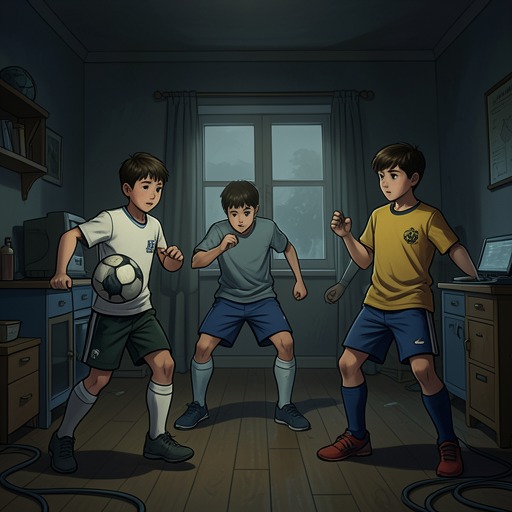
That shared shame changes the practice. Kevin walks to the ball and begins a controlled sequence: balancing it on his instep, lifting it into the air, heading it, stopping it with his chest, and passing it with his knee to Danny. Danny repeats the action and sends the ball to Alex; Julian, Tyler, Diego, and finally Roger continue the chain. The ball does not remain perfect—it falls into the mud when Roger receives it—but the failure no longer destroys the exercise. The players begin laughing again because they have discovered that the drill is not about preserving a clean, predictable sequence. It is about keeping the ball alive through adaptation.
From Frustration to Technique
The players recognize that the tennis-ball exercise resembles the high, controlled style Larry has associated with Kaka and Ronaldinho playing at the beach in Brazil. On a beach, Larry had explained, the ball must be kept in the air because the surface makes ordinary bouncing unreliable. The tennis ball creates a comparable demand. It forces the Wild Soccer Bunch to raise the ball, use different parts of the body, anticipate irregular movement, and rely on teammates rather than waiting for a comfortable ground pass.
This is the drill’s central transformation. At first, the tennis ball seems to reduce the players’ abilities to clumsy fragments: it vanishes in the grass, escapes their feet, and provokes accusations. After the turning point, the same unpredictability becomes a source of invention. The team learns to convert inconvenience into technique. Their new confidence is not based on pretending that the field or equipment has become easier; it comes from becoming more capable under conditions that remain difficult.
The training also reveals uneven development within the team. Kevin is especially irritated whenever Roger or Josh loses possession and the other side scores. He excuses some of Josh’s mistakes because Josh is only six years old, but he judges Roger more harshly, describing him as blind and clumsy. Diego’s illness adds another strain when his fever finally catches up with him and there are no more ice cubes available because his mother has defrosted the freezer. The drill therefore takes place within a vulnerable team whose members differ in age, health, confidence, and skill.
Consequences for the Match
Although the tennis-ball sessions feel disastrous while they are happening, their value becomes visible during the later match against the Unbeatables. The opponents choose harsh conditions, including play with the sun in the Wild Soccer Bunch’s eyes, and insist that the challenged side must accept the weapons selected by the challenger. Mickey also imposes a ten-goal format, while the Unbeatables declare that body contact is allowed. The match thus combines formal rules with intimidation and physical violence.
The Wild Soccer Bunch’s response reflects the adaptability developed in training. They begin with the battle cry “ONE, TWO, THREE WILD!” and move the ball through a coordinated passing sequence involving Kevin, Alex, Tyler, Danny, Joey, and others. Their play continues even after Octopus effortlessly catches a shot and the Unbeatables extend their lead. Tyler’s central attack, Danny’s cross, Kevin’s control in front of goal, and Alex’s powerful finish produce the team’s first goal. Julian, previously frightened by Kong’s strength, then intercepts him repeatedly, showing that defensive awareness can be restored under pressure.
Rain makes the field soft and muddy, but this time the condition favors the Wild Soccer Bunch. They have trained for twelve days on comparable ground and move through the Unbeatables as the opponents slide. Kevin scores his third goal, Danny scores his second, Joey equalizes the match at seven goals each, Tyler scores from distance when wind carries the ball into the goal, and Diego forgets his asthma long enough to become the Tornado again. The score rises to nine-nine, and the contest is decided by one final goal.
Kevin’s individual hunger almost damages the collective effort. After refusing to pass because he wants the tenth goal, Larry removes him and replaces him with Roger. Kevin protests, but Larry’s decision insists on the lesson that the tennis-ball training has taught: control means more than personal brilliance, and a team must preserve its shape even when one player wants glory. Roger misses an opportunity, and Kevin is tempted to blame him, yet Larry’s look restrains the outburst. Roger later scores the winning goal, producing the emphatic result, “WE WIN!” The players carry him across the field, while Kevin remains in disbelief that Roger has become the hero.
Significance
The Tennis-Ball Training is therefore not merely a comic equipment substitution. It is Larry’s answer to a team that wants the comfort of ordinary practice while facing an opponent, a deadline, and a field governed by hostile rules. By removing the familiar soccer ball and introducing a smaller, less predictable object, he makes the players confront the limits of their habits. Their progress begins only after anger, blame, and the threat of quitting have exhausted themselves.
The drill also turns the soccer field into a laboratory for shared responsibility. The players do not master the tennis ball through solitary talent. They learn by continuing a sequence across many bodies, accepting imperfect touches, and refusing to let one mistake end the play. That pattern returns in the match, where passing, defensive recovery, and trust matter more than Kevin’s desire to score the decisive goal himself.
Its deepest lesson is that difficult conditions can become an advantage when they have been faced deliberately. The muddy field, the wind, the rain, the inadequate equipment, and the pressure of the Unbeatables are not erased. The Wild Soccer Bunch wins because training has made those conditions familiar. What first appears to be Larry’s cruelty becomes the practical foundation of the comeback: the team learns to play not when the game is comfortable, but when comfort has disappeared.