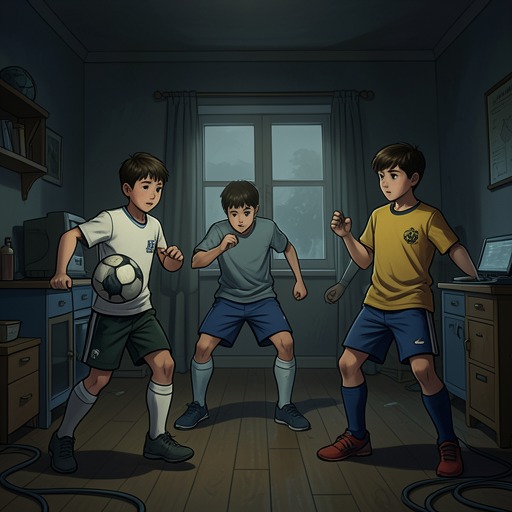
The Wild Bunch's lakeside training
Kevin the Star StrikerThe Wild Bunch's lakeside training is the practical and emotional foundation of the challenge to the Unbeatables. What begins as an attempt to prepare for a soccer match becomes a demanding education in movement, cooperation, discipline, and trust: the players learn to treat mud, stones, water, blindfolds, music, and even a tennis ball as training partners rather than obstacles. Over twelve days, Larry turns a miserable park near the lake into the place where the team acquires the habits that make its apparently impossible comeback possible.
A Training Ground Made from Defeat
At 9:00 AM sharp, Kevin, Tyler, Danny, Alex Alexander, Diego, Julian Fort Knox, Roger, and Josh reached the park near the lake, an hour before practice was due to begin. Their impatience immediately collided with the ground. Diego slipped face first into muck; Josh and Roger were stuck in mud up to their ankles; Julian and Tyler stumbled over stones; and Diego, Alex Alexander, and Kevin plunged into a knee-deep hole filled with water. The first lesson was not elegant soccer technique but physical adaptation. The field was unstable, wet, and hostile, and ordinary running could not survive on it.
Larry watched from a tree trunk and refused to let the players mistake their embarrassment for failure. When Kevin wanted to learn to swim after falling into the water, Larry redirected the impulse toward running, kicked Kevin's ball to the far end of the field, and said, "I think the water is still too cold for swimming. That’s why I suggest you first learn how to run." He then used pebbles to demonstrate the field's hidden logic. A large body could be powerful but slow; a pebble was quick, nimble, and light, able to bounce over puddles and stones. The players had to become agile enough to use the terrain's irregularity rather than fight it directly.
That change in perception released the first breakthrough. The players raced repeatedly across the mud, falling into puddles, scraping their knees and elbows, and refusing to give up. They eventually repeated the exercise blindfolded. When Larry turned on his boom box, they moved to the rhythm of the music, and the muddy field seemed smoother than a golf course. The scene changes the meaning of the training: the players are not merely enduring punishment but learning, collectively, to transform an apparently unusable field into a place where they can move with confidence. Lemonade from Larry's stand followed the exhausting practice, and their laughter restored the confidence that the morning's humiliations had threatened to destroy.
Larry's Progression of Exercises
Larry's method develops by replacing the expected ball with progressively less cooperative objects. After the first day of movement across mud and stones, the players expected to play soccer. Instead, Larry tossed a tennis ball onto the field. The small yellow ball disappeared into clumps of grass, slipped through their feet, and bounced away from their shoes toward the other team. Frustration quickly became open revolt: players shouted warnings, declared that they had had enough, and threatened to quit.
Larry stayed firm because the team had only two weeks before the challenge to the Unbeatables. The purpose of the tennis-ball exercise was not amusement or cruelty for its own sake. Larry insisted that success with the tennis ball would make every trick with a soccer ball feel easy. The day's failure therefore becomes part of the training's structure. The players went home depressed, with bitter-tasting lemonade and the fear that they would never beat the Unbeatables if their preparation continued to go badly. Larry's coaching forces them to remain inside that fear long enough for skill to replace it.
The training also changes the relationship between coach and players. When the team mocked the tennis ball as a "cute little fuzzy yellow ball" and joked that the next day's equipment might be a hard-boiled egg, Larry stopped the laughter and asserted that he was their coach. The players did not immediately accept his authority, but the confrontation marks a necessary shift from spontaneous play to deliberate preparation. The challenge imposed by Mickey the Bulldozer had a fixed deadline, and Larry's exercises give that deadline a concrete daily shape.
The Ten-Pass Challenge and Collective Skill
The decisive technical test was the attempt to pass the ball ten times while Sox disrupted the exercise with his speed. The team could manage five passes at most before the sequence collapsed, and the players were close to giving up. At that point Larry revealed a more energetic side of himself. Despite his lame leg, he danced around the players and ran alongside them, calling out precise instructions: Kevin had to pass right, Julian was free, Tyler had to move left, Joey should receive a heel pass, and Kyle needed to run into the middle.
Larry's instructions convert a collection of individual movements into a shared pattern. The ball began to move through the ranks with increasing fluency, reaching seven passes and then eight. Larry withdrew and sat on the grass without speaking, allowing the players to continue while his shining eyes showed how intensely he was following their progress. His temporary silence is as important as his commands: the coach's guidance has begun to become the team's own coordination.
The sequence did not end at ten. The Wild Bunch reached ten passes and continued to seventeen, when Sox finally yelped angrily, gave up on soccer for the day, and hid beneath his paws until Kevin put him on the leash. The players embraced one another and then embraced Larry. For the first time, they formed a circle, and, after Larry counted to three, they shouted their battle cry, "ONE, TWO, THREE WILD!" The training thus produces not only a measurable skill but a ritual of belonging. The team's identity is voiced after its first shared success, while Sox's mocking bark provides a comic reminder that even triumph remains part of an unruly, living group.
From Mud to Match Play
The meaning of the lakeside exercises becomes fully visible during the challenge match. Before the game, the Wild Bunch entered the field shoulder to shoulder after repeating their battle cry. Their opening passing sequence moved from Kevin to Alex Alexander, then to Tyler, Danny, and Joey, showing the circulation and positional awareness that Larry had cultivated. Later, when Tyler drew several defenders toward him, he passed to Danny, whose cross found Kevin; Kevin resisted the urge to shoot and passed back with his heel, allowing Alex Alexander to strike the ball into the goal. The training's central lesson appears in that decision: the attack succeeds because the ball is shared rather than possessed.
The match also returns the players to the environmental conditions they had been taught to master. When rain began and the score reached seven to four, the ground became soft and muddy. The Unbeatables slid around, but the Wild Bunch had practiced for twelve days on precisely that kind of surface and moved through the opposition with confidence. Kevin scored his third goal, Danny his second, and Joey tied the game at seven to seven. Tyler then scored from halfway down the field when the wind carried the ball beyond Octopus's reach, and Diego forgot his asthma and became the Tornado again as the team scored its ninth goal.
The training's discipline is tested most severely when Kevin loses the ball because he wants to score the tenth goal himself. Larry removes him and puts Roger into the match, despite Kevin's protest that the substitution could cost them the game. The Unbeatables equalize at nine to nine, and the next goal becomes decisive. Kevin finally promises to pass, but Roger misses one chance after another. Kyle must make a diving save to prevent the winning goal, then rises and steers another shot around the post. Roger eventually strikes the ball into the net, and the Wild Bunch win. The players carry Roger on their shoulders across the field, while Kevin remains before the goal, unable to believe that Roger the Hero has truly become their hero.
Significance and Lasting Result
The training begins in disarray and ends in coordinated victory, but its deepest achievement is not simply physical preparation. It teaches the Wild Bunch to accept correction, endure humiliation without surrendering, read one another's movements, and replace individual glory with collective action. Larry's obstacles are deliberately smaller, stranger, or more difficult to control than a normal soccer ball because they expose weaknesses that ordinary play might conceal. Mud reveals balance; pebbles reveal agility; the tennis ball reveals touch and concentration; Sox reveals whether the players can preserve a passing pattern under pressure.
The training also answers the Unbeatables' claim that the soccer field belongs exclusively to them. Mickey the Bulldozer had declared that only the Unbeatables could play there, while Kevin challenged him to a soccer match after two weeks. The game was governed by hostile conditions and disputed rules, including the Unbeatables' insistence that body contact was allowed, but the Wild Bunch answered that imposed power with preparation and cooperation. Roger's condition that the losing team fix Larry's stand tied the contest to the team's material home as well as its sporting pride.
The final victory confirms that the lakeside training was a form of transformation. The same children who initially fell into water, mud, and stones later danced across a rain-softened field while the Unbeatables slipped. The same group that could not complete five passes eventually reached seventeen against Sox and used its passing game to survive a nine-nine climax. Their victory is therefore not an accidental reversal but the visible result of twelve days in which failure was repeatedly made useful. The park near the lake becomes the workshop of the Wild Bunch's identity: a place where discomfort is converted into skill, skill into mutual trust, and mutual trust into a team strong enough to reclaim the soccer field.