The Wild Bunch’s Indoor Soccer Battle
Kevin the Star StrikerThe Wild Bunch’s Indoor Soccer Battle is both an improvised response to a winter that refuses to end and the decisive match in which the Wild Soccer Bunch becomes a true collective. What begins with children striking balls against household walls eventually develops into a seven-goal deficit, a rain-soaked comeback, and Roger’s winning goal. The action’s central reversal is moral as well as athletic: Kevin’s hunger to score alone must give way to trust, passing, and shared responsibility.
Causes and Background
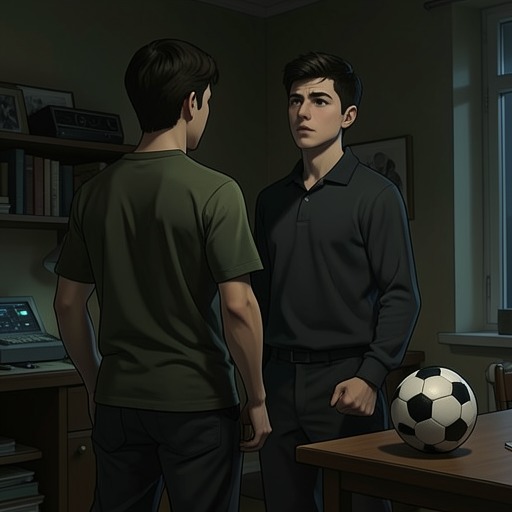
The battle grows out of confinement. Spring break is only days away, yet winter has extended into April, leaving the soccer field buried beneath at least seven inches of snow and ice. Kevin and Tyler stare through ice crystals on the window above Wilson Street, their Christmas cleats itching to be used, while their scratched and scuffed soccer ball rests on Kevin’s lap. The children imagine themselves as hibernating grizzlies or caged tigers, but the metaphors cannot contain their need for movement. The weather turns ordinary rooms into substitute fields.
The indoor game begins with Tyler and Kevin throwing the ball rapidly between them and calling it goalie training, even though Tyler is the number 10 midfield playmaker and Kevin is the center forward. Their invented exercise soon becomes more direct: they kick the ball at the wall, alternating each violent, rhythmic impact. The same drumbeat spreads through the neighborhood. Danny fires the ball at his bedroom wall at 44 Dearborn Street; Julian Fort Knox and Josh play across the street; and Alex Alexander creates a goal in the narrow space between a mirror and a china cabinet at One Woodlawn Avenue. The repeated crashes connect separate homes into one imagined stadium.
The improvised contest also exposes the unequal conditions surrounding the team. Joey lives in a van with his unemployed mother and cannot afford cleats; sometimes he lacks even a jacket and sometimes fails to appear because his mother drinks heavily. Alex Alexander, by contrast, plays in a fancy house where a fragile domestic interior limits the available space. Kevin and Tyler’s father later makes access to their ball conditional on taking Sox to practice, turning family responsibility into a condition of participation. Even Larry’s authority comes from an unlikely place: he works at the lemonade stand beside the soccer field and did not get far in life, yet his near-professional soccer past makes him, to the children, the greatest coach in the world.
From Household Walls to the Match
The indoor sequence provides temporary liberation but also produces real consequences. The children’s imagined victory saves spring break in their minds, yet Danny advances too quickly and crashes into a bookshelf, sending books and boxes down around him. Tyler supplies a perfect chip pass, and Kevin attempts his signature “flip over bicycle kick,” only for the ball to strike a lamp. Julian prevents Josh’s imagined goal by sliding into his mother, sending sandwiches flying into Josh’s face as the fantasy collapses back into domestic reality.
Alex Alexander’s shot is the most spectacular and costly. He carefully measures the distance to the wall beside the china cabinet, then drives the ball into the corner. The ball rebounds through the living-room window and rolls outside until Alex Alexander’s father stops it with his foot after returning from work at the bank. Alex Alexander’s silent grin disappears when his father sentences him to ten days of grounding with a complete soccer ban and removes his soccer equipment, which took more than five years to save for, in garbage bags. The conflict reveals how the children’s soccer world depends on adult spaces and adult power even when their imagination makes those spaces into Toyota Park.
Alex Alexander refuses to accept the ban as final. While handling the globe beside the window, he dismantles it from its stand, kicks the North Pole, and uses it as a substitute ball. The globe becomes an absurd but precise emblem of the battle’s logic: when the real field is inaccessible, the entire world can be turned into a playing surface. The indoor game is therefore not merely practice. It is an act of resistance against weather, household limits, punishment, and the idea that soccer can be separated from the children’s lives.
The Match and Its Reversals
The decisive outdoor contest begins with the Wild Soccer Bunch facing the Unbeatables. The Wild Bunch opens with its repeated battle cry, “ONE, TWO, THREE WILD!” The sequence that follows is a collective demonstration rather than a solo exhibition: Kevin starts, passes to Alex Alexander, receives Tyler’s return, and then moves through Danny and Joey before shooting. The Unbeatables appear paralyzed by the coordinated movement, but Octopus catches the shot. The counterattack immediately exposes the danger of the opposing team. Octopus sends a goal kick to Kong, Kong passes to Mickey the Bulldozer, and Mickey scores after Kyle’s fingertip save is not enough to keep the ball from the post.
The score widens to seven goals before the Wild Bunch finds its shape. The team’s first goal comes through a chain of decisions rather than Kevin’s individual ambition: Tyler drives toward the goal, passes to Danny, Danny crosses toward the penalty spot, and Kevin receives the ball in front of Octopus. Kevin feels the defender behind him and heels the ball back to Alex Alexander, whose cannon-like shot carries Octopus and the ball into the goal. The goal changes the match’s emotional arithmetic. Although the score is seven to one, the Wild Bunch experiences it as the beginning of a possible seven-to-one reversal.
Rain then changes the physical conditions. The ground softens into mud, and the Unbeatables slide through it, while the Wild Bunch has practiced on similar terrain for twelve days. Kevin scores his third goal for a hat-trick, Danny scores his second, and Joey strikes the ball into the corner to make the score seven to seven. Tyler controls midfield and scores from halfway down the field when wind carries the ball beyond Octopus’s tentacles. Diego forgets his asthma and becomes the Tornado again, helping produce the ninth goal. The comeback is therefore built from repeated contributions: Kevin’s finishing, Danny’s running, Joey’s skill, Tyler’s midfield command, the wind, and Diego’s recovered speed.
Kevin, Roger, and the Final Goal
At nine to seven, Kevin loses the ball because he refuses to pass and wants the tenth goal for himself. Larry removes him from the field and replaces him with Roger. Kevin protests that the decision will make the team lose, but Larry’s intervention turns the match into a test of character rather than mere scoring ability. Roger hesitates because he fears becoming responsible for defeat; Larry urges him onto the field and reminds him that the team would have lost long before without him.
Mickey scores the Unbeatables’ eighth goal, and Roger misses a chance to win. Kevin nearly curses him, but Larry’s glance keeps him silent. The Grim Reaper then equalizes the match at nine to nine, making the next goal decisive. Kevin finally tells Larry that he will pass the ball, but the promise is tested immediately: Roger receives another clear chance and misses again, while Kyle must make a nosedive save in the lower-left corner and then recover quickly enough to steer Kong’s follow-up shot around the post.
Roger’s final attempt reverses his earlier failures. Kevin warns him not to use his left foot, but Roger ignores the instruction, strikes the ball, and drives it into the net. The victory is announced with the stark declaration “WE WIN!” The children fall over one another, then carry Roger across the field on their shoulders. Kevin, lying before the goal, cannot believe that Roger the Hero has truly become their hero. The moment confirms that the battle’s real climax is not the tenth goal alone but the redistribution of honor: the boy once treated as a liability becomes the player who completes the team’s victory.
Consequences and Significance
The battle’s immediate consequence is the Wild Soccer Bunch’s victory over the Unbeatables, but its deeper consequence is the team’s internal reorganization. Kevin remains a gifted striker, yet his selfishness directly causes the crisis that sends him to the bench. Roger’s missed chances do not disqualify him; instead, persistence and collective support allow him to score the winning goal. Larry’s coaching makes victory depend on trust, passing, defensive effort, and the willingness to give another player the decisive opportunity.
The surrounding episodes sharpen the meaning of that victory. Joey’s brilliance exists alongside poverty, missing equipment, and an unstable home; Alex Alexander’s devotion to soccer brings grounding and the loss of equipment; and the Unbeatables’ own access to the field is shadowed by the destruction of Larry’s stand, which leaves them without lemonade and surrounded by rubble. The children’s soccer world is never socially equal, but the match creates a temporary arena in which skill can emerge from a van, a frozen room, a muddy field, or a boy who has been afraid to take responsibility.
The indoor battle thus joins comic domestic damage to serious team formation. Walls, lamps, windows, a globe, mud, rain, and goalposts all become parts of the same struggle to keep playing. The repeated drum-roll rhythm of the early indoor scenes expands into the shouted battle cry and the accelerating scoreline of the final match. By the time Roger is carried from the field, the Wild Soccer Bunch has moved beyond a collection of talented children: it has become a team whose victory depends on converting private frustration into shared action.