The Wild Bunch's challenge to the Unbeatables
Kevin the Star StrikerThe Wild Bunch's challenge to the Unbeatables is the central contest over the soccer field: a confrontation that begins as an act of defiance against Mickey the Bulldozer and becomes a test of courage, discipline, trust, and collective play. Kevin answers physical intimidation with a declared two-week challenge, and the eventual match turns a threatened group of smaller players into a team capable of overcoming a seemingly invincible opponent.
Causes and Background
The challenge grows out of the Unbeatables’ occupation of the soccer field and their attempt to make their possession seem permanent. Mickey the Bulldozer embodies that power. He is described as the toughest boy in the school and neighborhood, surrounded by a group of larger followers, and his appearance at the gate makes the field feel less like an open place for play than territory controlled by a gang. His size, companions, and theatrical confidence are all instruments of exclusion.
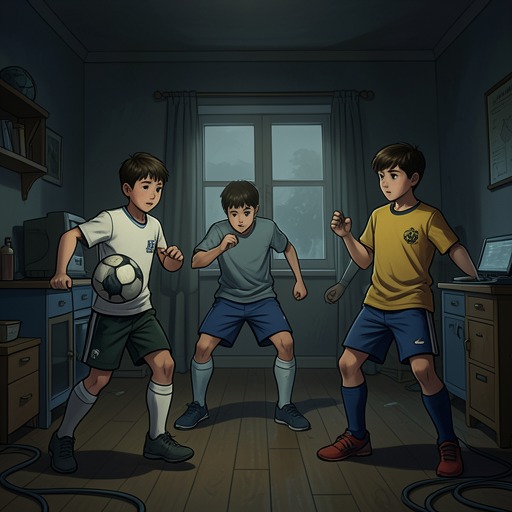
The Wild Bunch nevertheless treats the field as something that can be reclaimed through soccer rather than surrendered through fear. Kevin’s relationship with the team gives the challenge a personal and collective foundation. Danny is his best friend and the world’s fastest right forward, while Tyler, Kevin’s older brother, is the team’s number 10, described as its brains and heart because he never gives up. Kyle, who comes to the team against his parents’ wishes, is a natural goalkeeper. These players do not merely provide positions on a lineup; they represent the trust and persistence on which the later match depends.
The immediate cause is Mickey’s direct humiliation of Kevin. Mickey throws Kevin’s soccer ball against his chest, first making him stumble and then knocking him to the ground. Kevin responds by catching the ball on the third throw and sending it back. His refusal is repeated rather than softened: he tells Mickey, “Not a chance,” and then repeats, “I said, ‘not a chance,’” making the words an action that rejects the Unbeatables’ claim to unquestioned authority.
The Challenge as a Public Act
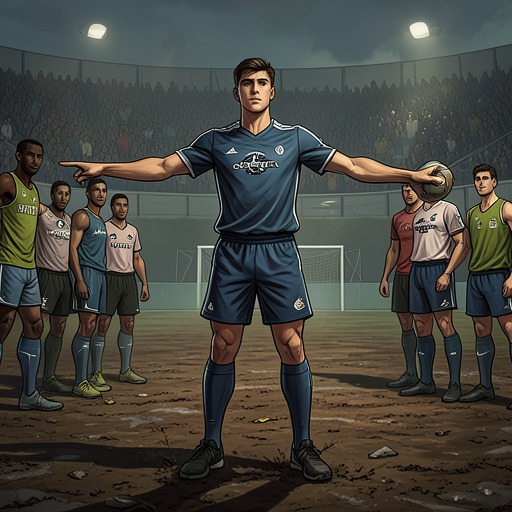
Kevin’s challenge establishes a precise time limit and a clear condition for ownership. He gives Mickey and his followers two weeks, and not a day more, to behave as if the soccer field belongs to them. After that, the teams will play. If the Unbeatables win, the field will remain theirs; if the Wild Bunch wins, the larger boys must leave and the field will belong to the Wild Bunch permanently. The challenge therefore converts an informal occupation into a contest governed by terms both sides can recognize.
The declaration is dangerous because Kevin is surrounded by the Unbeatables, including Humungous, the Grim Reaper, Octopus, and Kong. His friends may think he is suicidal or crazy, and Danny’s reaction is an astonished recognition that the act is genuinely wild. Mickey initially answers with disbelief and laughter. He is stunned that a boy who barely reaches his belly button dares to confront him, and his laughter turns the challenge into a spectacle before it becomes an agreement.
The agreement is secured not because Kevin is free from fear, but because he refuses to display submission. When Mickey asks whether Kevin is afraid, Kevin’s courage falters internally, yet he maintains the confrontation. Mickey claims that he does not know what fear is; the force of the scene lies in the contrast between that boast and Kevin’s actual awareness of fear. Mickey finally accepts the deal and promises to meet the Wild Bunch at the field in two weeks. Kevin and his friends immediately run away, shouting and cheering as though they have already won, even though the match has not begun.
The Match and Its Reversals
The eventual game initially confirms the Unbeatables’ reputation. Mickey scores five goals in seven minutes, all by himself, while the Wild Bunch is left on the grass, injured and staring at the ground. Julian’s eye is darkgreenblueviolet, Tyler holds his ribcage, and Kevin has a badly scraped knee. Kyle’s careful joke that the match is not going as planned is enjoyed only by the Unbeatables, whose laughter emphasizes the apparent collapse of the challenge.
The turning point begins when the Wild Bunch stands shoulder to shoulder and roars, “ONE, TWO, THREE WILD!” The repeated battle cry reorganizes the players from isolated, frightened bodies into a coordinated unit. Kevin passes to Alex, Alex plays back to Tyler, Tyler sends the ball toward Danny, and the sequence continues through Joey before Kevin shoots. Octopus saves the attempt, but the attack demonstrates that the Wild Bunch can move the ball through cooperation rather than trying to imitate Mickey’s individual domination.
The team then begins to recover. Tyler draws defenders toward him before passing to Danny, whose cross reaches Kevin; Kevin chooses a back-heel pass instead of forcing a shot, allowing Alex to score. Julian, previously afraid of Kong, confronts him directly, wins the ball, and becomes the team’s all-in-one defender again. Joey shoots, Octopus punches the ball away, and Kevin scores with his famous flip-over bicycle kick. The match’s meaning shifts with these actions: technique and passing begin to undo the authority that brute force appeared to establish.
Rain changes the field as the score reaches seven to four. The ground becomes soft and muddy, and the Unbeatables slide around like ducks on an ice rink. The Wild Bunch, however, has practiced for twelve days on that kind of surface. Kevin scores his third goal for a hat-trick, Danny scores his second, and Joey makes the score seven to seven. Tyler then shoots from halfway down the field; a gust of wind carries the ball beyond Octopus’s reach for the eighth goal. When Diego forgets his asthma and becomes the Tornado again, the Wild Bunch scores number nine and believes it has won.
That apparent victory is endangered by Kevin’s selfishness. Wanting the tenth goal for himself, he keeps the ball instead of passing, and Larry removes him from the field and replaces him with Roger. Kevin protests that Larry is risking the match, but Larry’s decision makes the team’s deeper lesson unavoidable: the final victory cannot belong to the player who wants to complete the story alone.
Crisis and Resolution
Mickey scores the Unbeatables’ eighth goal, and Roger misses an opportunity that could have produced the winner. The match reaches nine to nine when the Grim Reaper equalizes, making the next goal decisive. Kevin finally tells Larry that he will pass the ball, but the promise is tested immediately rather than accepted as sufficient. Roger misses another clear chance, and Kyle must stop what seems to be the winning attack.
Kyle first fists Kong’s shot out of the lower-left corner with a nosedive. Because the ball remains in play, Kong shoots again while Kyle is still on the ground. Kyle springs back up, pushes himself off with both arms and legs, and steers the ball around the post at the last moment. The save preserves the possibility of victory and turns Kyle’s earlier reputation as a natural goalkeeper into a concrete act of rescue under extreme pressure.
Roger then receives another chance. Kevin tells him not to use his left, but Roger ignores the instruction, strikes the ball, and drives it into the net. The Wild Bunch wins. The final goal is especially significant because it comes from the player who had hesitated, missed earlier opportunities, and feared being responsible for defeat. Roger is carried across the field on the team’s shoulders, and Kevin, lying in front of the goal, recognizes that Roger the Hero has truly become their hero.
Consequences and Significance
The challenge resolves more than possession of a field. It changes the meaning of strength within the group. Mickey’s version of power depends on size, intimidation, laughter, and the ability to score alone; the Wild Bunch’s victory depends on passing, covering for mistakes, accepting substitutions, surviving pain, and allowing the overlooked player to decide the match. The event does not deny fear. Larry later explains that fear is the team’s strength, while Diego asks directly what they are supposed to do about it. The challenge’s outcome confirms that fear can coexist with action when teammates trust one another.
The match also exposes the limits of heroic individualism. Kevin begins the contest by making the decisive public declaration, but his desire to score the tenth goal nearly damages the team. He must be removed before he can understand that victory requires surrendering control of the final play. Roger’s winning goal completes that correction: the player who seemed least likely to become the hero becomes the one whose success the whole team carries and celebrates.
The event’s athletic narration intensifies its social meaning through exact scores, rapid actions, injuries, repeated shouts, and successive reversals. Five goals in seven minutes creates apparent inevitability; the sequence from seven to four, to seven to seven, to nine to nine, makes recovery measurable rather than abstract. The rain and mud do not simply decorate the climax: they reward the twelve days of preparation that the Unbeatables lack. The field becomes a proving ground where the group’s chosen values—persistence, mutual trust, and shared responsibility—defeat the occupation that began the conflict.
The Wild Bunch’s victory therefore restores both a place and a community. The field is no longer controlled by the loudest or largest boy; it becomes the space where the team’s collective identity is made visible. Kevin’s challenge begins with a ball thrown into his chest and ends with the Wild Bunch carrying Roger across the field. Between those two gestures, intimidation is answered by play, fear is converted into resolve, and ownership is won through cooperation rather than force.