The globe
Kevin the Star StrikerThe globe is a household model of the world that briefly becomes the most consequential piece of soccer equipment in the story. In Alex Alexander’s living room, it changes from a silent object on a sideboard into a substitute ball, a projectile, a weapon, and finally a shattered image of a world that seems to have ended. Its destruction gives physical form to Alex’s anger at his soccer ban, while its later appearance in Kevin’s dream turns the same violent episode into a strange passage from winter and despair toward spring and hope.
From Household Object to Improvised Ball
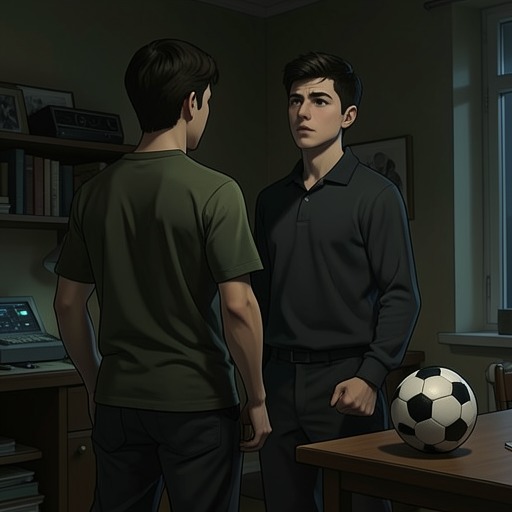
The globe rests on a small sideboard beside the living-room window while Alex Alexander faces punishment. His father has sentenced him to ten days of Grounding with a complete Soccer ban and has removed three garbage bags of soccer equipment, gear that Alex spent more than five years saving for. Watching the bags carried through the gate toward a waiting garbage truck, Alex is stone-faced, but the globe becomes the object through which his sense of injustice finds an outlet.
The globe’s ordinary function makes the scene especially pointed. It represents the whole round world at the exact moment Alex feels that no one can live without soccer. He handles it absentmindedly, then notices that the screws holding it to its stand are easy to remove. Once detached, the model is no longer safely displayed or transparently useful; its material weight and vulnerability become visible. The object is suddenly available for bodily action, and Alex converts the world itself into the ball his father has forbidden him to use.
Alex Alexander’s Globe Bicycle Kick
Alex first fires the globe repeatedly against the living-room wall. His private protest escalates when he declares that a complete soccer ban will not stop him. He lifts the globe with his knee until it rises almost to the ceiling, gathers momentum with his left leg, and executes the bicycle kick he has imagined. His right foot strikes the coast of Madagascar, and the globe shoots toward the wall like a cannonball.
The result is both athletic imitation and domestic catastrophe. The globe rebounds through the only surviving living-room window in an explosion of glass. Outside the gate, Alex’s father is watching the garbage truck depart with the soccer gear when the globe crashes through the window and hits him in the head. The object has crossed the boundary between Alex’s controlled interior space and his father’s authority outside it, converting a symbolic act of resistance into direct physical consequence.
The globe also exposes the difference between soccer fantasy and household reality. Alex performs the movement as though the globe were a regulation ball, but its trajectory breaks a window and injures his father. The father then picks it up, throws it into the air, and launches it skyward with a shot impressive enough to impress Alex. That response mirrors Alex’s own action while restoring parental power: the forbidden object becomes evidence against him, and the punishment increases by ten more days, making twenty days of Grounding in total.
The End of the World
After the collision, the globe’s journey becomes an exaggerated spectacle. Alex watches it rise into the morning sky, pass the sun on its descent, strike the neighbor’s driveway, crack and bounce, and finally come to rest broken in half on the neighbor’s flower bed. The household object has been pushed beyond its intended scale, made to travel through the sky as though the entire world were a ball in play.
Its final break gives the episode its bleakest image. Alex’s father’s words cut as sharply as the glass scattered across the front lawn, while Alex remains absorbed in the globe’s flight. The destruction of the model parallels the collapse of Alex’s immediate freedom, the loss of his soccer equipment, the broken window, and the extension of his punishment. The globe does not literally end the world, but its fragmentation makes Alex’s private catastrophe visible. The broken world in the flower bed is the concrete shape of his belief that soccer, friendship, and ordinary life have all been taken away.
The Globe in Kevin’s Dream
The globe returns in Kevin’s dream after the Wild Soccer Bunch falls silent for Alex Alexander. The day after the incident is gray and colorless: the sun disappears behind low clouds, classmates discuss their Spring break plans, and the boys have nothing to say because Alex is grounded for twenty days. Against this emotional landscape, the dream replays the globe’s flight with comic and fantastical exaggeration.
Kevin sees Alex Alexander’s bicycle kick send the globe into the wall, through the window, and into his father’s head. Kevin laughs, climbs into the sky alongside the globe, circles the moon twice, and crashes back to Earth as the globe shatters. The object therefore carries the group’s mixed response: Alex’s punishment is genuinely sad, but the impossible scale of the incident also releases laughter and imaginative energy. The dream does not erase the damage; it transforms the damaged globe into a moving image through which Kevin processes fear, admiration, and helplessness.
The dream then reverses the object’s meaning. Kevin dislikes sad dreams, but snow around the globe melts and the first daffodils appear. The broken world is surrounded by the first signs of Spring. In that transition, the globe becomes more than a record of Alex’s punishment: it is a hinge between the gray aftermath and the possibility of renewal. Its destruction belongs to the past, yet the dream gives the fragments a seasonal future.
Symbolic and Narrative Significance
The globe’s decisive function is to connect personal rebellion with collective consequence. Alex uses it because his real soccer equipment has been confiscated, but the substitute object carries an entire world on its surface. When he kicks Madagascar and sends the model through the window, soccer is no longer confined to the soccer field or to the equipment removed by his father. It has invaded the home, struck authority, and made the phrase “soccer ban” impossible to sustain as a purely verbal rule.
The object also anticipates the Wild Soccer Bunch’s later use of daring soccer technique under pressure. During the decisive match, Alex Alexander contributes to a passing sequence and later thunders a shot that carries the ball into the goal with Octopus. The globe is not used in that match, but the earlier bicycle kick remains part of the group’s imaginative vocabulary: an outrageous domestic act is recast as evidence of Alex’s wildness and sacrifice for his friends. The boys’ later battle cry, “ONE, TWO, THREE WILD!”, belongs to the same transformation of imposed restriction into collective energy.
By the end of the match, the team wins, and Roger is carried across the field on the players’ shoulders. That communal victory contrasts with the solitary image of Alex standing stunned in the shattered window beside his father. The globe belongs to the story’s earlier world of isolation, punishment, and broken boundaries, yet its dream image of melting snow helps prepare the movement toward restored color and action. As an object, it matters because it is never merely decorative: it records the cost of defiance, embodies Alex’s refusal to accept a world without soccer, and survives in memory as a broken but generative image of change.