Tyler
Kevin the Star StrikerTyler is Kevin’s older brother and the Wild Bunch’s number 10, the player Kevin identifies as both the team’s brains and its heart. Their relationship combines irritation, dependence, rivalry, and unmistakable pride: Tyler can drive Kevin crazy, yet Kevin insists that the team cannot function without him. Tyler’s defining quality is persistence. He keeps going when others accept defeat, and his influence helps transform the Wild Bunch from a group frightened by the Unbeatables into a coordinated team capable of winning.
Identity and Place in the Team
Tyler is introduced through Kevin’s intimate, sometimes exasperated account of family life. Kevin calls him a pain in the manner of an older brother, but immediately balances the complaint with the recognition that a brother is necessary “like the air you breathe.” On the soccer field, Tyler’s importance is even clearer. As number 10, he directs play from midfield, supplies intelligence, and gives the team its emotional endurance. Kevin’s description makes Tyler more than a talented player: he is the organizing force that keeps the Wild Bunch from falling apart.
Tyler’s persistence also distinguishes him from Danny. Danny is Kevin’s best friend and the world’s fastest right forward, while Tyler is the player who gives the team structure and refuses to abandon a difficult situation. The contrast does not weaken Danny’s importance; it clarifies Tyler’s particular function. Speed belongs to Danny, but direction and resilience belong to Tyler.
Brotherly Conflict and Practical Cunning
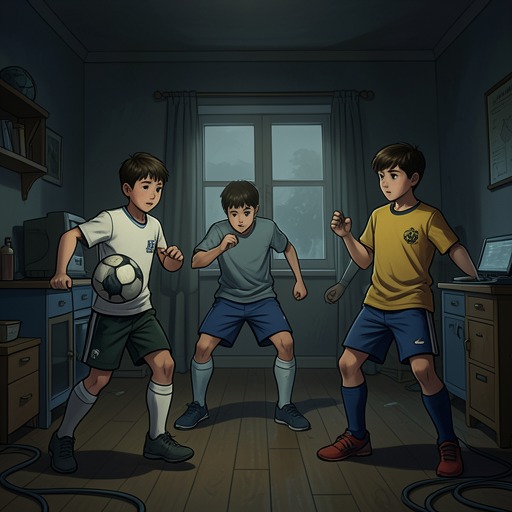
Tyler’s relationship with Kevin is full of friction, but the friction is productive. When the brothers are under Grounding after the broken lamp, Tyler devises a way to help Kevin get outside with his soccer ball without openly confronting their father. He points out that Kevin could not simply walk into the room carrying the ball and expect permission to play, because their father would remember both the broken lamp and the punishment. The plan works, and Kevin privately admits that Tyler was right for once and that the trick was clever, even though he refuses to praise him directly.
The exchange ends not with sentimentality but with their familiar verbal sparring. Kevin calls Tyler a pain, Tyler answers in kind, and then tosses the ball back to him, declaring that this is why they are brothers. The moment gives their bond its characteristic shape: affection is expressed through argument, mockery, and practical help rather than through open tenderness. Tyler’s annoyance is therefore not the opposite of loyalty. It is one of the forms that loyalty takes between them.
From Fear to Collective Action
Tyler’s refusal to give up becomes most important when the Unbeatables occupy the soccer field and Mickey the Bulldozer appears with his intimidating group. The Wild Bunch are confronted by opponents who are larger, stronger, and surrounded by reputations that make the team lose confidence. With Diego coughing and the group slumped on the curb, Tyler is the one who breaks the silence and states that the situation will not be solved without a plan. His question to Julian about making a new soccer field out of thin air is sarcastic, but the underlying demand is serious: fear must be answered with strategy rather than paralysis.
Tyler initially struggles to accept Larry’s teaching that fear can be a strength. When Larry says that the team’s fear gives it a chance against the Unbeatables, the boys do not understand him. Tyler’s later behavior, however, gives the idea practical meaning. He continues organizing play while frightened, and his courage is not presented as the absence of fear. It is the capacity to keep acting while fear remains present. This creates a sharp contrast with Mickey’s model of toughness, which depends on intimidation, domination, and the appearance of being afraid of nothing. Tyler’s leadership belongs to a different kind of strength: persistence, cooperation, and trust.
The Final Match and the Discipline of Passing
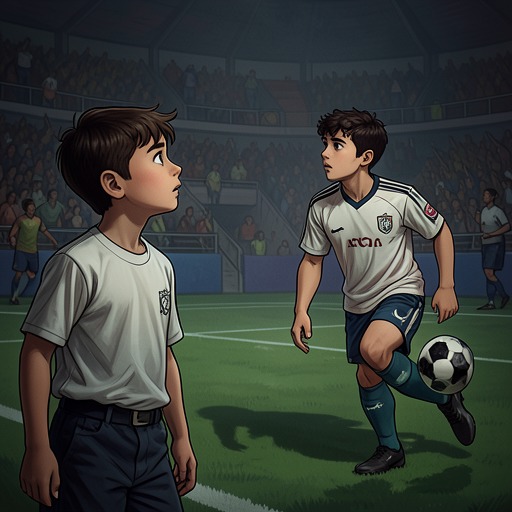
In the decisive match, Tyler’s role is visible in the rhythm of the Wild Bunch’s comeback. The team begins the sequence with the cry “ONE, TWO, THREE WILD!” and immediately moves through coordinated passes involving Alex, Tyler, Danny, Kevin, and Joey. Later, Tyler runs directly toward the goal while Mow-down, Juggernaut Jim, and Humungous Henry close around him. Instead of forcing the attack, he passes to Danny, who sends the ball across the field for Kevin. The move eventually allows Alex to score the Wild Bunch’s first goal.
Tyler’s play is especially significant because the match tests individual ambition against collective discipline. The Wild Bunch are losing heavily, and Kevin wants to score the tenth goal himself. Tyler, by contrast, repeatedly makes the pass that keeps the attack alive. When the rain turns the ground muddy, the training on the mud field becomes an advantage, and Tyler controls midfield while the Unbeatables slide. His shot from halfway across the field is carried by a gust of wind into the goal, putting the Wild Bunch ahead. The goal is both technically improbable and narratively fitting: Tyler’s intelligence and persistence convert hostile conditions into an opportunity.
The match then exposes the danger of abandoning the team’s principles. Kevin loses the ball because he refuses to pass, and Larry removes him from the field. The score moves from seven to four to seven-seven, then to eight and nine for the Wild Bunch, before the Grim Reaper equalizes at nine-nine. Tyler remains the number 10 at the center of this mounting pressure, while Kevin finally promises that he will pass. The victory is completed when Roger scores the winning goal, not when Kevin claims the decisive moment. Tyler’s role in the result is therefore part of the story’s larger correction of individual heroism: the Wild Bunch win through coordinated action, not through one player’s desire to become the sole star.
Change, Meaning, and Ending
Tyler does not undergo a dramatic conversion from cowardice to bravery. His arc is subtler and more consistent: he begins as the boy who already refuses to give up, but the crisis teaches the others to recognize the value of that refusal and to place it within a team strategy. Even during the night after the disastrous training session, when the players believe Larry lied and that everything they learned was worthless, Tyler continues resisting the conclusion that they are defeated. At around three in the morning he insists that they beat Sox, and he repeats the claim later despite the others’ despair. His persistence is painful in that moment, but it also preserves the possibility of recovery.
Tyler’s significance lies in the way he links family, football, and masculinity without reducing strength to aggression. The book surrounds him with competing versions of boyhood: Mickey the Bulldozer embodies physical dominance and contempt, while the Wild Bunch gradually learns that acknowledging fear, trusting a coach, protecting teammates, and passing the ball are also forms of courage. Tyler is the clearest bridge between the older language of never giving up and the newer collective practice that makes perseverance effective. His final position is not that of a solitary champion. He remains the team’s number 10, the brother who irritates Kevin, and the player whose refusal to surrender helps the whole Wild Bunch become capable of winning.