Wild Bunch–Unbeatables Soccer-Field Challenge
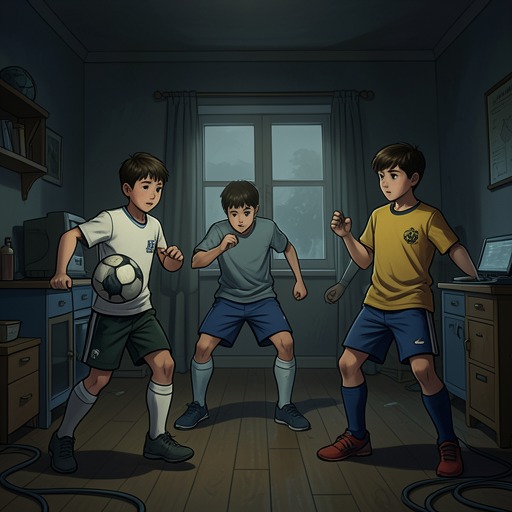
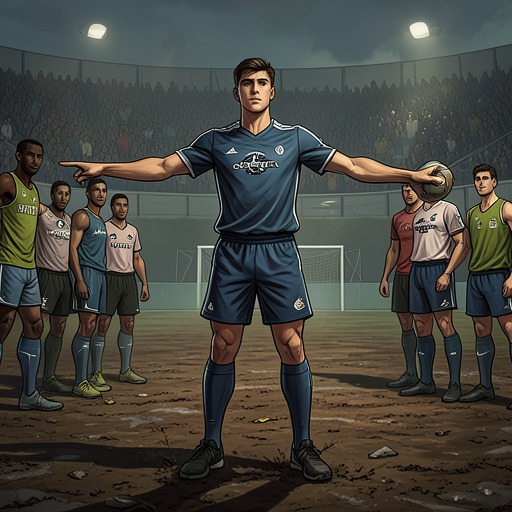
Kevin the Star StrikerWild Bunch–Unbeatables Soccer-Field Challenge is the central agreement that turns a physical occupation of the soccer field into a formally contested soccer match. It gives the Wild Bunch a fixed chance to reclaim their field, but its terms are repeatedly shaped by the stronger side, so that the match becomes both a sporting contest and a struggle over who may define fairness, belonging, and power.
Origins and Stakes
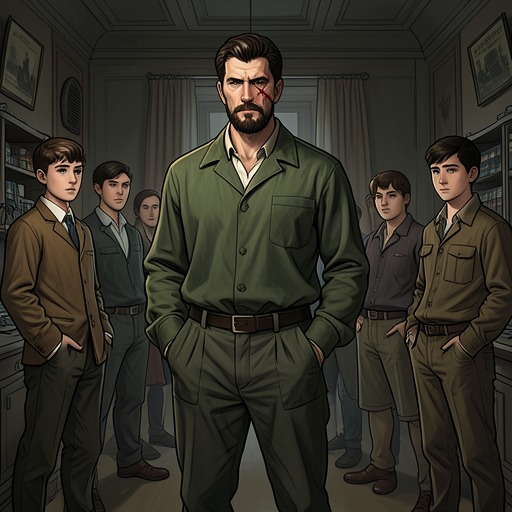
The challenge arises after Mickey the Bulldozer and his followers announce that the field belongs exclusively to the Unbeatables. Mickey presents the takeover as an immediate rule of possession: the Wild Bunch and every other former user are told to leave. His authority rests not on an accepted decision but on intimidation, physical size, and the group surrounding him. The field therefore becomes more than a place to play; it becomes the territory through which the Unbeatables display dominance.
Kevin answers by converting the exclusion into a challenge. He gives Mickey two weeks, and not a day more, to pretend that the field is theirs before the Wild Bunch returns to play for it. The proposed consequence is absolute: if the Unbeatables win, the field remains theirs, but if the Wild Bunch wins, Mickey must take his followers elsewhere and surrender the field permanently. Kevin’s threat is reckless enough to frighten his teammates, yet it gives their dispossession a deadline, a public opponent, and a possible remedy.
Mickey accepts the deal after Kevin refuses to retreat from the confrontation. Mickey claims not to know what fear is, but his acceptance makes the challenge binding. The Wild Bunch leave the field shouting as though victory has already been achieved, while the terms still require them to survive a contest against the team that has physically displaced them.
Authority and the Choice of Weapons
The agreement contains a principle that lets the challenged side choose the conditions of play: “That’s how it is with duels. The one who’s been challenged gets to choose the weapons.” In practice, this principle does not make the contest equal. Mickey uses his position as the dominant team to select conditions that favor the Unbeatables, including play with the sun in the Wild Bunch’s eyes. The language of a duel gives the arrangement a ceremonial fairness, while the actual choice reveals how rules can preserve an unequal balance of power.
Mickey also proposes that the match continue until one team has scored ten goals. He treats the condition as a convenience, expecting to return home within twenty minutes because he assumes the Unbeatables will overwhelm their opponents quickly. The ten-goal limit thus functions both as a scoring rule and as a declaration of confidence: Mickey imagines the match as a short demonstration of superiority rather than an uncertain competition.
The Wild Bunch’s challenge is consequently tested against more than skill. The team must play inside conditions selected by an opponent who controls the field, the atmosphere, and the apparent authority to interpret the contest. The match’s stakes are territorial and communal, while Mickey approaches it as another performance of personal power.
Rules Under Pressure
The Unbeatables repeatedly turn the match’s rule system into a license for aggression. When the Grim Reaper pushes Tyler to the ground, Kevin protests that the action is a foul. Mickey answers, “Body contact. Totally allowed.” The declaration changes the meaning of the game at once: contact that would ordinarily threaten the contest’s sporting character is reclassified as permissible because Mickey says so. Julian is then struck in the eye by Mickey’s elbow while trying to reach the ball, showing the physical consequence of this imposed interpretation.
The Wild Bunch’s fear is part of the rule’s pressure. Before the challenge, Diego asks what can be done about their fear, and Larry answers that fear is their strength. The agreement requires the players to acknowledge the danger rather than pretend that they possess Mickey’s invulnerability. Mickey’s model of competition suppresses fear beneath taunts and violence; the Wild Bunch’s emerging model treats fear as something that can be shared, understood, and transformed into disciplined action.
The difference becomes visible in the match’s movement. After seven minutes, Mickey has scored five goals himself, while Julian, Tyler, and Kevin are injured on the grass. Kyle and Joey sit beside them, and Kyle cautiously observes that the game has not gone as planned. Joey’s response refuses surrender, asserting that the last laugh has not yet been decided. The challenge therefore remains open even when the score and the bodies appear to confirm the Unbeatables’ authority.
Restorative Stakes and Collective Identity
Roger adds a further condition: the losing team must repair Larry’s stand. This rule extends the consequences beyond the field. Victory will not merely determine possession; defeat will create an obligation to restore something damaged in the surrounding community. The condition introduces responsibility into a contest otherwise dominated by insults, territorial claims, and bodily force.
The repair rule also contrasts with the Unbeatables’ treatment of the field. Mickey’s declaration excludes others and treats possession as the right to expel them. Roger’s condition links competition to restitution: whoever loses must repair Larry’s stand, acknowledging that conflict affects people and objects beyond the immediate players. The rule gives the match a restorative dimension without erasing its antagonism.
The Wild Bunch’s response is collective rather than individual. They stand shoulder to shoulder and roar, “ONE, TWO, THREE WILD!” before launching a coordinated passing sequence involving Kevin, Alex, Tyler, Danny, Joey, Julian, and the other players. The sequence matters because it answers Mickey’s solitary dominance with combination and trust. Even while the Unbeatables hold the advantage and the ball eventually reaches Mickey for another goal, the chant and passing pattern make the challenge a test of whether the Wild Bunch can remain a team under pressure.
Meaning and Legacy
The challenge transforms the soccer field into a miniature society with boundaries, membership, deadlines, chosen conditions, scoring limits, permitted contact, and penalties. Yet the contest also demonstrates that rules do not automatically produce fairness. A rule may provide a public framework for resolving conflict, or it may be manipulated by the stronger party to make domination appear legitimate. The Wild Bunch–Unbeatables Soccer-Field Challenge holds both possibilities together.
Its deepest contrast is between two forms of strength. Mickey’s strength is expressed through size, fearlessness, humiliation, and unilateral command. The Wild Bunch’s strength develops through honesty about fear, reliance on teammates, coordinated passing, and willingness to accept consequences. Danny’s importance as Kevin’s fastest right forward, Tyler’s role as the team’s number 10 and strategic heart, and the broader team identity all support the idea that the field can be reclaimed only as a collective enterprise.
The agreement also anticipates a later, more inclusive understanding of the team. The Wild Bunch initially treats membership narrowly, while Zoe’s later wish to join despite being the only girl reveals that belonging remains contested. Her determination to become the first woman to play for the United States men's national soccer team places the earlier struggle over access to the field in a wider frame: a field claimed by force can exclude, but a field defended through shared rules can become a place whose membership must continue to be challenged and renegotiated.