Yaxiao Team and Sox's Partnership
Kevin the Star StrikerThe Wild Bunch–Sox relationship is a partnership between the eleven young players and Kevin’s dog, Sox. At first, the boys describe Sox as more than a cute pet but still treat him as a complication to be managed. Through the team’s training and decisive match, however, Sox moves from the edge of the group into its emotional and practical center: he disrupts practice, becomes the subject of a demanding soccer exercise, helps create the team’s shared ritual, and finally confronts the Unbeatables when victory alone cannot protect the field.
Identity and Place in the Wild Bunch
Sox is introduced through Kevin’s insistence that the Wild Bunch are not merely eleven friends and a cute dog. Kevin presents the dog as part of what makes the group “dangerous and wild,” rejecting the idea that Sox is decorative or incidental. The wording establishes a tension that the later episodes develop: Sox is loved as a companion, but his animal nature does not fit neatly into the boys’ plans for disciplined soccer.
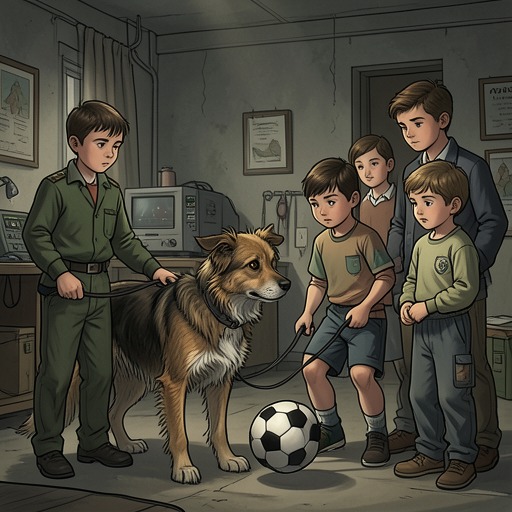
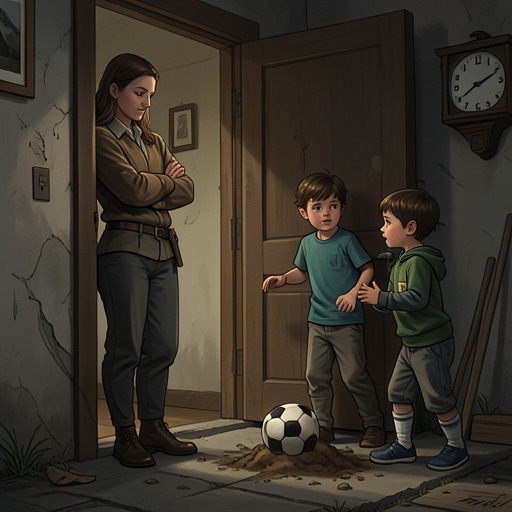
The dog’s place in the group is also shaped by the promise Kevin and Tyler made when their father bought him. They had promised to take good care of Sox every day. That promise becomes binding when their father allows them to recover their soccer ball only on the condition that Sox accompany them to practice. The boys immediately object that Sox will ruin the session, but their father’s reminder forces them to recognize that team ambitions do not cancel responsibility for an animal who depends on them.
From Obstacle to Training Partner
The boys initially imagine Sox as uncontrollable. They expect him to chase every ball, comparing his likely behavior to a dog running after a mailman. Their complaint that he is a “total pain” reflects a human-centered view of training: the session is designed around the players’ needs, while Sox appears to be a distraction that must be restrained.
Larry reverses that arrangement by making Sox the central opponent in a passing exercise. Rather than asking the dog to remain quietly beside the field, he places Sox in the center and challenges the players to pass the ball ten times before Sox can grab it. The boys protest that the exercise is unfair and argue that seven players should easily defeat one dog. Larry’s method nevertheless turns Sox’s instinctive pursuit into a test of the team’s coordination, awareness, and collective movement.
The result changes the meaning of Sox’s disruption. The ball moves through the players’ ranks as they reach the seventh and eighth passes, then the ninth and tenth, while Sox runs between them without success. He finally gives up at number seventeen, yelps angrily, pants, barks once more, and retreats beneath a tree, covering his eyes with his paws until Kevin puts him on the leash. The scene is comic, but it also grants Sox an independent response: he is not simply an instrument in Larry’s lesson. He becomes a participant with his own energy, frustration, and limit.
Shared Ritual and Team Belonging
The passing challenge produces one of the Wild Bunch’s first fully collective celebrations. After Sox has been stopped, the players embrace one another and embrace Larry before forming their circle. Larry counts to three, and the boys shout their battle cry, “ONE, TWO, THREE WILD!” The ritual emerges directly from the encounter with Sox, so the dog’s failed attempt to win the ball becomes part of the team’s origin story.
Sox answers the battle cry with a mocking “woof.” That response keeps the relationship from becoming sentimental or purely obedient. He remains playful, resistant, and unmistakably canine. Yet his mockery also places him inside the group’s language and rhythm. The Wild Bunch’s identity is not built by eliminating difference; it is built by absorbing Sox’s unruly presence into the team’s shared performance.
This partnership contrasts with the Unbeatables’ claim that the soccer field belongs to them alone. Mickey declares that only the Unbeatables may play there and orders the others to leave. Kevin answers by challenging them to a match for possession of the field. The boys’ bond with Sox therefore exists within a wider conflict over who has the right to belong. The Wild Bunch define themselves through cooperation and attachment, while the Unbeatables define belonging through exclusion.
Sox During the Decisive Match
Sox is not presented as a conventional soccer player during the final contest, and the match’s action is carried by the boys. The team opens with its battle cry and executes a rapid sequence involving Kevin, Alex, Tyler, Danny, and Joey, while the Unbeatables respond through their powerful goalkeeper Octopus and their physical attackers. Later, the Wild Bunch’s training on soft, muddy ground allows them to exploit conditions that make the Unbeatables slide and struggle. Their comeback moves from seven–one to seven–seven, then to a lead, a nine–nine tie, and finally victory.
Although Sox does not score or make a save, the training exercise with him has already entered the team’s competitive formation. Larry’s challenge taught the players to move the ball collectively rather than rely on individual speed or force. That principle becomes crucial when Kevin refuses to pass in pursuit of a tenth goal and Larry removes him from the field. The victory is completed only after Roger scores the winning goal, while Kyle’s desperate save prevents the Unbeatables from finishing the match first. Sox’s contribution is therefore indirect but concrete: he helped turn passing into a practiced form of trust.
The match also shows why Sox cannot be reduced to a training device. After the Wild Bunch win, the Unbeatables continue to threaten them and deny that the field is now theirs. The boys retreat helplessly despite their victory. At that moment Josh and Sox appear behind them, and Sox lifts his chops to display his teeth. The Bulldozer’s confidence falters, and he asks who Sox is. The dog’s physical presence changes the balance of the confrontation when the team’s formal victory has failed to secure its safety.
Significance and Development
The relationship develops from care, through irritation, into reciprocal belonging. Kevin and Tyler are responsible for Sox because they promised to care for him, but the story gradually shows that Sox also protects and strengthens them. His inability to follow the boys’ preferred training pattern becomes the basis for a useful exercise; his playful “woof” becomes part of the team’s ritual; and his final growl gives the Wild Bunch an ally when the Unbeatables attempt to override the result of the match.
Sox also complicates the book’s idea of wildness. The boys call themselves wild because they resist intimidation and play as a united group, while Sox is wild in a more literal, bodily sense: he chases the ball, ignores the intended structure of practice, gives up on his own terms, and answers danger with teeth. The partnership joins these forms of wildness without making them identical. The boys learn discipline through passing and trust, while Sox remains an animal presence that cannot be fully absorbed into human rules.
By the ending, Sox is both dependent companion and active teammate. He needs the boys to put him on the leash after training, yet the boys need his presence when the Unbeatables continue their intimidation. The relationship’s decisive significance lies in that mutuality. The Wild Bunch do not win because Sox becomes a human soccer player; they win, and endure the aftermath, because the group makes room for a different kind of partner whose loyalty is expressed through play, persistence, and physical protection.