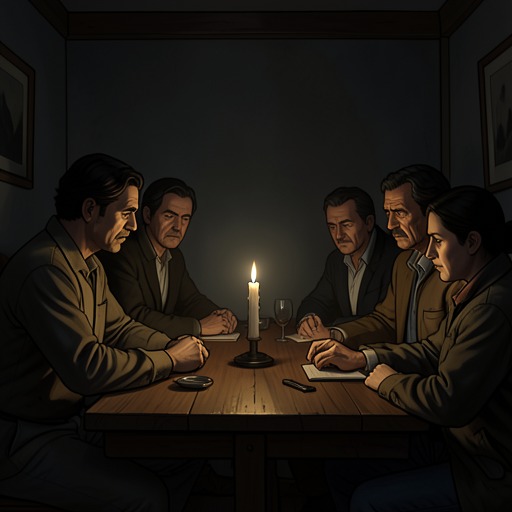
A. W. Comstock, Osage attorney
Killers of the Flower MoonA. W. Comstock, Osage attorney was a local lawyer and guardian to several Osage people who became an occasional intermediary in the investigations of the Osage murders. He offered detectives access to information circulating through his local network, yet his own past and privileged position made him difficult to assess. In a county where the guardianship system placed Osage finances under white control, he was both a possible investigative resource and part of the system surrounding the people the detectives sought to protect.
Identity and Position
A. W. Comstock, Osage attorney appeared in Gray Horse settlement one summer carrying a .44-caliber, snub-nosed English Bulldog revolver and offering assistance to the private detectives. He had an aquiline nose and tan complexion; some local people thought he might be part American Indian, an impression he did little to discourage as he built his legal practice. Another lawyer questioned whether presenting himself that way helped him get along with Osage people. The account records the suspicion, not proof of any false claim about his ancestry.
His work as a guardian placed him in a consequential position within the financial lives of several Osage people. The federal government had required the Office of Indian Affairs to decide which Osage people it considered capable of managing their trust funds. Many, including Anna Brown and Lizzie, were classified as “incompetent” and required to have a local white guardian authorize their spending, even for ordinary purchases. Guardians commonly came from the most prominent white citizens in the county. A. W. Comstock, Osage attorney’s legal and guardianship roles therefore brought him into contact with Osage families while also locating him within an imposed structure of financial oversight.
Information and the Whitehorn and Brown Cases
The private detectives took up A. W. Comstock, Osage attorney’s offer because of his numerous contacts among the Osage. They were trying to determine whether the slayings of Charles Whitehorn and Anna Brown were connected. Through his informants, he passed on talk that Whitehorn’s widow, Hattie, had coveted her husband’s money and had been jealous of his relationship with another woman. That led investigators to consider whether the woman might have been Anna and whether Whitehorn could have fathered Anna’s baby. These were investigative possibilities prompted by local chatter, not established findings.
Detectives followed Hattie Whitehorn between Pawhuska, Oklahoma City, Guthrie, and Tulsa, but the surveillance produced no developments. By February 1922, nine months after the murders of Whitehorn and Anna, the investigations appeared to have stalled. Pike, the private detective William K. Hale had recruited, had moved on, and Sheriff Harve M. Freas had been expelled from office after a jury found him guilty of failing to enforce the law. A. W. Comstock, Osage attorney’s information had helped direct attention toward a possible connection between the cases, but the leads described here did not resolve either murder.
A Questionable but Useful Intermediary
A. W. Comstock, Osage attorney’s relationship with investigators carried an unresolved complication. William J. Burns had previously investigated him for allegedly helping an oil company devise a scheme to bribe the Osage Tribal Council in pursuit of a favorable lease. The charge was never proven. The earlier allegation did not prevent detectives from accepting his offer of assistance, but it meant that his access and usefulness could not simply be equated with trustworthiness.
The uncertainty persisted when the federal investigation resumed under Agent Burger and T. B. White. A. W. Comstock, Osage attorney told investigators he believed he could obtain critical evidence if he could see the Bureau of Investigation’s files. T. B. White refused to disclose confidential records. Even so, A. W. Comstock, Osage attorney continued to visit, offer information, and ask how the investigation was progressing, then leave carrying his English Bulldog revolver. The repeated visits kept him close to the inquiry without giving him access to its confidential contents; the investigators accepted what he might learn from his contacts while maintaining a boundary around their own files.
Public Criticism and the Investigation’s Stakes
A. W. Comstock, Osage attorney also carried his criticism of the federal inquiry beyond the investigators. He personally briefed Senator Charles Curtis about the Bureau of Investigation’s disastrous handling of its work in Osage County. John Palmer, a prominent advocate for the Osage, separately wrote to Curtis that murderers might have been financially and politically powerful enough to remove honest officers or quiet dishonest ones. The account places these complaints amid mounting scrutiny of the bureau, including criticism from Oklahoma’s attorney general, and a growing risk of scandal for its director, J. Edgar Hoover.
The wider legal setting helps explain why failures in the investigation mattered. Officials concluded that many killings on allotted surface land could be prosecuted only by the state, where William K. Hale’s influence made a trial dangerous. The murder of Henry Roan offered a different jurisdictional basis: Roan was killed on an Osage allotment that had not been sold to white people, and its owner was a ward of the federal government. Prosecutors proceeded with that case in federal court. The account does not assign A. W. Comstock, Osage attorney a role in deciding that jurisdiction; his documented contribution was to expose the bureau’s failures to a senator and to provide investigators with local leads. His mixed position—as guardian, local lawyer, informant, and critic—shows how much the inquiry depended on people embedded in the same contested local power structure it was trying to penetrate.