Anti-Indigenous racism
Killers of the Flower MoonAnti-Indigenous racism is presented as a governing structure as well as a prejudice: it takes land, imposes assimilation, classifies Osage people as incapable of managing their own property, and casts doubt on whether their deaths will receive equal justice. Across the book, coercion appears in treaties and administrative rules as well as in murder, while Osage testimony and memory expose the human consequences of those systems.
Land, coercion, and settlement
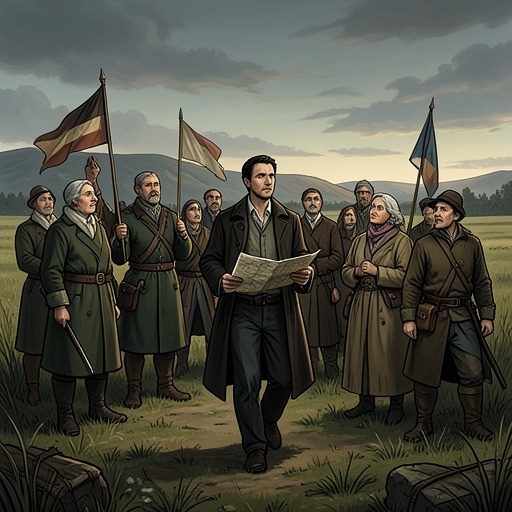
The history begins with a widening gap between the language of friendship and the exercise of power. After a delegation of Osage chiefs met with the president in 1804, the government soon compelled the Osage to give up territory between the Arkansas and Missouri rivers. An Osage chief said his people “had no choice, they must either sign the treaty or be declared enemies of the United States.” Over the following two decades, the Osage ceded nearly a hundred million acres and were eventually concentrated in a 50-by-125-mile area in southeastern Kansas. The book presents that history not as a single agreement freely made, but as a sustained loss of ancestral land under threat.
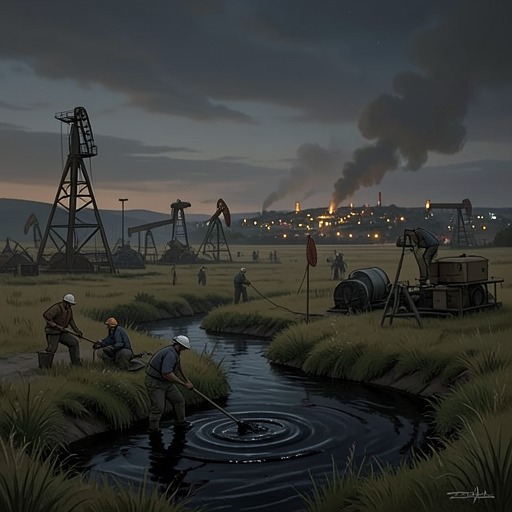
The seizure continued through settlement. In 1870, after being expelled from their lodges and seeing graves plundered, the Osage agreed to sell their Kansas lands to settlers for $1.25 an acre. Settlers nevertheless massacred several Osage, mutilated their bodies, and scalped them. An Indian Affairs agent asked, “The question will suggest itself, which of these people are the savages?” The question reverses the accusation often used to justify colonial violence: the conduct of the settlers, not the Osage, supplies its evidence. When the Osage considered purchasing land from the Cherokee in Indian Territory, white observers described the hilly country as “broken, rocky, sterile, and utterly unfit for cultivation.” The terrain whites dismissed as worthless was also a hoped-for refuge from further encroachment.
Assimilation and the making of dependency
The book shows coercion continuing through policy directed at children. In 1894, when Mollie Burkhart was seven, her parents were told to enroll her at St. Louis School, a Catholic boarding institution for girls in Pawhuska. The government’s stated principle was that “The Indian must conform to the white man’s ways, peacefully if they will, forcibly if they must.” Mollie’s parents were warned that failure to comply could mean the loss of annuity payments, leaving the family without that support. In March, Mollie was taken from her family by wagon. Her removal makes the policy concrete: assimilation was not simply an appeal to adopt another culture, but a demand backed by the threat of economic deprivation and separation from home.
Financial guardianship imposed a related form of control on Osage adults. The Office of Indian Affairs determined who could manage trust funds, and many Osage, including Lizzie and Anna Brown, were designated “incompetent.” A local white guardian then had to oversee and authorize their spending, even for ordinary purchases such as toothpaste. The book describes a system in which legal capacity was assigned along racial lines, not simply according to an individual’s demonstrated ability. One Osage veteran of World War I protested, “I fought in France for this country, and yet I am not allowed even to sign my own checks.” Military service did not dislodge the racial presumption that made the person a ward.
Wealth under racial control
The federal government’s scrutiny extended from individual purchases to public hearings. In 1920, a House subcommittee examined an inspector’s report on Osage spending, including the expenses of Mollie’s family. Lawmakers singled out “Exhibit Q,” a $319.05 butcher-shop bill run up by Lizzie before her death. The close examination of that bill contrasts with the larger question of who had the authority to decide how Osage families could use their own money.
The criteria for guardianship sharpened the racial distinction. The book reports that the decision was nearly always based on the property holder’s quantum of Indigenous blood, a practice a state supreme court justice called “racial weakness.” A full-blooded American Indian was invariably appointed a guardian, while a mixed-blood person rarely was. In 1921, Congress added another restriction: Osage people with guardians could withdraw only a few thousand dollars a year from their trust funds. The limit applied even when money was needed for education or a sick child’s hospital bills. The last hereditary chief objected that the Osage wanted to raise and educate their children and did not want their own money held back by someone who cared nothing for them. Mollie, as a full-blooded Osage, was restricted; her husband, Ernest Burkhart, was her guardian. The arrangement placed control of her resources inside the same family structure later implicated in the crimes against her.
Violence, investigation, and unequal justice
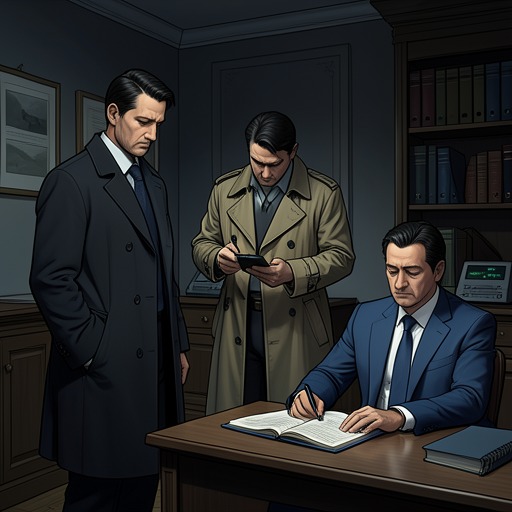
The murders unfolded amid an assumption of impunity. When John Burger investigated the murder of Henry Roan, John Ramsey referred to Osage people simply as “the Indian.” Ramsey said that white people in Oklahoma thought no more of killing an Indian than they did in 1724. His words make explicit the racial contempt that the crimes exploited. They also help explain why the investigation could not rely on the expectation that white citizens would accuse one of their own: Tom White concluded that prejudiced and corrupt white residents would not implicate another white person in the killing of American Indians, and shifted his search toward outlaws who might be pressured to cooperate.
The trial of William K. Hale and Ramsey placed the racial stakes before the jury without resolving them in advance. A prominent Osage member wondered whether the jurors were deciding a murder case or whether, for them, killing an Osage counted as “merely cruelty to animals.” Hale and Ramsey were ultimately found guilty of first-degree murder in Roan’s death and sentenced to life imprisonment. The judge noted that first-degree murder could carry the death penalty, but the jury had qualified its verdict with life imprisonment. The conviction was consequential; its limit mattered too. The jury punished the killers, but would not sentence them to death for killing an Osage man.
Memory and the authority to remember
The book’s account also traces who gets to preserve and interpret this history. In 2012, the author visited the Osage Nation Museum and saw a panoramic photograph of a 1924 ceremony with a panel missing. Kathryn Red Corn showed him the removed image of Hale. The Osage had not removed it because they had forgotten the murders, but because they could not forget. Red Corn also recounted the recovery and burial of Anna Brown’s skull, which had been kept by an undertaker and later passed to another man. At Red Corn’s urging, the remains were returned and interred with Brown’s other remains. These acts give the community a role not merely as the subject of historical investigation, but as a keeper of the dead and a participant in deciding how painful evidence is shown.
Red Corn explained that the murders were difficult to discuss because so many Osage had lost close relatives and that the pain did not go away. The author describes relying on Osage contributors, interviews with family members, and materials supplied by descendants, alongside government, court, and investigative records. That method matters to the book’s treatment of racism: institutional files do not alone define what happened or what should remain visible. Against a history in which Osage people were dispossessed, classified, and managed by others, their testimony and choices about remembrance assert continuing authority over their own history.