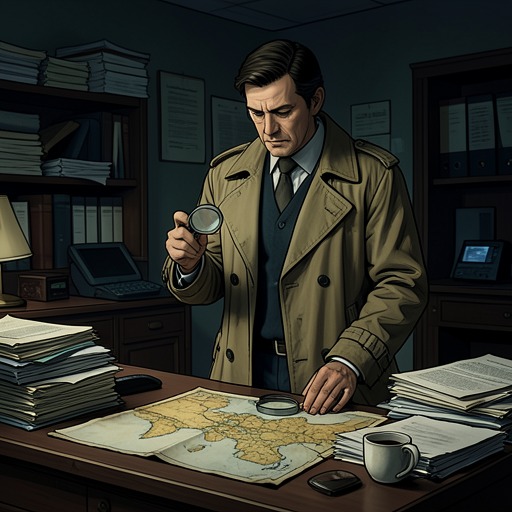
Burt Lawson
Killers of the Flower MoonBurt Lawson became a pivotal but unreliable witness in T. B. White’s investigation of the Osage murders. In October 1925, while serving a burglary sentence, he claimed that William K. Hale and Ernest Burkhart had recruited him to bomb Bill and Rita Smith’s home and that he had set off the explosive. His confession appeared to connect Hale directly to the attack; Lawson later repudiated it, saying he had lied and knew about the bombing only from jailhouse hearsay.
Background and Imprisonment
Lawson told investigators that he had begun working as a ranch hand for Bill Smith in 1918, and that through this work he came to know Hale and Hale’s nephews, Ernest and Bryan Burkhart. His relationship with Smith ended after Lawson said he discovered an intimacy between Smith and Lawson’s wife around the beginning of 1921. In Lawson’s account, the affair broke up his family and led him to leave Smith’s employment—a personal grievance that later gave investigators a possible context for Ernest’s approach to him.
Lawson had already faced serious charges before he became a witness in the murder investigation. In 1922 he was charged with killing a fisherman, but was acquitted after claiming the man had come at him with a knife. Less than three years later, he was convicted of second-degree burglary and sentenced to seven years in the state penitentiary at McAlester. It was there, in late October 1925, that an aide to the governor of Oklahoma told T. B. White about a prisoner who claimed to know a great deal about the Osage murders.
The Confession and the Smith House Bombing
T. B. White and Frank Smith went to McAlester to interview Lawson. White chose a room off the warden’s office, an unfamiliar setting he used to unsettle interviewees. Lawson told the investigators he wanted to make a clean breast of what he knew. In a signed statement, he said Ernest had approached him with a proposal to blow up Bill Smith and his wife. Lawson said he refused at first, after which Hale came to see him and offered $5,000 to carry out the job.
According to Lawson’s account, Hale explained how to use nitroglycerin and demonstrated with a length of white fuse, cutting off a short piece and lighting it. Lawson later described placing and lighting the fuse beneath the Smiths’ house. He said he hurried away as it burned, heard the house break apart, and was then picked up nearby by Hale and Ernest. They returned him to the jail, where another deputy smuggled him back into his cell. Before leaving, Hale allegedly warned him that he would be killed if he told anyone what had happened.
On October 24, 1925, three months after taking over the case, T. B. White wired J. Edgar Hoover that he had Lawson’s confession: Lawson said he had set off the explosive and had been persuaded, prompted, and assisted by Hale and Ernest. Hoover quickly congratulated White. For the investigation, the account seemed to offer a direct connection between the bombing and the men White was pursuing. But White and his investigators still needed to corroborate its details, and Lawson had not explained the suspected role of Asa Kirby, leaving an important gap in the account.
Retraction and Evidentiary Uncertainty
Lawson’s account did not hold. When Ernest Burkhart later spoke about Hale’s plan to kill Rita and Bill Smith, he said Lawson had nothing to do with the explosion and that investigators had the wrong man. Burkhart’s own account instead described a chain of attempted recruits and said that he had carried a message to John Ramsey for Asa Kirby. He also said that Hale had gone with Henry Grammer to Fort Worth to establish an alibi, while Ernest himself was at home with Mollie on the night of the explosion.
Lawson subsequently told T. B. White that his story about the Smith bombing had been a lie and that everything he knew about it came from what he had heard in jail. The retraction overturned the apparent certainty of his confession: his detailed description and accusation could no longer be treated as proof that he had planted the explosive or that Hale and Ernest had enlisted him. Lawson’s role in the investigation thus rests on a sharp reversal—from the prisoner whose statement gave White a promising lead to a recanting witness who said his account was invented.
Narrative Significance
Lawson’s shifting story illustrates the difference between obtaining a confession and establishing what happened. His initial account supplied the investigators with names, a proposed payment, a fuse demonstration, and a sequence for the bombing, and it brought White’s pursuit of Hale into a moment of apparent breakthrough. Yet the later denial, alongside Burkhart’s conflicting account, left the bomb plot’s testimony contested rather than resolved by Lawson alone. His appearance marks both the force and the fragility of a lead in an investigation where direct evidence was scarce and corroboration remained essential.