Discovery of oil on the Osage Reservation
Killers of the Flower MoonThe discovery of oil on the Osage Reservation turned an underground resource the Osage had deliberately retained into the foundation of a vast oil economy—and of a profound struggle over who would control its proceeds. The first signs appeared before the reservation’s mineral rights were secured; later gushers made the wealth spectacularly visible. But the oil’s value did not simply pass from the ground to the Osage: leases, headrights, guardianships, and the eventual decline of production shaped who benefited and who bore the costs.
Land, Minerals, and the First Signs
The discovery unfolded against a history of dispossession. After being compelled to relinquish territory between the Arkansas and Missouri Rivers and cede nearly a hundred million acres, the Osage were eventually driven from Kansas. In 1870 they agreed to sell their Kansas lands for $1.25 an acre, after settlers had already seized land and killed members of the tribe. The Osage then sought a new homeland in a region of northeastern Indian Territory that white observers considered rocky and unsuitable for cultivation. Decades later, oil beneath this land would make it among the most valuable territory in the country.
The Osage recognized that minerals mattered when negotiating the terms of allotment. During discussions with government officials, they secured an agreement to divide the land among tribal members, increasing individual allotments from 160 to 657 acres, while reserving the oil, gas, coal, and other minerals to the Osage Tribe. This provision protected a resource that could not be seen from the surface, even as individual surface parcels could later be sold. Under the 1906 agreement, each person on the tribal roll received a headright, a share in the tribal mineral trust. Headrights could not be bought or sold; they could only be inherited. The arrangement preserved collective control over mineral income in a form distinct from ownership of the land above it.
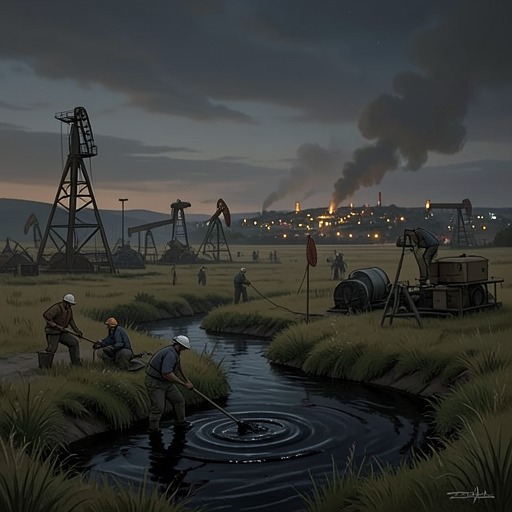
Evidence of oil had surfaced more than a decade before the allotment agreement. An Osage person showed John Florer, the owner of a trading post in Gray Horse, a rainbow sheen on a creek in the reservation’s eastern part. Florer dabbed a blanket into the liquid and squeezed it into a container. He recognized its smell as similar to axle grease sold at his store, then showed the sample to others, who confirmed that it was oil. With the Osage’s approval, Florer and a wealthy banking partner obtained a drilling lease. By the time the allotment terms were negotiated, several small wells were operating. The mineral reservation was therefore not merely a fortunate clause adopted in ignorance: it held on to a realm the Osage knew to exist, though they could not yet know the scale of the fortune beneath it.
Drilling and the Gushers
As the Osage leased more areas to white prospectors, drilling altered the landscape and brought unfamiliar labor and machinery into the reservation. Workers lowered torpedoes filled with nitroglycerin into wells and detonated them. At times the explosions brought fragments of ancient Indigenous spearpoints or arrowheads to the surface, remnants of an older human presence among the new structures built to reach the oil. Many prospectors found only dry wells, known as dusters, and left disappointed. The search was uncertain and often frantic, but every successful well could change the value of the surrounding land and the scale of the income flowing to the tribe.
A dramatic strike came in the spring of 1917 on Lot 185, less than half a mile from Lot 50. Frank Phillips, a wildcatter who had previously sold a baldness-prevention tonic, was on the drilling platform with his workers when the derrick began to tremble. A rumbling sound rose from the hole; the workers ran as the noise swelled. A driller pulled Phillips away from the platform just before the earth burst open and a black column of oil shot into the air. The scene condensed the risks and sudden reversals of drilling: a hole in the ground could yield nothing, or erupt into a forceful public display of wealth.
The strikes grew more remarkable. In 1920, E. W. Marland discovered the Burbank field, where a new well produced 680 barrels in its first twenty-four hours. Osage people rushed to watch gushers, moving close for a view while taking care not to cause a spark. Oil could rise fifty, sixty, or even a hundred feet above the rigging, then spray the fields and flowers and coat the faces of workers and spectators. People hugged and tossed their hats in celebration. The dark, foul-smelling substance that had come from deep underground could look, in the moment of its arrival, like a marvel. The spectacle made the oil’s abundance visible, but it did not reveal how unequally the authority over its proceeds might be exercised.
Royalties, Auctions, and Control of Wealth
As more oil was tapped, the financial transformation became measurable. Members of the tribe received quarterly payments that began at only a few dollars and grew over time into hundreds and then thousands. In 1923 alone, the tribe took in more than $30 million, an amount described as equivalent to more than $400 million in present-day money. The Osage were regarded as the wealthiest people per capita in the world. These figures registered both the success of preserving mineral rights and the exceptional scale of the oil deposits; they did not mean that every member had unrestricted access to their wealth.
Leasing created another arena in which the value of the underground reservation was negotiated. Auctions overseen by the Department of the Interior began in 1912 and were held about four times a year. Only a portion of the reservation had been opened to drilling, while bidding for an individual lease, typically covering 160 acres, rose sharply. The events drew oil barons to Pawhuska, capital of the Osage Nation, including E. W. Marland, Bill Skelly, Harry Sinclair, and Frank Phillips. In good weather, auctions took place beneath the Million Dollar Elm, with Osage spectators and local businesspeople watching. The leases brought money and commercial activity into the community, while concentrating the immediate contest over access to oil in the hands of bidders, officials, and those who managed the legal process.
The distinction between ownership of a headright and control over the money it generated became consequential. Many Osage were subject to restrictions on their finances and assigned white guardians to manage their affairs. Some guardians acted in their wards’ interests, but others exploited the system: they sold goods from their own businesses at inflated prices, directed clients to favored stores and banks in exchange for kickbacks, claimed to purchase property for wards while acquiring it for themselves, or stole outright. One government study estimated that guardians had taken at least $8 million directly from restricted Osage accounts before 1925. The oil discovery had made the mineral trust immensely valuable; guardianship then became a mechanism through which people entrusted to protect Osage wealth could divert it.
Decline and Aftermath
The boom did not last at its peak. The oil fields were gradually depleted, and the Great Depression brought a severe fall in prices and income. Oil that had sold for more than $3 a barrel during boom years fell to 65 cents in 1931. An annual headright payment dropped below $800 the following year. The change was especially stark in Gray Horse, where, as one resident later recalled, the wells that had once pumped nearby eventually stopped. The decline did not erase the history of the boom, but it made plain how closely income had depended on volatile oil prices and continued production.
More than ten thousand wells remained scattered across the reservation in the later period described in the book, but most were stripper wells producing fewer than fifteen barrels a day. At a 2012 auction in Tulsa, three leases sold for less than $15,000 altogether. A later headright holder still received quarterly payments from the mineral trust, but the amount varied with oil prices and usually came to only a few thousand dollars; it helped without providing enough to live on. The progression from creekside sheen to towering gusher, from millions in collective revenue to depleted wells and smaller checks, gives the discovery its double significance. It brought the Osage extraordinary wealth because their agreement had preserved mineral rights, while the subsequent contests over leases and the administration of income showed that keeping a share in the resource did not by itself secure control over every benefit it produced.