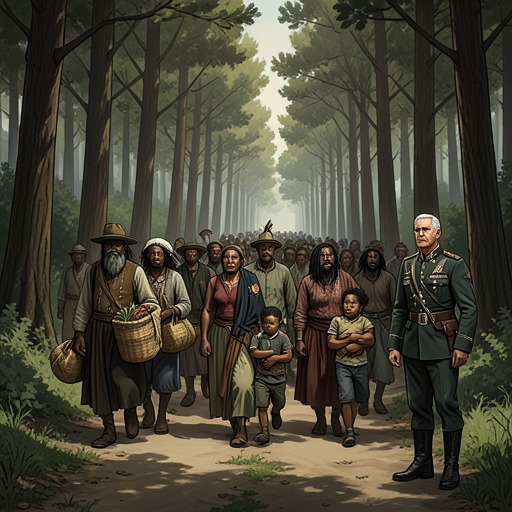
Every buffalo dead is an Indian gone
Killers of the Flower MoonEvery buffalo dead is an Indian gone is an army officer’s phrase for a policy that made the destruction of the American buffalo part of the pressure imposed on Indigenous peoples. In the history of the Osage, it connects the loss of an animal essential to the old way of life with a wider campaign of territorial dispossession and forced assimilation. The line is brief; the consequences it gathers are not.
The phrase and its setting
By 1877, virtually no American buffalo remained to hunt. The account says that this collapse was hastened by authorities who encouraged settlers to eradicate the animals, knowing the meaning of that destruction. The officer’s words therefore register more than a general observation about a changing landscape: they make explicit the relationship between the killing of buffalo and the weakening of Indigenous life. The phrase does not describe the buffalo’s disappearance as an accidental by-product of settlement; it places that disappearance within a policy that understood its human consequences.
That policy followed earlier attacks on Osage independence and control of territory. After the United States acquired Louisiana in 1803, President Thomas Jefferson met Osage chiefs and spoke of friendship and kinship. Within four years, however, the Osage had been compelled to relinquish territory between the Arkansas and Missouri rivers. Over the next two decades they ceded nearly a hundred million acres and were confined to a 50-by-125-mile area in southeastern Kansas. In 1870, after being expelled from their lodges and seeing their graves plundered, they agreed to sell their Kansas lands to settlers for $1.25 an acre; settlers nevertheless massacred several Osage people. Against this history, the officer’s phrase points to an accumulating process of dispossession, not a single loss.
From hunting grounds to hunger
Buffalo hunting remained important on the new reservation, not only as a source of food but as a connection to earlier life. A trader who accompanied Osage hunters recalled older men gathering around campfires to remember the warpath and the hunt. The disappearance of the buffalo thus removed sustenance while also narrowing the space in which cultural memory and practices could continue.
The government’s treatment of annuity payments compounded the deprivation. It owed the tribe payments for the sale of its Kansas land, but refused to distribute them until able-bodied men, including Ne-kah-e-se-y, took up farming. Even then, the payments were made as clothing and food rations rather than money. As Osage people were pressed toward churchgoing, English-speaking, agricultural lives, the buffalo’s absence made resistance to that imposed transformation more difficult. Unaccustomed to the government’s agricultural methods and deprived of their hunting resource, Osage people went hungry; many died. An Osage delegation, including Wah-Ti-An-Kah, traveled to Washington, D.C., to seek an end to the ration system, but the commissioner of Indian Affairs declined to meet them, saying he had another appointment.
A continuing system of coercion
The phrase belongs to a longer history in which policy acted on land, subsistence, education, and property rather than through one measure alone. In 1894, when Mollie was seven, her parents were compelled to send her to the Catholic St. Louis School in Pawhuska. The government threatened to withhold annuity payments if they refused, making the family’s already restricted access to resources an instrument of assimilation. In the late 1890s, allotment threatened to divide the reservation into individual parcels and open the remaining territory to settlers. The Osage negotiated a different arrangement: the 1906 agreement distributed land among tribal members and reserved the oil, gas, coal, and other minerals to the tribe. Their success in retaining mineral rights did not end the struggle over who could control Osage resources.
Federal financial guardianship extended that struggle into household decisions. Officials classified many Osage, including Lizzie and Anna Brown, as unable to manage their own money, leaving local white guardians to authorize spending down to ordinary purchases. In practice, the decision was often based on blood quantum: full-blooded Indigenous people were commonly assigned guardians, while mixed-blood people rarely were. The phrase about the buffalo does not itself describe these later laws, but it resonates with the continuity between destroying the material basis of an older life and restricting the people who survived from exercising control over their land and property.
Meaning in the book’s account
The line gives a compressed measure of how environmental destruction can serve political ends. Its force comes from the blunt equation it makes: the death of each animal is also a loss for a people. The narrative places that equation beside the consequences—hunger, deaths, and pressure to abandon established ways of life—so the phrase reads not as a detached maxim but as an acknowledgment that authorities understood what the destruction would do.
The book also makes clear that the history cannot be reduced to the disappearance of the buffalo. Land cessions, settler violence, forced schooling, allotment, and guardianship each carried distinct harms, and the Osage negotiated to preserve what they could, including their mineral rights. The phrase’s significance lies in naming one devastating connection within that wider history: the destruction of a source of life could help make a people more vulnerable to control, even as Osage communities carried traditions and memory forward.