Gray Horse settlement
Killers of the Flower MoonGray Horse settlement was an Osage community in the western part of the reservation, shaped by forced migration, allotment, and the oil wealth that transformed the region. In 1921, its houses and family ties formed the setting for the first days of Anna Brown’s disappearance; a century later, the original settlement had largely vanished, but Gray Horse remained one of the places where Osage ceremonial life brought the community together.
Foundation and Relocation
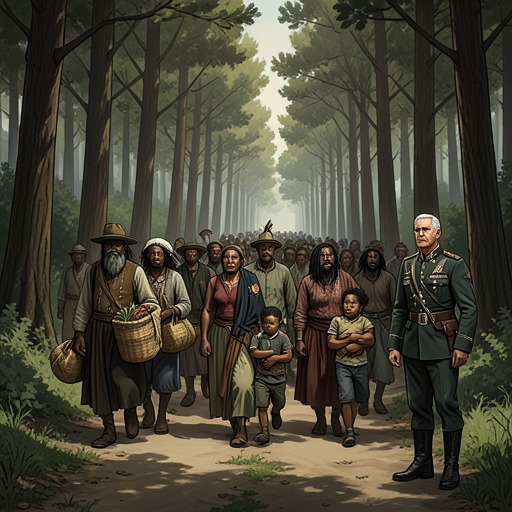
Gray Horse took shape after the Osage were driven from their Kansas lands. In 1870, following the expulsion of people from their homes and the plundering of graves, the Osage agreed to sell those lands to settlers for $1.25 an acre. Settlers had already seized land by force, and some massacred Osage people. Seeking a new homeland, the tribe considered purchasing land from the Cherokee in Indian Territory: a rocky area that white observers dismissed as poor farmland. The Osage bought the territory for seventy cents an acre and began moving west in the early 1870s.
The migration was not simply a change of address. A witness recalled the grief of elders, especially women, leaving the graves of their children behind. Once the Osage reached the new reservation, they established several camps. Pawhuska became the most prominent, while Gray Horse, in the reservation’s western part, began as little more than a cluster of newly built lodges. Lizzie and Ne-kah-e-se-y settled there after marrying in 1874. The settlement was thus part of a new homeland made under pressure, carrying family life forward after the loss of the older one.
A Settlement amid Political Change
The Osage faced renewed pressure as the government pursued allotment and prepared to incorporate Indian Territory into a new state. In the late nineteenth century, allotment threatened to break up communal landholding, assign parcels to individual tribal members, and open the remainder to settlers. The violent land rush through the nearby Cherokee Outlet showed the stakes: after the territory was opened, competing claimants raced to seize parcels, and the prairie was divided into private claims.
Osage leaders delayed allotment and negotiated its terms. In the 1906 agreement, the government divided land among tribal members rather than opening the reservation to a land rush, increasing each allotment from the proposed 160 acres to 657 acres. The agreement also reserved the oil, gas, coal, and other minerals to the Osage Tribe. The mineral reservation would later underpin the tribe’s oil income, even as the land around Gray Horse became increasingly subject to outside settlement and extraction. Gray Horse was one small community within that larger political and economic transformation.
By the early twentieth century, Gray Horse was one of the reservation’s older settlements. Nearby Fairfax had nearly fifteen hundred residents, while Pawhuska, the Osage capital, had more than six thousand. The towns and settlements of the region drew cowboys, fortune seekers, bootleggers, lawmen, financiers, and oil magnates. Automobiles sped along paved horse trails, fuel smells overtook the prairie’s, and cafés, opera houses, and polo grounds marked the new prosperity. Gray Horse belonged to this changing landscape, though its older lodges and family histories remained close to the center of the account.
Mollie Burkhart’s Gray Horse
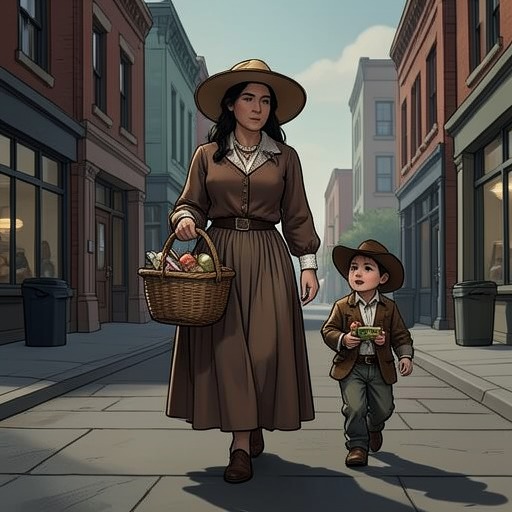
By 1921, Mollie Burkhart lived in Gray Horse in a large, rambling wooden house near her family’s former lodge of lashed poles, woven mats, and bark. She owned several cars and employed servants, but the house also held the daily work of a close family. Her mother, Lizzie, had moved in after Mollie’s father died. Mollie cared for her mother and her two young children, Elizabeth and James, whom the family called Cowboy. On May 21, she prepared for a small luncheon, fed the children, and gave instructions as the household stirred; Lizzie, unwell, remained in bed.
That morning, Mollie asked Ernest Burkhart to call her sister Anna Brown and see if she would come help tend to their mother. Anna arrived by taxi in red shoes, a skirt, and a matching Indian blanket, carrying an alligator purse. Her hair was windblown, her words slurred, and her step unsteady: she was drunk. Mollie was among the last people to see Anna before she disappeared. Three days later, on May 24, Mollie began to fear that something had happened. Anna had often stayed out drinking and dancing, but she normally returned to Mollie’s front stoop; now one night passed, then another, without her familiar arrival.
The disappearance struck a family already marked by loss. Mollie’s sister Minnie had died nearly three years earlier, aged twenty-seven, after what doctors called a wasting illness. Mollie doubted that explanation because Minnie had been healthy. Gray Horse’s family house therefore became more than the setting for a missing-person search: it was a home in which earlier bereavement sharpened the alarm at Anna’s absence.
Remains and Continuity
The original settlement has largely disappeared. On a later visit to the region, the book’s narrator found little at Gray Horse beyond rotted beams and bricks buried in wild grass. The physical remnants make the settlement’s name persist even where much of its built landscape does not. The location’s history survives through family memory, the record of the murders, and the continuing life of the Osage community.
Over several weekends each June, the Osage hold I’n-Lon-Schka ceremonial dances in Hominy, Pawhuska, and Gray Horse, among the areas where they first settled after arriving on the reservation in the 1870s. The dances preserve traditions, gather people from across the country, and give families and friends time to meet, cook, and reminisce. Gray Horse is therefore both a place of loss and a site of renewed communal presence: its old structures have nearly vanished, while its role in Osage gathering continues.