Harve M. Freas
Killers of the Flower MoonHarve M. Freas, the Osage County sheriff during the early investigations into Anna Brown’s murder, stood at the center of a crisis of confidence in local law enforcement. His record, as presented in the account, contrasts an imposing reputation for toughness with persistent allegations of indulgence toward criminal activity—and ends with his removal from office for failing to enforce the law.
Office and Reputation
At the time of Anna Brown’s murder, Freas was fifty-eight years old, weighed three hundred pounds, and bore the description of a frontiersman. A 1916 history of Oklahoma had characterized him as a terror to wrongdoers. Yet residents also murmured that he was close to criminal elements and allowed gamblers and bootleggers to operate freely. Among those said to benefit from this latitude were Kelsie Morrison and Henry Grammer, a rodeo champion who had served time for murder and controlled local moonshine distribution. One of Grammer’s workers believed that an arrest would result in his release within minutes, a report that gave force to suspicions that the sheriff’s authority was not being applied evenly.
The criticism became public in a citizens’ resolution appealing to Freas to do his sworn duty. Its authors framed law enforcement as a matter of community morality and urged residents to contact him directly. The appeal made the gap between the office’s formal responsibility and the doubts about its performance impossible to ignore.
Response to Anna Brown’s Murder
When Freas was told that Anna Brown had been murdered, the killing of Charles Whitehorn already occupied him. He initially dispatched a deputy to gather evidence, while Fairfax’s town marshal joined the deputy at the ravine where the Shoun Brothers were performing the autopsy. To identify the weapon, they tried to recover a bullet thought to be lodged in Anna’s skull. The brothers sawed through the cranium and lifted her brain onto a plank, but the tissue was too badly damaged for David Shoun to trace the bullet. He probed it with a stick and concluded that the bullet was not there.
The lawmen then searched the creek bank. Blood smears beside a rock marked where Anna’s body had lain, and a partly filled bottle containing clear liquid, which smelled like moonshine, was found on the ground. They inferred that she had been sitting on the rock drinking when someone approached from behind and shot her at close range, knocking her over. The marshal also noticed two separate sets of automobile tracks running between the road and the gulch. Both appeared to enter from the southeast and circle back. These were initial observations, not a solved case: the bullet was missing, and the tracks established the apparent movements of cars without identifying who had driven them.
Charges and the Investigation’s Collapse
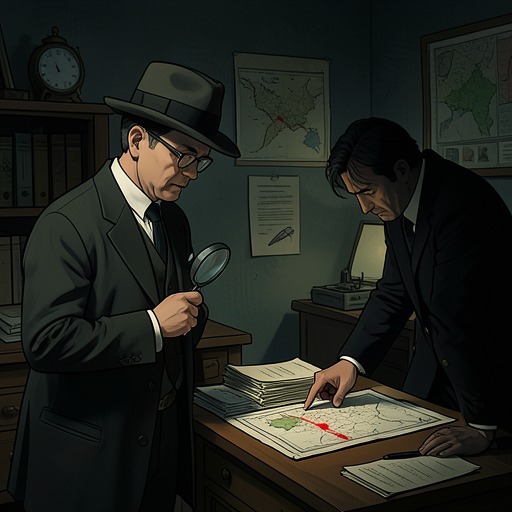
Freas’s authority came under formal challenge while the murders remained unresolved. The Oklahoma attorney general charged him with willfully failing to enforce the law by permitting bootlegging and gambling. Freas denied the allegations. As the case awaited trial, the two officials were pitted against each other, and William K. Hale announced that the deteriorating situation made it time to hire a private detective. The sheriff who bore the main responsibility for local order was thus himself under accusation as confidence in the investigation ebbed.
Freas continued to shape the inquiry through the rumors he passed to the private detectives. When they were pursuing allegations involving Rose Osage and her boyfriend, he urged them to discount the pair and offered another lead: two hard-boiled men from the oil camps had reportedly been seen with Anna Brown shortly before her death and had then left town. The detectives agreed to investigate his account, but their operative also maintained that they would continue following the theory about Rose. Freas’s counter-rumor widened the field of suspicion without resolving it; the competing leads remained difficult to corroborate.
By February 1922, nine months after the murders of Charles Whitehorn and Anna Brown, both investigations appeared to have reached a lasting impasse. Freas was no longer leading them: a jury found him guilty of failing to enforce the law, and he was expelled from office that month. The sequence gives his tenure a consequential ending—not a breakthrough in either murder case, but the removal of the sheriff whose conduct had become part of the county’s law-enforcement crisis.
Institutional Context and Narrative Role
Freas appears within a law-enforcement culture that had not yet embraced professional training or emerging methods such as fingerprint and blood-pattern analysis. Frontier officers were often expected to track and confront armed men, and the boundary between lawful authority and criminal association could be porous: the leader of the Dalton Gang had once served as the principal lawman on the Osage Reservation. This wider context does not excuse the allegations against Freas; it shows how little institutional distance separated the sheriff’s office from the disorder it was supposed to contain.
That tension gives Freas a role beyond that of a failed investigator. His formidable physical presence and reputation for toughness belonged to an older image of law enforcement, while the case demanded reliable evidence-gathering and public trust. The account places the sheriff’s alleged tolerance of bootlegging and gambling alongside the citizens’ appeal that he enforce the law, then shows his office itself becoming a subject of prosecution. In that sequence, the crisis is not only that murders went unsolved: the authority meant to pursue them had become compromised in the eyes of the community.