Kansas
Killers of the Flower MoonKansas was a refuge the Osage secured after losing nearly a hundred million acres of ancestral land, but it was never a secure or lasting home. The book traces how the pressure to surrender territory turned Kansas into one stage in a longer history of removal, violence, and renewed dispossession.
Refuge and Expulsion
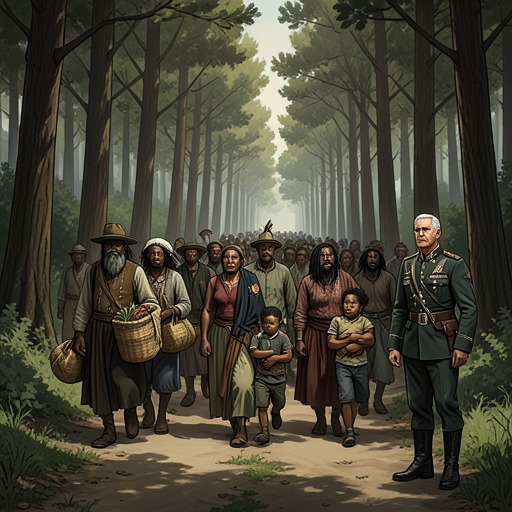
After the United States compelled the Osage to relinquish land between the Arkansas and Missouri Rivers, further cessions over the next two decades drove them into a refuge in southeastern Kansas measuring about 50 by 125 miles. Mollie Burkhart’s parents came of age there. The land was therefore not merely a temporary stop in the history of the family: it was a homeland formed under coercion, after the Osage had been forced to abandon much of their ancestral territory.
That refuge was itself taken. In 1870, after being expelled from their lodges and seeing their graves plundered, the Osage agreed to sell their Kansas lands to settlers for $1.25 an acre. The sale did not shield them from violence: impatient settlers massacred several Osage people, mutilating and scalping their bodies. The sequence makes the limits of the supposed choice plain: dispossession proceeded through formal transactions as well as direct force, while even the land the Osage had accepted as a refuge could be made to yield to settler expansion.
The Move Beyond Kansas
Kansas was not the Osage people’s final refuge. Searching for another homeland, they considered buying nearly 1.5 million acres from the Cherokee in Indian Territory, south of Kansas, where many tribes driven from their lands had reached the end of the Trail of Tears. White officials generally dismissed the rocky, hilly country as sterile and unfit for cultivation. At a council meeting, the Osage chief Wah-Ti-An-Kah argued that those very hills might keep settlers away: unlike flat prairie, the land seemed to him a place where white people would not try to claim the Osage lodges. His warning also looked beyond this particular move: if the Osage kept settling on open land, he said, settlers would keep demanding it until the Osage had no home left.
The Osage bought the territory for seventy cents an acre and began moving there in the early 1870s. The departure carried the grief of another rupture: a witness recalled the cries of older people, especially women mourning the graves of children they were leaving behind. On the new reservation, the Osage established several camps. The most significant was Pawhuska, where the Office of Indian Affairs built a sandstone field office on a prominent hilltop; farther west, Gray Horse was little more than a cluster of new lodges. Lizzie and Ne-kah-e-se-y, who married in 1874, settled at Gray Horse. Kansas thus marks a forced passage in the family’s history: after losing their lands there, Mollie’s parents made a home in a new territory whose hills had seemed to promise protection from another round of settlement.
The Kansas Border and the Next Contest over Land
Kansas remained a point of reference as the Osage faced another effort to divide their homeland. Near the western edge of the Osage reservation lay the Cherokee Outlet, a vast prairie the United States had purchased from the Cherokee. In 1893, the government opened it to settlers in a land run for forty-two thousand claims. Tens of thousands crowded along the boundary; after the starting gun, people and horses raced across the prairie, and violence broke out over who had reached a claim first. By nightfall, the land had been carved into pieces. For the Osage, the spectacle close to their reservation made the consequences of allotment visible: dividing territory into individual parcels could clear the way for settlers to take it.
The Osage delayed allotment longer than any other tribe in Indian Territory, giving them leverage while officials pressed to establish the new state of Oklahoma. In negotiations, Bigheart, John Palmer, and other Osage secured an agreement that divided land among tribal members rather than opening it to a land run. Each member’s allotment consequently rose from the proposed 160 acres to 657 acres. The agreement also reserved the oil, gas, coal, and other minerals to the Osage Tribe. Kansas thus belongs to the book’s larger geography of dispossession not only as land the Osage were forced to leave, but as the neighboring reference point for a later policy contest in which the Osage sought to prevent another wholesale opening of their territory.
Removal Beyond the Kansas Years
Leaving Kansas did not end the pressures reshaping Osage life; they continued through schools and federal control of family resources. In 1894, when Mollie Burkhart was seven, the government required her parents to enroll her at the St. Louis School, a Catholic boarding institution in Pawhuska. Officials threatened to withhold the family’s annuity if they refused. In March, Mollie was taken from Gray Horse by horse-drawn wagon, sent away from her family under a policy that demanded Osage children conform to white ways.
The school’s reach extended beyond the classroom. Students attended eight months a year, and some who tried to flee were chased on horseback, roped, and brought back. When Mollie returned to Gray Horse, she saw changes in clothing and appearance: girls had put aside blankets and moccasins, while young men wore trousers and broad-brimmed hats instead of breechcloths and scalp locks. The transformation of the Osage homeland was thus accompanied by an effort to alter the people who lived there and weaken the transmission of their language and customs between generations.
Federal control later reached into property and ordinary spending. Officials classified many Osage as unable to manage their own money and appointed white guardians to authorize purchases, in some cases down to toothpaste. In 1921, Congress added annual limits on withdrawals from trust funds for Osage people under guardianship, even when money was needed for education or a sick child’s hospital care. These restrictions show how the loss of land in Kansas belonged to a longer history: control over where the Osage could live was followed by controls over their children, property, and access to their own wealth.