Liberty, Texas
Killers of the Flower MoonLiberty, Texas, a small city about forty miles from Houston on the Trinity River, was the destination of Mary DeNoya-Bellieu-Lewis’s 1918 trip and the last known setting of her life. Her disappearance there became part of a wider history of violence over Osage headrights, showing that such killings began before the period commonly dated from 1921.
Setting and Mary Lewis’s visit
In the summer of 1918, Mary DeNoya-Bellieu-Lewis traveled to Liberty with her ten-year-old adopted daughter. Born in 1861, she was an allotted member of the Osage tribe whose headright income had enabled a prosperous life. She had been divorced from both of her husbands and was raising her daughter when she made the journey. Two white men accompanied her: Thomas Middleton, a friend, and Middleton’s companion.
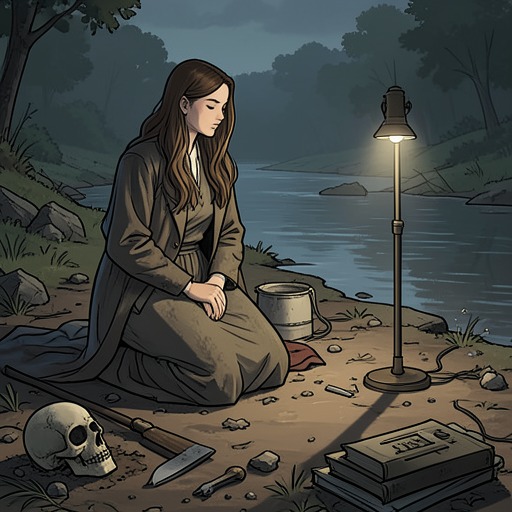
Using her money, the party bought a houseboat and stayed on the Trinity River. On August 18, Mary vanished. The river setting, initially a place for a stay with her daughter and companions, became the starting point for a search that would lead investigators toward a nearby swamp.
Search, Discovery, and the Case’s Wider Significance
Authorities failed to investigate Mary’s disappearance, so her family hired a private detective. He found that after she vanished, Thomas Middleton had pretended to be her adopted son to cash several of her checks. In January 1919, police detained Middleton and his companion, but neither disclosed what had happened. Two witnesses supplied a lead: on the day Mary disappeared, they had seen a car heading toward a snake-infested swamp a few miles from the houseboat.
On January 18, investigators searched the swamp, rolling up their pant legs to wade through the vegetation. One lawman became stuck in the water and, reaching down to free his feet, brought up a mass of women’s hair. Investigators then dredged up leg bones, a human trunk, and a skull that appeared to have been battered with a heavy metal object. The search transformed the swamp near Liberty from a place on the route of Mary’s trip into the site where her murder was confirmed.
Middleton’s companion confessed to beating Mary over the head with a hammer. According to the account assembled by Mary’s great-great-grandniece, Middleton had devised a scheme to kill her and use a female associate to impersonate her so they could collect her headright payments. In 1919, Middleton was convicted of murder and condemned to die, but his sentence was commuted to life imprisonment. After he had served only six and a half years, the governor of Texas pardoned him. Mary’s family suspected Middleton’s girlfriend had bribed authorities; the pardon, rather than ending their ordeal with a sense of justice, left them with disbelief and anger.
The case gives Liberty significance beyond its role as the setting of Mary’s final trip. Mary had been killed for her headright in 1918, three years before the period most historical accounts date as the beginning of the Osage Reign of Terror. Her murder also complicates the idea that the killings ended with William K. Hale’s arrest in 1926: other Osage were killed for headrights outside the conspiracy attributed to him, and many such deaths were never investigated or classified as homicides.
The Manuscript Behind the Record
The account that restored Mary DeNoya-Bellieu-Lewis’s story to view was itself a record of how family memory can outlast official inattention. While researching the murders, the book’s narrator found a spiral-bound manuscript in the Pawhuska public library, tucked among volumes on Osage history. Titled “The Murder of Mary DeNoya-Bellieu-Lewis,” it had been assembled by Anna Marie Jefferson, Mary’s great-great-grandniece, whose introductory note was dated January 1998. Jefferson traced her knowledge to a story first told by her great-grandmother around 1975, then spent two decades gathering details from relatives, newspaper clippings, and other records. The manuscript’s presence in the library preserved a family investigation that might otherwise have disappeared from the public record, and supplied the account through which the events associated with Liberty could be reconstructed.
Beyond the Official Case File
The recovery of Mary DeNoya-Bellieu-Lewis’s story belongs to a broader evidentiary method: the book draws on thousands of pages of primary and unpublished records, including FBI files, court transcripts, private correspondence, wills, guardian reports, and confessions, while also incorporating materials supplied by descendants and information gathered in family interviews. That combination matters to Liberty’s place in the history. The record of Mary’s disappearance and murder came not only through law-enforcement files, but through relatives who preserved and assembled what official attention had failed to pursue. The town therefore marks both the geography of a killing for an Osage headright and the wider work of recovering cases that formal investigations left incomplete.