Martha Vaughan
Killers of the Flower MoonMartha Vaughan was a social worker and granddaughter of W. W. Vaughan whose family had spent generations living with the unanswered questions surrounding his murder. She brought the family’s records and suspicions into the later investigation, helping turn a cold case from an abstract historical mystery into an inheritance of bereavement, fear, and fragile evidence. Her role was not to claim certainty, but to show what the absence of certainty had cost those left behind.
Family Background and Inherited Loss
Martha lived in Sallisaw, Oklahoma, and eagerly offered to meet the reporter researching the Osage murders. She proposed the Skirvin Hotel in Oklahoma City, Oklahoma, as a place that would convey the riches oil had brought to the state. The hotel’s original arched wooden entryway and Bacchus figures still evoked that prosperity. The Vaughan family’s own history supplied a sharp counterpoint: after W. W. Vaughan’s death, his widow, Rosa Vaughan, had ten children and no income.
Martha and her cousin Melville Vaughan described how Rosa and the children were forced to leave their two-story house for a storage garage and struggled to afford food. The Osage community gathered to help feed them. Some of the children, including Martha’s father, went to live with Osage families, where they learned the Osage language and traditional dances. Martha said her father felt safe among the Osage. This account makes community support part of the murder’s aftermath: the family’s survival depended not only on kinship, but on neighbors who took them in and sustained them.
The Family Archive and the Questions Around the Killing
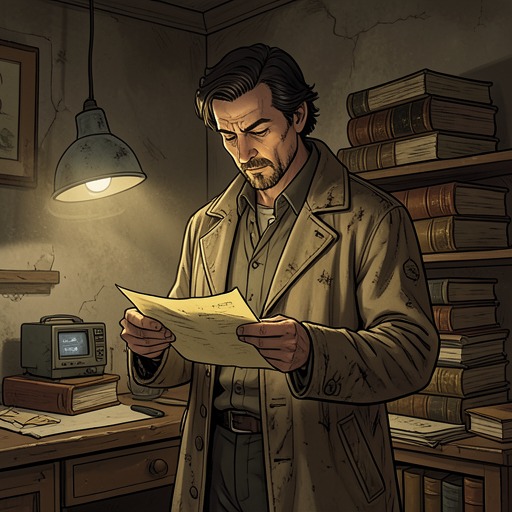
At the hotel, Melville brought two thick binders assembled through decades of the family’s focused research into W. W. Vaughan’s murder. They contained faded newspaper clippings, his death certificate, and an informant’s statement that Vaughan had said shortly before he died that he possessed enough evidence to send William K. Hale to the electric chair. The binders preserved more than a collection of documents. They carried the family’s conviction that Vaughan had been pursuing evidence, while leaving open what had happened to him and what, if anything, had been recovered from his death.
Martha explained that relatives believed Hale might have wanted Vaughan silenced, but they did not regard that suspicion as an answer to every question. They wondered who had carried out the killing and whether Vaughan had been killed before being thrown from a train or had died from the impact. The inquest had listed the cause of death as unknown; Martha’s family believed someone influential had ensured that it was a sham. Melville added that Vaughan was large and strong, suggesting to him that an attacker would have needed considerable strength or accomplices.
The family also remembered Vaughan telling his wife that he had hidden evidence concerning the murders, along with money for his family. Martha and Melville considered how a killer could have learned the hiding place: the information might have been forced from Vaughan, or disclosed to someone he trusted. These remained possibilities, not established findings. Their persistence in asking the questions shows the particular burden of an investigation that leaves both the killing and its purpose incompletely explained.
Burt, New Evidence, and the Limits of Certainty
When asked whether the family had suspected anyone besides Hale, Martha recalled a man who had embezzled money from Vaughan’s estate after his death and whom Rosa had sued in civil court. She could remember only that his name was something like Burt; Melville identified him as H. G. Burt, a bank president. The detail connected an episode of financial exploitation after Vaughan’s death to the family’s wider suspicion that the murder had involved more than one person, without proving that connection.
Later, the reporter found an informant’s statement identifying Herb Burt as the person who had carried out the killing. Notes from an unpublished interview with the Fairfax town marshal also indicated that Burt had been involved and that a local tough, a mayor of one of the boomtowns, had helped throw Vaughan from the train. According to those notes, Burt was frightened during the Federal Bureau of Investigation’s 1925 inquiry into the Osage murders and moved abruptly to Kansas that year. These accounts strengthened the lead but did not settle the case. The reporter emphasized the unfairness of accusing a dead man who could not answer the allegations, and Martha received the findings with those limits made clear.
Memory, Relief, and an Ending Without Resolution
The family’s fear had shaped what could be investigated. After Hale went to jail, a relative tried to continue looking into Vaughan’s murder and received an anonymous threat warning that the family would end up like him if they pursued it. The family stopped digging. Martha remembered asking her oldest uncle who had killed their grandfather; he recalled the warning and told her not to go further. Even near the end of his life, he was frightened. Martha’s account shows how intimidation could outlast the person who delivered it, interrupting inquiry within a family long after the crime.
After hearing the reporter’s findings, Martha fell silent and then sobbed softly. When the reporter apologized, she said it was a relief: the matter had been with her family for so long. Her response did not resolve the competing possibilities or establish the full circumstances of Vaughan’s death. It registered the importance of having the buried history addressed, even incompletely. Not long afterward, Martha died of heart failure at sixty-five. Melville described her death as the loss of another link to the past. Her place in the account is therefore both evidentiary and familial: she helped bring forward the records, the warning, and the questions, while her death made the transmission of that history more precarious.