Mary DeNoya-Bellieu-Lewis
Killers of the Flower MoonMary DeNoya-Bellieu-Lewis was an Osage allottee murdered for her headright in 1918, three years before the period commonly dated as the beginning of the Osage Reign of Terror. Her case enlarges the history beyond its best-known conspiracy: the killings tied to Osage headrights began earlier and, as later research suggested, reached beyond the murders officially counted and investigated.
Identity and the 1918 Journey
Born in 1861, Mary DeNoya-Bellieu-Lewis was a member of the Osage Nation who received an allotment and, with it, a headright. The income afforded her a prosperous life. She had been married twice, both marriages ending in divorce, and by 1918, in her mid-fifties, she was raising a ten-year-old adopted daughter.
That summer, Mary took her daughter to Liberty, Texas, a small city about forty miles from Houston on the Trinity River. Two white men accompanied them: her friend Thomas Middleton and another man. Using Mary’s money, they bought a houseboat and stayed on the river. On August 18, Mary disappeared. Her family later said authorities failed to investigate; the absence of official action left relatives to seek help from a private detective.
Search, Discovery, and Conviction
After Mary disappeared, a private detective hired by her family uncovered one immediate sign of fraud: Thomas Middleton had pretended to be her adopted son and cashed several of her checks. In January 1919, police detained Middleton and his companion, and the detective questioned them. Middleton denied knowing where Mary had gone. Neither man disclosed what had happened, but two witnesses reported seeing a car heading toward a snake-infested swamp a few miles from her houseboat on the day she vanished.
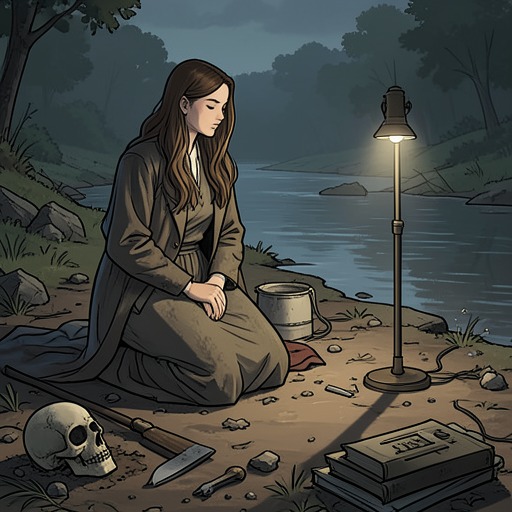
On January 18, 1919, investigators entered the swamp and searched its dense vegetation. A lawman first pulled up a thick growth of woman’s hair; leg bones followed, then a human trunk and a skull that appeared to have been struck with a heavy metal object. The discovery ended the search for Mary and established that her disappearance had ended in murder. Middleton’s companion confessed to beating her over the head with a hammer.
The murder had been planned by Middleton as a way to seize Mary’s headright payments. The intended next step was to use a female associate to impersonate Mary, turning her death into a scheme to collect the income attached to her allotment. In 1919, Middleton was convicted of murder and sentenced to death. His sentence was commuted to life imprisonment, but after six and a half years he received a pardon from the governor of Texas. Mary’s family believed Middleton’s girlfriend had bribed authorities; the pardon transformed their initial relief that the ordeal was over into disbelief and anger.
A Case Outside the Official Chronology
Mary’s murder changes the apparent boundaries of the Osage Reign of Terror. Many historical accounts date that period from the spring of 1921, when William K. Hale arranged Anna Brown’s murder, to Hale’s arrest in January 1926. Mary was killed in 1918, at least three years before that commonly accepted starting point. Her case therefore shows that the violence over Osage headrights did not begin with the conspiracy most often identified as the Reign of Terror, even though Hale may have led its bloodiest and longest killing spree.
The evidence also widens the history beyond its official case count. The book points to other deaths that were never investigated or even classified as homicides, and notes the possibility that killings continued after Hale’s arrest: Kathryn Red Corn said her grandfather had been poisoned in 1931. Mary’s murder is a documented instance of a headright scheme outside the familiar chronology; alongside less fully established deaths, it makes the limits of the historical record part of the story rather than proof that unrecorded crimes did not occur.
Family Record and Historical Recovery
Mary’s story reached the later investigation through family research as well as official records. In the Pawhuska public library, the author found a spiral-bound manuscript about her murder, compiled by her great-great-grandniece Anna Marie Jefferson. Jefferson wrote that she first heard the story from her great-grandmother around 1975, then spent two decades collecting fragments from relatives, newspaper clippings, and other records. Leaving a copy in the library preserved a family account that might otherwise have fallen out of the historical record.
The manuscript’s route into the narrative stands in contrast to the gaps surrounding so many Osage deaths. The author had searched archives that offered fewer documents and no single key to unlock the past; Mary’s history had instead been assembled over years from dispersed sources by a descendant determined to retain it. Her case thus carries a double significance: it records a murder for headright income in 1918, and demonstrates how family memory and patient collection can recover a crime from beyond the chronology that later came to define the Reign of Terror.
Headrights Within a System of Financial Control
Mary’s murder for the income attached to her allotment belongs to a wider history in which Osage wealth was both coveted and subjected to government control. The Office of Indian Affairs was required to decide which Osage could manage their own trust funds. Officials frequently classified full-blooded Osage as incompetent, while mixed-blood people were rarely assigned guardians; those deemed incompetent had local white guardians who could oversee and authorize even ordinary purchases. The records do not establish that Mary herself had a guardian, but they show the discriminatory financial regime surrounding the headrights that Middleton sought to capture.
The restrictions tightened in 1921, three years after Mary was killed. Under the new law, Osage with guardians could withdraw no more than a few thousand dollars a year from their trust funds, even when they needed money for education or a sick child’s hospital care. That later restriction was not the cause of Mary’s 1918 murder; the distinction matters. Her case shows that private efforts to seize headright payments were already underway before the government further limited Osage access to their own money. Set against the guardianship system, the murder exposes two different forms of control over Osage wealth: criminal appropriation and official restriction.