Mary Lewis murder
Killers of the Flower MoonThe Mary Lewis murder reveals that Osage people were being killed for their headrights before the period usually called the Reign of Terror began, and that the violence continued beyond the official case histories. The account reaches the reader through a family-assembled manuscript rather than a complete public investigation: its recovery turns a neglected murder into evidence that the known conspiracy was only part of a wider history.
Recovery and reconstruction
In 2015, while searching for further records of the Osage murders, the narrator found a spiral-bound manuscript in the Pawhuska public library, among books on Osage history. Titled The Murder of Mary DeNoya-Bellieu-Lewis, it had been assembled by Anna Marie Jefferson, Lewis’s great-great-grandniece. Jefferson’s introductory note, dated January 1998, explained that her great-grandmother had first told her the story around 1975. Jefferson spent two decades gathering fragments from relatives, newspaper clippings, and other records. The manuscript’s homemade form and long collection history are part of its significance: a family’s effort to preserve what official inquiry had left obscure brought the case back into view.
Lewis was born in 1861, was an allotted member of the tribe, and had enough money from her allotment to live prosperously. After two marriages ended in divorce, she was raising a ten-year-old adopted child. In the summer of 1918, she took the child to Liberty, Texas, a small city about forty miles from Houston on the Trinity River. Thomas Middleton, a friend, and another white man accompanied them. Using Lewis’s money, the party bought a houseboat and stayed on the river. On August 18, Lewis disappeared. Authorities did not pursue the case effectively; one relative later recalled that the family believed officials would never have done anything. The family therefore hired a private detective.
The detective discovered that, after Lewis vanished, Middleton had pretended to be her adopted son in order to cash several of her checks. In January 1919, police detained Middleton and his companion, and the detective questioned them. He told Middleton that he would far rather find Lewis alive than dead and asked for information that might locate her. Middleton denied knowing where she had gone and said he was not afraid. Neither man disclosed what had happened. The gap between Middleton’s denial and the evidence that followed makes the family’s private investigation crucial to the narrative: it carried the search forward where the initial official response had failed.
Discovery, prosecution, and the limits of justice
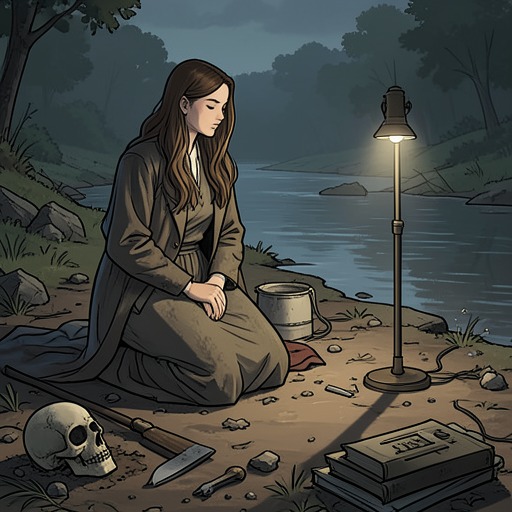
The search for Mary DeNoya-Bellieu-Lewis’s body began after two witnesses reported seeing a car traveling toward a snake-infested swamp a few miles from her houseboat on the day she disappeared. On January 18, 1919, investigators waded into the thick vegetation with their pant legs rolled up. A lawman’s feet became trapped in the bayou mud; reaching down to free them, he brought up a mass of a woman’s hair. Investigators next dredged up leg bones, then a human trunk and a skull that appeared to have been struck with a heavy metal object. A local headline announced that the gruesome discovery had ended the search.
Middleton’s companion confessed to beating Lewis over the head with a hammer. The murder had been Middleton’s plan: after Lewis was killed, a female associate was to impersonate her so that the men could collect her headright payments. The scheme belonged to a broader pattern of attempted fraud around Osage inheritances. After Bill Smith died in a house explosion, for example, the government initially suspected that a relative claiming to be his heir was an impostor. Lewis’s case thus joined physical violence to the theft of the income attached to Osage headrights, while the planned impersonation showed how that theft could continue after a victim’s death.
Middleton was convicted of murder in 1919 and condemned to die. Lewis’s family initially felt relief that the ordeal seemed over, but the sentence was commuted to life imprisonment. After serving only six and a half years, Middleton was pardoned by the governor of Texas. Lewis’s family believed that Middleton’s girlfriend had bribed authorities; in Anna Marie Jefferson’s account, the pardon reduced the punishment to what she called “only a slap on the hand.” The conviction had established Middleton’s responsibility in court, but the early release left the family with disbelief and anger rather than a settled sense of justice.
The murder's place in the wider chronology
The manuscript alters the dates by which the killings are usually bounded. Many accounts place the Reign of Terror between the spring of 1921, when William K. Hale had Anna Brown murdered, and January 1926, when he was arrested. Mary DeNoya-Bellieu-Lewis was killed in 1918, at least three years before that familiar starting point. The account also points beyond the supposed ending: Kathryn Red Corn’s grandfather was poisoned in 1931, five years after Hale’s arrest. These cases stretch the history both backward and forward, making it harder to treat the violence as a closed episode with a single beginning and end.
The expanded chronology also changes what Hale’s prosecution can stand for. The evidence does not make every unsolved death part of one scheme, nor does it establish who was responsible for every suspicious case. Instead, Lewis’s murder joins a record of killings tied to Osage headrights that the official histories did not fully capture. The account argues that William K. Hale may have directed the bloodiest and longest killing spree, while many other deaths remained outside official estimates, uninvestigated or never classified as homicides. The family manuscript therefore does more than restore one victim’s story: it exposes how the limits of investigation and classification helped make a larger pattern difficult to see.
The archival record and the deaths it could not explain
The family manuscript was one piece of a much larger, incomplete record. In Fort Worth, the narrator searched government archives through boxes of expenses, census reports, oil leases, and other files, eventually finding a cloth-covered Office of Indian Affairs logbook that listed guardians and their Osage wards. When a ward died, the clerk had often written a single word beside the name: “Dead.” The notation recorded an outcome without explaining it, leaving the circumstances of death—and any responsibility for it—outside the ledger.
The entries made the problem visible in numbers. H. G. Burt, a suspect in W. W. Vaughan’s killing, had served as guardian to George Bigheart’s daughter and four other Osage; one of those wards was marked dead. Scott Mathis, owner of the Big Hill Trading Company, had nine listed wards, including Anna Brown and her mother, Lizzie. Seven had died, and at least two of those deaths were known murders. Elsewhere in the same record, one guardian’s eleven wards included eight deaths; another had thirteen wards, more than half listed as deceased; a third had five wards, all marked dead. Such totals suggested deaths far beyond an ordinary pattern, but the cases had mostly gone uninvestigated, so the log could not establish how many were murders or who had caused them. Notes elsewhere in the files pointed to suspected poisoning in Anna Sanford’s case and an informant’s allegation that Hlu-ah-to-me’s guardian withheld treatment before taking control of her estate. Against this background, the murder of Mary DeNoya-Bellieu-Lewis is not merely an earlier date in a familiar chronology: it is one recoverable instance of a wider history that sparse records could register, but rarely resolve.