Murder of Anna Brown
Killers of the Flower MoonThe Murder of Anna Brown began with an absence that became a family crisis and then a public revelation of murder. After Anna failed to return home, her sister Mollie’s search led from a locked, dark house to a body found near Three Mile Creek; the clothes Mollie had washed and the gold fillings in Anna’s teeth made the identification. The discovery exposed not only Anna’s killing but the vulnerability of a community already unsettled by another disappearance.
Disappearance and Identification
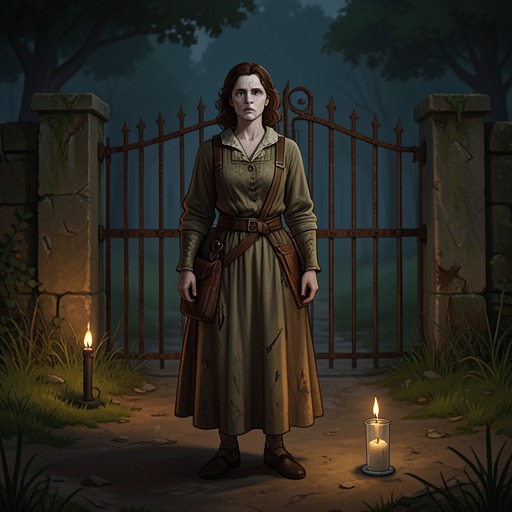
Mollie had last seen Anna after caring for her: she washed her clothes, gave her food, and stayed with her until she seemed sober and once again bright and charming. The sisters shared a moment of calm before Anna left. Bryan Burkhart said he had taken Anna directly home, but after three nights Mollie pressed the family to act. Ernest went to Anna’s house, tried the locked front door, and saw dark, apparently deserted rooms. Anna’s head servant confirmed that she had found the door locked when she stopped by to close the windows before a rainstorm. Anna was gone. Her disappearance circulated through the boomtowns, where concern was sharpened by news that Charles Whitehorn had vanished a week earlier. A thirty-year-old man known as genial and witty, Whitehorn had left his home in the southwestern part of the reservation for Pawhuska on May 14 and never returned. His disappearance made Anna’s absence feel less like a private family mystery and more like part of a wider danger. A week after Anna disappeared, an oil worker on a hill about a mile north of downtown Pawhuska noticed something in brush at the base of a derrick. The corpse was badly decomposed, with two bullet holes between the eyes. A letter in one of its pockets identified the victim as Charles Whitehorn. Around the same time, a boy squirrel hunting with his father and another man near Three Mile Creek found a decomposing woman’s body in a ravine. The men could find no lawman in Fairfax, so they went to the Big Hill Trading Company, where Scott Mathis arranged for an undertaker and other men to retrieve the body. Mathis, who managed Anna’s financial affairs, contacted Mollie when those at the ravine could not identify the woman. Mollie arrived with Ernest, Bryan, her sister Rita, and Rita’s husband, Bill Smith; others who had known Anna, as well as curious onlookers, followed. The face was almost impossible to recognize, but Mollie and Rita knew the Indian blanket and clothes Mollie had washed for her. Bill used a stick to open the dead woman’s mouth, revealing Anna’s gold fillings. Rita wept; Mollie confirmed the identification and left the creek with Ernest, composed in manner but facing the first sign of a darkness threatening her family and the Osage people.
Inquest and Crime Scene
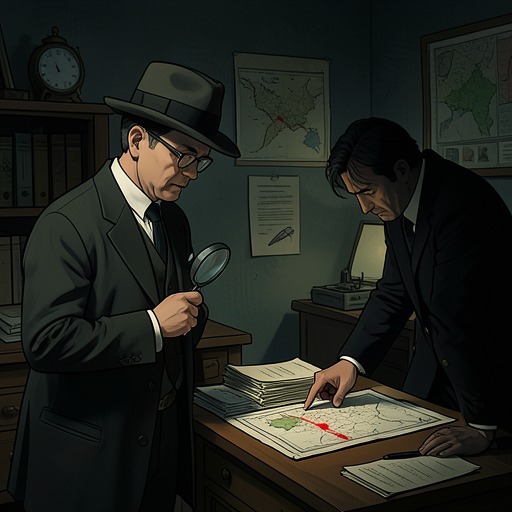
The discovery at Three Mile Creek initiated a hurried coroner’s inquest, an older form of citizen-led investigation that survived in places where formal policing remained thin. A justice of the peace selected jurors from among the white men gathered at the ravine, including Scott Mathis. They were to decide whether Anna Brown had died by accident or human action and, if a felony had occurred, to identify its principals and accessories. James Shoun and David Shoun, the brothers who cared for Mollie’s family, were summoned to examine the body while the jurors and others crowded around.
The doctors worked over a plank serving as a table, using a few basic instruments from a medical bag, including a saw. They inspected Anna’s bloomers and skirt for tears or stains, then tried to estimate when she had died. Decomposition made precise timing impossible, but they placed her death roughly five to seven days before the examination. The delay had obscured much of what the body might otherwise have disclosed.
When the Shouns shifted Anna’s head inside the wooden box, part of her scalp slipped away and exposed a round opening in the back of her skull. The hole was barely the width of a pencil. Mathis thought it might have been made by a .32-caliber bullet; its path, entering just below the crown and traveling downward, made the conclusion unmistakable to those present: Anna had been murdered. The evidence transformed the question before the inquest from whether a death had occurred into how little the investigators could recover about the person who had caused it.
Sheriff Harve M. Freas was already occupied with Charles Whitehorn’s killing, so he initially sent a deputy to collect evidence. A Fairfax town marshal joined him while the Shoun brothers attempted to find the bullet, apparently lodged in Anna’s skull. They sawed through the cranium and lifted her brain onto the plank, but David Shoun could not trace the bullet through its damaged tissue. The effort produced no weapon identification and no projectile for later comparison.
At the creek, the lawmen found smears of blood on a rock where Anna’s body had lain and a bottle partly filled with clear liquid that smelled of moonshine. They surmised that Anna had been drinking on the rock when someone approached from behind and shot her at close range. The marshal also spotted two sets of car tracks running from the road into the gulch; both appeared to have entered from the southeast and circled back. These observations suggested a sequence of events, but they did not establish who had been there or when.
The investigation stopped short of preserving even these traces. No cast was made of the tire marks, the bottle was not dusted for fingerprints, Anna’s body was not tested for gunpowder residue, and the scene was not photographed. By then, numerous onlookers had already disturbed the ravine. The inquest had found the decisive fact of murder, but the untrained investigators left behind no reliable forensic record capable of carrying that finding toward an identified killer.
Family Loss and the Meaning of the Death
The identification reached Lizzie by a separate, intimate route. Someone retrieved one of Anna Brown’s earrings from her body and brought it to Mollie Burkhart’s mother, who was too ill to go to the ravine. Lizzie recognized it immediately. The small object confirmed at home what the clothes and gold fillings had established at the creek: Anna, her oldest and most favored daughter, was dead.
For Lizzie, the loss carried a meaning deeper than the failure of the inquest to identify a killer. In Osage understanding, the birth of children was among the greatest blessings of Wah’Kon-Tah, the life force present in the sun, moon, earth, and stars. Lizzie had held to these traditional beliefs even as many Osage had relinquished them; government officials disparaged women who maintained such practices as resisting modern ideas and customs. The death of her daughter therefore entered a spiritual order that had long helped make sense of a world marked by chaos and uncertainty.
Now that order seemed threatened. Anna had been taken before her allotted time, and Lizzie’s worsening health followed the loss, as though grief itself had become an illness. The murder’s consequences thus reached beyond the ravine and the failed collection of evidence: a killing that the local inquiry could establish but not solve deepened a family’s bereavement and intensified the sense that the violence might unsettle the wider Osage community.
The Limits of Local Law
The inquest belonged to an older tradition of citizen policing: a justice of the peace assembled jurors to decide whether Anna Brown’s death resulted from human action and, if so, to identify those responsible. Such inquiries survived even after formal police departments had displaced citizen-led pursuit in much of the country. At the ravine, however, this remnant of public investigation depended on men gathered at the scene, while the evidence was already exposed to heat, decomposition, and a crowd.
The local law-enforcement system offered little assurance that a formal investigation would be more effective. Sheriff Harve M. Freas, a fifty-eight-year-old frontiersman, had a reputation in one account as a terror to wrongdoers, but residents also murmured that he tolerated gamblers and bootleggers, including Kelsie Morrison and Henry Grammer. One of Grammer’s workers later told authorities he expected to be released within minutes if arrested. A citizens’ resolution had already urged Freas to enforce the law. These reports do not establish that the sheriff participated in Anna’s murder; they show why the authority meant to investigate it was itself a source of public doubt.
The killing therefore emerged amid two overlapping failures: the inquest could establish that Anna had been shot, but its investigators did not preserve the physical traces that might have carried the inquiry further, and the county’s law-enforcement reputation was clouded by allegations of indulgence toward criminal businesses. The ravine yielded a clear finding of murder and no identified killer. That gap between certainty about the crime and weakness in the institutions charged with pursuing it made Anna’s death a warning of a danger larger than one unresolved case.