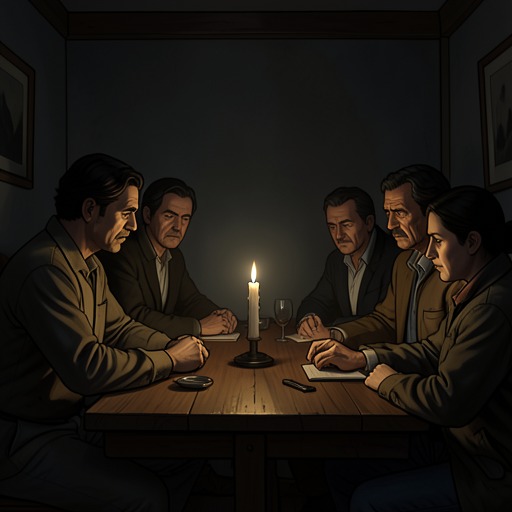
Murder of Barney McBride
Killers of the Flower MoonThe Murder of Barney McBride transformed a request for federal help into an apparent warning. In August, as suspicious deaths continued among the Osage, McBride traveled to Washington, D.C., to press authorities to investigate. He was seized outside an Elks Club, and the next morning his body was found in Maryland: stabbed more than twenty times, his skull beaten in, and his clothes removed except for his socks and shoes. The violence reached beyond the immediate crime scene; authorities suspected his killers had shadowed him from Oklahoma.
A Trusted Messenger
McBride was a fifty-five-year-old white oilman, wealthy and well known in Oklahoma’s Indian affairs. His wife, a Creek woman, had died, and he was raising his stepdaughter. The Osage trusted him, and his familiarity with officials in Washington made him an appealing intermediary at a moment when deaths were accumulating and local assurances were not enough. A reporter described him as kind-hearted and white-haired; the community’s choice of him rested not only on his access to federal authorities, but on the confidence he had earned.
McBride’s mission arose amid a wider atmosphere of danger. Earlier that year, an Osage woman had died of suspected poisoning without a thorough toxicology examination. In July, Joe Bates took a sip of whiskey obtained from a stranger, began frothing at the mouth, and collapsed; authorities attributed his death to a strange poison. Such cases, in which suspected toxins could resemble illness or accidental poisoning, helped make the growing number of deaths difficult to investigate and easy to dismiss. McBride was sent to ask federal authorities to act against that uncertainty.
Seizure and Murder
When McBride checked into a Washington rooming house, a telegram from an associate was waiting: a warning to be careful. He carried a Bible and a .45-caliber revolver. That evening, he went to the Elks Club to play billiards. As he headed outside, someone seized him and tied a burlap sack tightly over his head. The following morning his body was discovered in a culvert in Maryland.
The condition in which he was found made the murder unmistakably violent. He had been stabbed more than twenty times, his skull had been beaten in, and he had been stripped naked except for his socks and shoes. A card bearing his name had been left in one shoe. Forensic evidence suggested more than one assailant. Authorities also suspected that the killers had followed him from Oklahoma, a possibility that made the attack appear not simply to have happened far from home, but to have reached across state lines after the messenger himself.
A Murder Read as a Warning
News of the killing quickly reached Mollie Burkhart and her family. The Washington Post called it the most brutal crime in the District’s annals, while its headline announced a believed conspiracy to kill rich Indians. In the account, the murder seemed to carry a message: McBride had been trusted to take the Osage appeal to federal officials, and he was killed during that mission. The evidence presented does not identify his assailants or establish who ordered the crime; the force of the episode lies in the suspicion it sharpened and the fear it communicated.
That suspicion belonged to a place where oil wealth drew powerful interests and enormous sums. Federal auctions of Osage leases, held about four times a year under the Department of the Interior, had become a spectacle of competition over the reservation’s mineral wealth. At the same time, the guardianship system gave white guardians and administrators control over many Osage people’s finances. Tom White’s later investigation found widespread practices ranging from inflated purchases and kickbacks to outright theft; a government study estimated that guardians had taken at least $8 million from restricted Osage accounts before 1925. These conditions help explain why the deaths could not be separated from contests over wealth and power, but the available account does not prove that a particular financial interest caused McBride’s murder.
Aftermath and Historical Memory
McBride’s death made the effort to obtain outside intervention seem dangerous in its own right. The authorities’ suspicion that the killers had tracked him from Oklahoma, combined with the apparent plurality of assailants and the message-like handling of his body, gave the killing a reach beyond the culvert where he was found. The murder did not settle the question of who was behind the growing violence; instead, it strengthened the perception that the deaths formed a broader assault on wealthy Osage people and on those who tried to bring their case before officials.
The event also belongs to a longer history in which the Osage had repeatedly been forced to defend their land and security against the power of white settlers and institutions. In 1870, after being expelled from their Kansas homes, the Osage agreed to sell their land for $1.25 an acre, yet settlers massacred several people. Decades later, oil income and mineral rights brought wealth without removing the vulnerability built into systems of outside control. McBride’s murder stands at the point where a trusted appeal for protection met the violence it sought to expose: the messenger was killed, and the community received the news as a warning.