National Archives and Records Administration
Killers of the Flower MoonThe National Archives and Records Administration is presented as a crucial source for reconstructing the Osage murders, not as a repository that could resolve every mystery. In its Fort Worth records, a reporter found grand-jury testimony, investigative files, court documents, and a guardianship log that exposed links among suspected conspirators and the deaths of Osage wards. Yet the records also registered the limits of historical knowledge: many deaths were never classified as homicides, and the surviving evidence could not establish who was responsible.
The Fort Worth Archive
The southwest branch of the U.S. National Archives occupied a warehouse in Fort Worth, Texas, described as larger than most airport hangars. Its humidity-controlled storage held more than a hundred thousand cubic feet of records, arranged in rows of boxes fifteen feet high. The holdings ranged widely: transcripts from the U.S. District Courts of Oklahoma from 1907 to 1969, reports from Bureau of Indian Affairs field offices, documents on slavery and Reconstruction, and records concerning events including the 1900 Galveston hurricane and the assassination of John F. Kennedy.
That scale gave the archive a striking double character. Its orderly storage gathered the traces of crimes, wars, disasters, and government actions; the neatness of the files could not make the disorder they documented disappear. The reporter went there hoping to find a clue to the murder of W. W. Vaughan, whose death had remained entangled with other unresolved Osage cases.
Records and Investigative Leads
Among the materials were records from the U.S. Attorney’s Office for the Western District of Oklahoma, including secret testimony from the 1926 grand jury investigating the Osage murders. Ernest Burkhart and Dick Gregg were among the witnesses. H. G. Burt was not listed as a witness, but testimony from the insurance agent who had issued the policy on Henry Roan described Burt recommending another American Indian as a possible target for an insurance scheme. The testimony therefore connected Burt to a wider pattern of suspected exploitation, without establishing that he had testified or proving his role in any killing.
The reporter also found two references to Burt in Bureau of Investigation files. One agent recorded an informant’s claim that Burt and William K. Hale were close associates and had divided money obtained from George Bigheart. The same report noted that Hale later claimed $6,000 from Bigheart’s estate using a bogus creditor’s note. Another Bureau report described Burt as a murderer. These records sharpened suspicion, but they did not convert it into a prosecution: the account notes that the amounts at issue did not appear to offer as substantial an incentive as the headrights involved in other murders or the $25,000 life-insurance policy in Roan’s case.
A separate archival discovery bore on Vaughan’s final journey. A folder contained an interview with an informant who had been close to Hale and had provided evidence in other murder cases. Asked about Vaughan’s killing, the informant said, “I think Herb Burt pulled that.” The statement was a lead, not conclusive proof. Newspaper accounts and other materials indicated that Burt had boarded the train with Vaughan and later reported him missing, while the reporter also found an unpublished interview in which the Fairfax town marshal implicated Burt and a local tough. The evidence accumulated across records of different kinds, but the account preserves the distinction between suspicion and certainty.
Guardianship Records and Uncounted Deaths
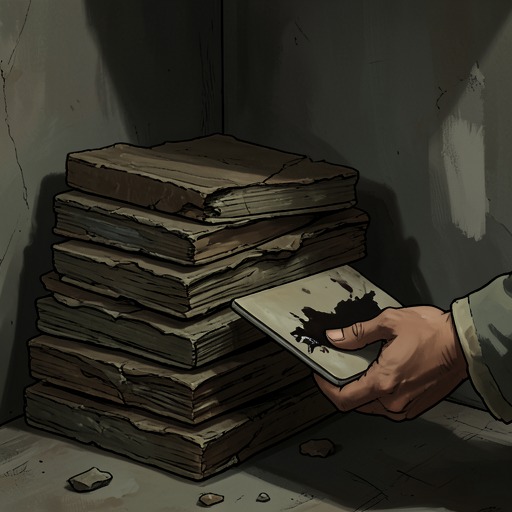
On a later visit, the reporter searched boxes of largely routine material—expenses, census reports, and oil leases—and found a tattered, fabric-covered logbook from the Office of Indian Affairs. Written by hand, it listed guardians and the Osage people assigned to them. When a ward died under guardianship, the clerk commonly wrote “Dead” beside the name. The plain notation turned a bureaucratic register into a disturbing record of lives lost.
The log showed that Burt had been guardian to Bigheart’s daughter and four other Osage people; one of those wards was marked dead. Scott Mathis, owner of the Big Hill Trading Company, had nine listed wards, including Anna Brown and her mother, Lizzie. Seven of Mathis’s nine wards had died, and at least two of those deaths were known murders. Other guardians’ lists showed similarly alarming totals: one had eleven wards, eight recorded dead; another had thirteen, with more than half deceased; a third had five, all marked dead.
The figures suggested a death rate that could not be explained as ordinary mortality, but the register could not identify the circumstances of every death or establish the responsible parties. Other files offered hints rather than resolution. Bureau records indicated that agents suspected Anna Sanford had been poisoned, though her death was never classified as a homicide. A telegram from an informant alleged that Hlu-ah-to-me’s guardian withheld treatment and refused to send her to a hospital in the Southwest, then made himself administrator of her estate after she died of tuberculosis. In each case, the archive preserved a trace of a possible crime while also exposing the absence of a full investigation.
Research, Memory, and the Limits of the Record
The reporter’s search extended beyond Fort Worth. In a New York office, thousands of pages of FBI documents, autopsy reports, wills, crime-scene photographs, trial transcripts, bank records, eyewitness statements, confessions, and other materials accumulated in labeled stacks. The researcher described this as a personal, imperfect version of a Hoover filing system. Each new document offered some hope of filling gaps in the historical account, but some gaps contained no recorded witnesses or voices—only the silence left by the dead.
The book sets this documentary labor beside Osage community memory rather than treating government files as the sole authority. At the Osage Nation Museum, a missing section of a 1924 ceremonial panorama concealed William K. Hale’s image; the museum director later produced a small print of the removed panel. The image had not been erased to forget the murders, but removed because the community could not forget them. The book also recounts how Anna Brown’s skull, retained by an undertaker and later given to Bureau agents for analysis, was eventually retrieved and buried with her other remains after Kathryn Red Corn insisted that it belonged home. These episodes show records and objects moving through different hands, with their meaning shaped by community decisions as well as official custody.
The archive’s significance is therefore double. Its immense collections enabled the reporter to connect names, payments, guardianships, and suspected deaths across dispersed records. At the same time, the missing testimony, unclassified deaths, and unresolved allegations warn against mistaking what survived in government files for a complete history. The documents could help expose the scale of suspected violence; they could not restore every lost account or deliver certainty where investigations had never been made.