Office of Indian Affairs Guardian Register
Killers of the Flower MoonThe Office of Indian Affairs Guardian Register is a handwritten logbook that records guardians and the Osage people placed under their care during the Reign of Terror. Its stark entries—names followed, in many cases, by the word “Dead”—turned a routine administrative record into evidence of a mortality pattern that official investigations had largely failed to confront. The register revealed the scale of loss, but not by itself whether each death was a murder or who was responsible.
The Logbook and Its Entries
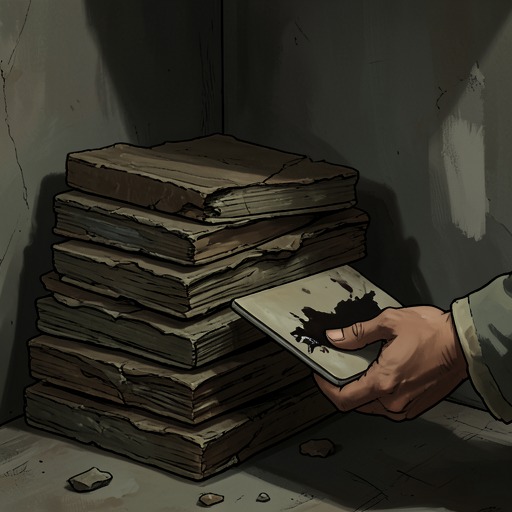
The register was a tattered, fabric-covered book cataloging guardians, with each guardian’s Osage wards listed beneath his name. When a ward died while under guardianship, a single word was usually written beside the person’s name: “Dead.” The format offered no account of circumstances, cause, or responsibility. Its force came instead from the accumulating names and the repetition of that terse notation.
The book surfaced in the National Archives at Fort Worth during a search through boxes of records. The surrounding archive included dry administrative materials such as expenses, census reports, and oil leases; among them, the logbook made the human consequences of guardianship visible in a form that could be compared across households. It provided a list, not a complete record of individual lives or deaths, and its silences mattered as much as its entries.
The Pattern of Deaths
The researcher first searched for H. G. Burt, a suspect in W. W. Vaughan’s killing. The register showed that Burt had been guardian to George Bigheart’s daughter and four other Osage wards; one of those wards was marked dead. The entry connected a person already associated with a murder investigation to a broader system of financial guardianship, but did not establish that Burt had caused the recorded death.
A separate search for Scott Mathis, owner of the Big Hill Trading Company, revealed a more striking count. Mathis had been guardian to nine Osage people, including Anna Brown and her mother, Lizzie. Seven of the nine were listed as dead. At least two of those deaths were known murders. The register therefore placed documented killings within a larger cluster of deaths without proving that every death in the cluster was criminal.
Other guardians’ lists widened the pattern: one had eleven wards, eight of whom had died; another had thirteen, with more than half listed as deceased; and one guardian’s five wards were all dead. The figures, repeated across different guardians, defied an ordinary death rate. Yet because most of the cases had never been investigated, the register could not provide a precise count of suspicious deaths or identify who might have been responsible for foul play.
What the Record Could Not Establish
Other documents made clear why a name marked dead could not be treated as a verdict. Anna Sanford, whose name appeared in the register, was never officially classified as a homicide, although an FBI record indicated that agents suspected poisoning. Hlu-ah-to-me was officially said to have died of tuberculosis. A telegram from an informant to the U.S. attorney alleged that her guardian had denied her treatment and refused to send her to a hospital in the Southwest; after her death, the guardian became administrator of her valuable estate. The allegation and the official cause of death do not resolve the case, but together they expose questions the register itself cannot answer.
The logbook’s evidentiary importance rests on this tension. It does not transform every recorded death into proof of murder; it makes the concentration of deaths legible and points toward cases that received little or no scrutiny. Set against vanished testimony and files that failed to classify suspected killings as homicides, its repeated notation preserves a pattern that the investigative record otherwise obscured. The book is at once a record of guardianship and an index to the limits of the system that recorded it: many deaths are visible, while their histories remain unresolved.