Osage allotment policy and the 1906 agreement
Killers of the Flower MoonThe Osage allotment policy and the 1906 agreement were a pivotal compromise: the federal government pressed to break up Osage land and communal life, while Osage leaders negotiated individual land allotments without surrendering the tribe’s mineral wealth. The agreement preserved oil, gas, coal, and other minerals for the Osage Nation, creating a lasting source of revenue and a new form of collective property. It did not end the struggle over control. The division of surface land, the rules governing inherited mineral shares, and later restrictions on Osage finances formed connected layers of policy that shaped both the oil boom and the exploitation that followed.
From forced cession to allotment
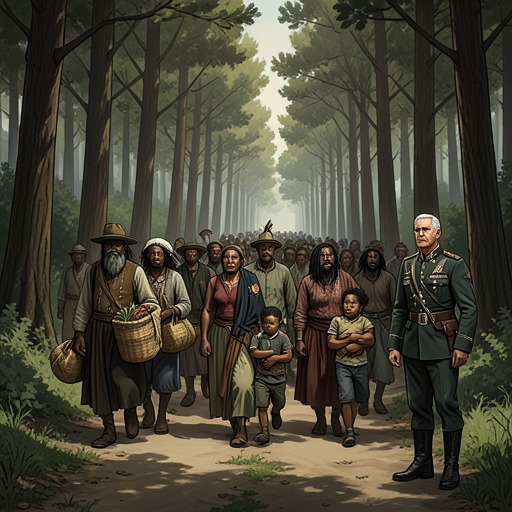
The policy followed decades of dispossession. After the United States compelled the Osage to relinquish land between the Arkansas and Missouri Rivers, the tribe was forced over the next two decades to cede nearly one hundred million acres of ancestral territory. In 1870, after Osage people had been driven from their lodges and their graves plundered, the tribe agreed to sell its Kansas lands to settlers for $1.25 an acre. Settlers nevertheless massacred several Osage, mutilating and scalping their bodies. Allotment was not an isolated administrative change: it continued a history in which pressure to transfer Indigenous land was accompanied by coercion and violence.
The federal allotment model proposed dividing a reservation into 160-acre parcels, assigning each tribal member an allotment and opening the remaining territory to settlers. Its declared transformation of communal land into private property also made land easier to acquire. The policy followed other efforts to reshape Osage life, including compulsory assimilation. In 1894, when she was seven, Mollie Burkhart was made to attend the St. Louis School in Pawhuska; her parents were warned that refusal could mean the loss of government annuity payments. The family’s experience shows how land policy belonged to a broader campaign that also sought to change Indigenous education and ways of life.
Osage negotiation and the 1906 agreement
The Osage were able to delay allotment in part because they had purchased their land, making it harder for the government to impose the policy. James Bigheart, one of the tribe’s leading chiefs, helped forestall the process for several years. As plans to make Oklahoma a state intensified pressure for a settlement, Bigheart sent John Palmer to Washington in 1904 to monitor the government’s position. Bigheart, Palmer, and other Osage negotiators then spent months bargaining over the terms.
The Osage secured allotments among tribal members alone, increasing each individual parcel from the proposed 160 acres to 657. This avoided opening the territory to a land rush, although white buyers could still seek to purchase the surface allotments from their Osage owners. The negotiators also inserted a provision reserving the oil, gas, coal, and other minerals beneath the land to the Osage Tribe. The distinction mattered: while surface land could pass into outside ownership, the mineral estate remained collectively reserved to the tribe. After the terms were agreed in 1906, Palmer told Congress that he had written the agreement out in longhand.
Headrights and the oil economy
The agreement’s mineral reservation took on extraordinary importance as drilling expanded. Oil had already been identified on the reservation, and small wells were operating by the time allotment was negotiated. In 1917, a well on Lot 185 erupted into a towering column of oil; in 1920, a new well at the Burbank field produced 680 barrels in its first twenty-four hours. Such discoveries made the mineral rights the foundation of immense revenues, even as the land above them was divided into individual parcels.
Each person on the Osage tribal roll received a headright, a share in the tribe’s mineral trust. When Oklahoma entered the Union in 1907, Osage people could sell their surface land in what was then Osage County. Headrights, by contrast, could not be bought or sold: they could only be inherited. This arrangement kept the mineral trust under tribal control and made the reservation an underground reservation, with a collective resource beneath a changing pattern of surface ownership. The oil leases, auctioned about four times a year under the Department of the Interior’s oversight from 1912 onward, drew wealthy oilmen and generated sums that transformed the local economy.
Control of wealth and the policy’s consequences
The reservation of mineral rights did not mean that individual Osage could freely control the income those rights produced. Federal authorities classified many Osage as incompetent to manage their own money and appointed white guardians to oversee their spending. The classification was commonly tied to blood quantum: full-blooded Osage were routinely assigned guardians, while mixed-blood people rarely were. Guardians could authorize expenditures down to ordinary purchases, even though the underlying wealth derived from the Osage mineral trust.
In 1921, Congress tightened this financial control. Osage people who had guardians were also restricted, limiting how much they could withdraw annually from their trust funds, even when they needed money for education or a sick child’s hospital care. Mollie Burkhart, as a full-blooded Osage, was among those whose funds were restricted; her husband, Ernest Burkhart, was her guardian. These limits were imposed after the 1906 agreement and should not be confused with its mineral-reservation clause, but they show how the preservation of collective mineral ownership coexisted with severe constraints on individual access to its returns.
Guardianship also opened the way to extensive private exploitation. Some guardians bought goods for their wards at inflated prices, directed their business to favored stores and banks for kickbacks, claimed to buy property for wards while acquiring it themselves, or stole outright. One guardian bought a car for $250 and resold it to his ward for $1,250. A government study estimated that guardians had taken at least $8 million directly from restricted Osage accounts before 1925. The contrast was stark: the agreement had protected the tribe’s claim to minerals, yet systems of financial oversight enabled local officials and prominent white citizens to profit from Osage wealth.
Legacy
The agreement’s design endured beyond the first rush of oil development. By keeping mineral rights with the Osage Nation and making headrights inheritable rather than saleable, it preserved a tribal interest that could not simply be bought out along with surface land. But the same flow of oil revenue intensified the stakes of guardianship, restrictions, and local financial control. Later, the Great Depression, falling oil prices, and depletion of the fields reduced the payments: in 1931 the price of a barrel fell to 65 cents, and an annual headright payment dropped below $800. The agreement thus stands both as a consequential achievement of Osage negotiation and as part of a longer history in which formal protection of tribal resources did not, by itself, secure Osage control over the wealth or autonomy those resources were meant to sustain.