Osage diaspora
Killers of the Flower MoonThe Osage diaspora is the result of repeated displacement and restriction, not a single departure: the Osage were pushed from vast ancestral lands into a shrinking refuge, subjected to schooling and property policies that weakened community control, and later scattered further as violence deepened. Yet the dispersal has never erased the community. Osage family histories, the return of victims’ remains, and recurring ceremonial gatherings carry connections to place and one another across generations and distance.
Land cessions and the search for a homeland
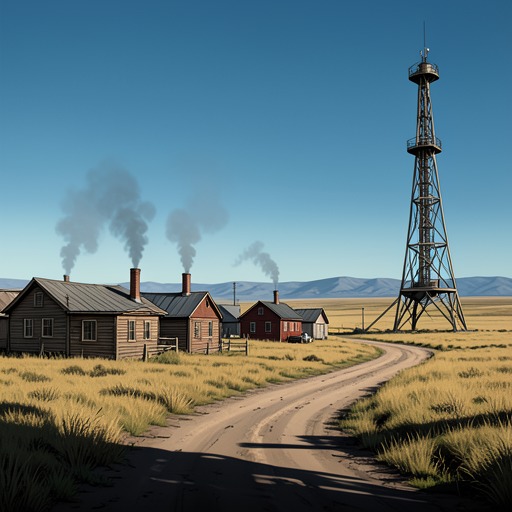
In 1803, the United States acquired the Louisiana Territory, including lands dominated by the Osage. The following year, Osage chiefs met President Thomas Jefferson at the White House. Jefferson spoke of friendship and kinship, but within four years the United States had compelled the Osage to relinquish territory between the Arkansas and Missouri Rivers. Over the next two decades, they were forced to cede nearly 100 million acres. The land left to them was a refuge in southeastern Kansas measuring about 50 by 125 miles; it was there that Mollie Burkhart’s parents came of age.
Displacement continued after the Osage had settled in Kansas. In 1870, expelled from their lodges and facing the plundering of their graves, the Osage agreed to sell their Kansas lands to settlers for $1.25 an acre. Settlers nevertheless massacred several Osage and mutilated and scalped their bodies. The violence made clear that a negotiated sale did not protect the community from those impatient to take its land.
The Osage then sought a new homeland in Indian Territory, considering the purchase of nearly 1.5 million acres from the Cherokee. An Osage chief, Wah-Ti-An-Kah, argued that the hilly land might offer protection because white settlers considered it poor country. His warning also captured the recurring pressure behind the search: if the Osage moved onto open, level land, settlers would soon demand it, and the tribe could be left without a home.
Allotment, schooling, and constrained lives
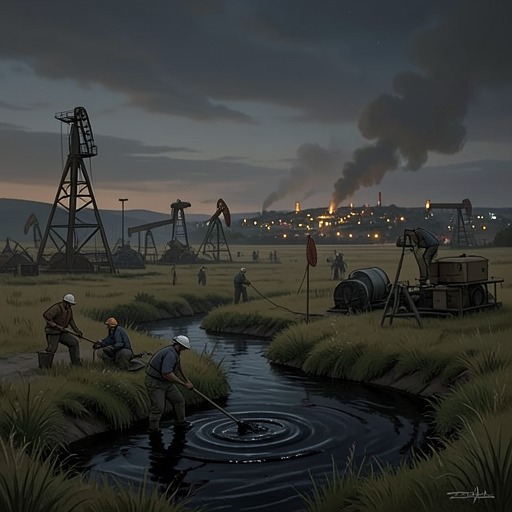
In the late nineteenth century, the federal government pressed to break up communal Osage land through allotment. The policy proposed dividing the reservation into 160-acre parcels for individual tribal members and opening the remainder to settlers. The Osage had already seen the Cherokee Outlet land run, in which tens of thousands of settlers competed for claims and the territory was rapidly carved into private parcels. To avoid a similar rush, Osage negotiators, including Bigheart and John Palmer, secured an agreement distributing land among tribal members and increasing each allotment to 657 acres. They also reserved the reservation’s oil, gas, coal, and other minerals to the Osage Tribe.
The agreement preserved an important collective interest, but allotment still made land into individual real estate and made it possible for whites to try to buy allotments. The mineral reservation protected a resource beneath the land that the Osage could not see, even as the land above ground was reorganized under pressure from the federal government. The outcome therefore combined a significant Osage negotiating success with a broader policy designed to dismantle communal landholding and open territory to settlers.
Displacement also took the form of forced assimilation. In 1894, when Mollie Burkhart was seven, her parents were told to enroll her at the St. Louis School, a Catholic boarding school for girls in Pawhuska, two days away by wagon. They were warned that refusal could mean the loss of government annuity payments on which the family depended. In March, Mollie was taken from her family and sent across the prairie. The journey carried her away from Gray Horse, the familiar limit of her world, and into a school system imposed through financial coercion.
Mollie attended school for eight months each year. Many students tried to run away; lawmen pursued them on horseback, tied them with ropes, and brought them back. When Mollie returned to Gray Horse, she saw changes in dress and language: some girls had stopped wearing blankets and moccasins, while young men wore trousers and broad-brimmed hats instead of breechcloths and scalp locks. Some students grew embarrassed by parents who did not speak English or follow the new ways. Assimilation thus separated children from family practices as well as from home, while allotment pressed to transform the land and the communal life rooted in it.
Guardianship and the loss of control
Even when the Osage held extraordinary mineral wealth, many could not freely decide how to use their own money. Federal authorities classified Osage people as capable or incapable of managing trust funds; those deemed incompetent had to rely on a local white guardian to oversee and approve spending. The control reached ordinary purchases, including toothpaste. A World War I veteran protested that he had fought for the United States but still could not sign his own checks.
The classification was not applied evenly. In practice, guardianship was closely tied to blood quantum: full-blooded Indigenous people were routinely assigned guardians, while mixed-blood people rarely were. The system converted racial classification into administrative control over property and everyday decisions. Congress scrutinized Osage expenditures in detail, including a $319.05 butcher-shop bill run up by Mollie’s mother, Lizzie, before her death. The result was another kind of separation from home and community: people remained on Osage land but were denied ordinary authority over their own resources.
Violence and further dispersal
In the fall of 1925, as Tom White pursued evidence against William K. Hale and his accomplices, the consequences of the murders were visible in daily life. White saw lights burning at night around Osage homes, heard of parents unwilling to let children go into town alone, and watched residents sell their houses and move to distant states or to Mexico and Canada. The outward movement was accompanied by distrust of the investigation. Osage people questioned why they had to use their own money to fund a Justice Department inquiry and why no one had yet been arrested. A chief recalled the contrast between having made peace with the white man and still being made to suffer.
This flight was not simply a search for opportunity elsewhere. It unfolded amid fear, grief, and doubt that public authorities would protect the community. The history of land loss and financial control had already made the Osage vulnerable; the murders and the apparent delay in securing justice deepened the pressure to leave. The book later describes the wider Osage population as dispersed: most of the Nation’s 20,000 members lived elsewhere in the state or country, while about 4,000 remained in Osage County.
Memory, return, and continuity
Distance has not ended the Osage community’s relationship to its history. During a 2012 visit to Pawhuska, the narrator saw photographs of allotted Osage members at the Osage Nation Museum, including victims of the Reign of Terror. A panoramic photograph taken at a 1924 ceremony had a panel removed. Kathryn Red Corn showed the missing section, which contained Hale’s image: the Osage had removed it not because they had forgotten the murders, but because they could not forget them.
Memory also prompted an act of return. Red Corn learned that a man had Anna Brown’s skull, apparently the portion retained by an undertaker in 1921 and later given to federal agents for analysis. She objected that it belonged buried in Osage country, contacted the Osage chief, and Brown’s skull was retrieved and interred with her other remains in a quiet ceremony. The episode joins the violence of the past to a present effort led by Osage people to restore dignity and care to the dead.
The book’s account depends in part on Osage descendants who shared family histories and on interviews with people connected to the victims. Red Corn explained that the subject remained difficult to discuss because so many Osage had lost close relatives and the pain did not go away. That testimony makes the diaspora more than a map of where people live: it is also a history carried through kinship, grief, and community knowledge.
Over several weekends each June, Osage people travel to ceremonial dances in Hominy, Pawhuska, and Gray Horse, places associated with the first Osage settlements on the reservation. The gatherings preserve traditions, bring relatives and old friends together, and connect people who have come from elsewhere. The dispersal remains part of the history, but it is not its final measure: the community continues to gather its past and present, sustaining Osage life across distance.