Osage land allotment and retention of mineral rights
Killers of the Flower MoonOsage land allotment and retention of mineral rights was a negotiated response to federal pressure to divide Osage territory and open it to settlement. The agreement gave individual tribal members larger surface allotments than the standard proposed parcel while reserving the minerals beneath the land to the tribe. Its lasting importance lies in that double result: the Osage preserved collective control over mineral wealth even as allotment transformed their landholding system and placed individual families within a new economy of inherited headrights, oil leases, and restricted funds.
Dispossession and the push for allotment
The policy followed a long history of coerced land loss. Within four years of meeting Osage chiefs in 1804, Thomas Jefferson’s administration compelled them to relinquish territory between the Arkansas and Missouri Rivers. Over the next two decades, the Osage ceded nearly a hundred million acres and eventually sought refuge on a 50-by-125-mile tract in southeastern Kansas. In 1870, after squatters had begun taking land by force, the Osage agreed to sell their Kansas lands to settlers for $1.25 an acre; settlers nevertheless massacred several Osage people. The later allotment debate therefore did not begin on untouched ground: it followed repeated displacement and the violent pressure to make Indigenous land available to white settlement.
Federal assimilation policy extended beyond land. In 1894, when Mollie Burkhart was seven, her parents were ordered to enroll her at the St. Louis School, a Catholic boarding school for girls in Pawhuska, capital of the Osage Nation. They were warned that refusal could mean the government withheld annuity payments and left the family without support. The episode shows how administrative pressure on families accompanied the larger campaign to remake Osage life. By the late 1890s, allotment had become the next major instrument of that campaign: the reservation was to be divided into 160-acre parcels, with one parcel for each tribal member and the remaining territory opened to settlers. The policy aimed to end communal landholding and establish private property, a change that would also make Indigenous land easier to acquire.
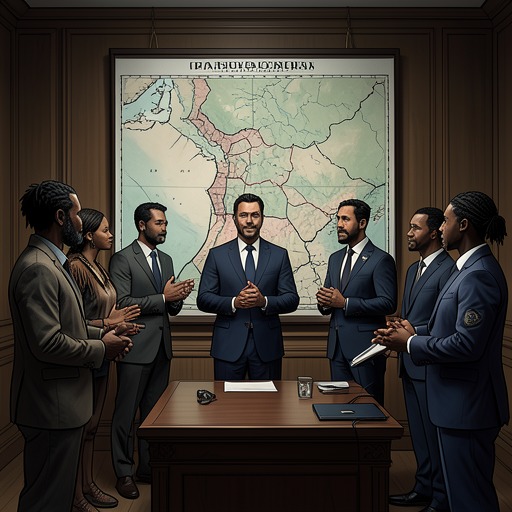
The Osage had watched the 1893 Cherokee Outlet land run turn a vast territory into competing individual claims. Because they had purchased their own land, however, the government found it harder to impose allotment on them. James Bigheart, one of the tribe’s leading chiefs, delayed the process for years. That delay gave the Osage leverage: the federal government was eager to break up Indian Territory and create the State of Oklahoma, and the Osage were the last tribe there to be allotted. In 1904, Bigheart sent John Palmer, a young lawyer adopted by an Osage family, to Washington to monitor the negotiations and advocate for the tribe.
Negotiating land and mineral rights
For months, Bigheart, Palmer, and other Osage negotiators worked with government officials on the terms. They secured a distribution of the land among tribal members alone, rather than the standard 160-acre allotment. This increased each individual allotment to 657 acres and avoided opening the reservation to a land run. White buyers could still try to purchase individual surface allotments, but the agreement reserved the oil, gas, coal, and other minerals beneath the land to the Osage Tribe.
The reservation of mineral rights was consequential because the tribe already knew that oil existed beneath its territory. More than a decade before the agreement, an Osage person had shown John Florer, the owner of the trading post in the Gray Horse settlement, an oily sheen on a creek. Florer recognized the substance as oil; with tribal approval, he and a banking partner obtained a drilling lease. By the time allotment was negotiated, several small wells were operating. The mineral provision secured this unseen realm even while the surface was being divided. After the terms of the Osage Allotment Act of 1906 had been agreed, Palmer told Congress that he had written the Osage agreement out in longhand.
When the State of Oklahoma entered the Union in 1907, Osage members could sell their surface land in what was now Osage County. The mineral trust, by contrast, remained under tribal control: no one could buy or sell an Osage headright, which represented a share in the mineral trust, and headrights could only be inherited. Mollie Burkhart and her family, like other members on the tribal roll, received headrights. The distinction between saleable surface holdings and inheritable mineral interests made the arrangement a first Underground reservation: a collective resource held beneath individually allocated land.
Oil wealth and the vulnerabilities of inheritance
The mineral reservation became the foundation for large-scale leasing and extraction. As more white prospectors obtained leases, drilling transformed the landscape. In 1917, Frank Phillips and his workers were drilling on Lot 185, less than half a mile from another leased parcel, when the derrick began to tremble and a black column of oil erupted from the ground. In 1920, E. W. Marland discovered the Burbank field; a new well produced 680 barrels in its first twenty-four hours. These gushers brought the Osage’s mineral rights into a rapidly expanding oil economy, while also making the value of the inherited interests increasingly consequential.
The lease auctions, overseen by the United States Department of the Interior, made that value visible. Held about four times a year, they had begun in 1912, and only part of the underground reservation had been opened to drilling. A single lease typically covered a 160-acre tract, and bidding escalated. In good weather, auctions took place beneath the Million Dollar Elm in Pawhuska, capital of the Osage Nation. Oilmen arrived in luxurious railcars, while Osage spectators, including Mollie and Ernest Burkhart, watched the proceedings. The auctions concentrated attention on the income generated by the mineral trust, but the right to inherit a headright did not mean that its holder could freely manage the resulting wealth.
Tom White’s investigation into the flow of oil money found that guardians and administrators often exploited Osage beneficiaries. Some bought goods from their own businesses at inflated prices, routed wards’ purchases to favored stores and banks for kickbacks, claimed to buy property for wards while acquiring it for themselves, or stole outright. One guardian bought a car for $250 and resold it to a ward for $1,250. A government study estimated that guardians had directly taken at least $8 million from restricted Osage accounts before 1925. These abuses reveal a central limit of the arrangement: the mineral rights remained collectively reserved and headrights could not be sold, but beneficiaries’ access to the income could still be controlled by a system of guardianship that was widely corrupted.
Historical record and continuing memory
The book’s later account of the policy and its consequences draws on both official records and Osage family knowledge. Its sources include government files, court transcripts, tribal records, oral histories, and interviews with descendants of people affected by the Reign of Terror. In 2012, the reporter visited the Osage Nation Museum in Pawhuska, capital of the Osage Nation, where director Kathryn Red Corn showed photographs of the 2,229 allotted members, including Mollie Burkhart and her family. A panoramic photograph taken at an Osage ceremony in 1924 had a section missing; Red Corn later showed the removed panel, which depicted William K. Hale. The image records how the community has handled a history in which the wealth associated with allotment and oil was entangled with murder, while refusing to let the perpetrators’ place in that history disappear.
The distinction established by the agreement—individual surface allotments alongside tribally reserved minerals—was neither a simple preservation of the old land system nor a complete transfer of control to settlers. It secured an enduring collective interest in underground resources, yet the oil revenues flowed through leases, inherited headrights, and administrative controls that created new opportunities for exploitation. The agreement’s significance is therefore inseparable from both what the Osage negotiators managed to retain and the institutions through which others later sought to control the wealth that retention produced.