Osage oil boom period
Killers of the Flower MoonThe Osage oil boom period was a dramatic reversal: land regarded by outsiders as barren became the foundation of extraordinary mineral wealth, while the people whose rights made that wealth possible faced the continuing consequences of dispossession, assimilation, and exploitation. Oil brought rapidly rising income and a transformed local economy, but it did not erase the coercive history of how the Osage came to hold the land—or the unequal systems through which its resources were developed and controlled.
Dispossession and the Reservation
The boom’s origins lay in a long struggle to retain a homeland. After the United States forced the Osage to relinquish territory between the Arkansas and Missouri rivers, further cessions pushed them from nearly a hundred million acres of ancestral land. In 1870, they agreed to sell their Kansas lands to settlers for $1.25 an acre after squatters had begun taking land by force. Settlers also massacred several Osage, mutilating and scalping their bodies. The people then sought a new home in Indian Territory, where many white observers considered the rocky, hilly country unfit for cultivation.
That judgment helped make the land appear safe from further white encroachment. Yet the supposed worthlessness of the reservation concealed what lay beneath it. Oil would later make the territory valuable to prospectors and investors, turning the land that had seemed a refuge into the focus of a new contest over resources and rights.
Allotment, Mineral Rights, and Assimilation
The federal drive to divide tribal land into individual property threatened Osage control over their territory. The allotment policy proposed parcels of 160 acres for each member and opened the remainder to settlers, disrupting communal ownership and making land easier to acquire. The Osage delayed allotment longer than other tribes in Indian Territory, gaining leverage while officials pressed toward statehood. In negotiations, they secured allotments of 657 acres per member and, crucially, a provision reserving oil, gas, coal, and other minerals to the tribe.
The distinction between surface land and mineral rights shaped the boom that followed. After the 1906 agreement and the formation of the State of Oklahoma, members could sell their surface land, but no one could buy or sell headrights in the mineral trust; headrights could only be inherited. Each person on the tribal roll received a share. In this way, the Osage retained collective control of the underground wealth even as the land above it became subject to private sale. The arrangement created what the book describes as an underground reservation: a continuing tribal interest beneath the surface.
This defense of mineral rights came amid policies aimed at remaking Osage life. In 1894, when Mollie Burkhart was seven, the government required her to attend the St. Louis School, a Catholic boarding school in Pawhuska. Her parents were warned that refusal could mean the loss of annuity payments. The family’s experience belonged to a wider campaign of forced assimilation, while allotment sought to replace communal landholding with private property. These were connected pressures on culture, family, and control of land—not events separate from the later rush to extract oil.
Drilling and the Changing Landscape
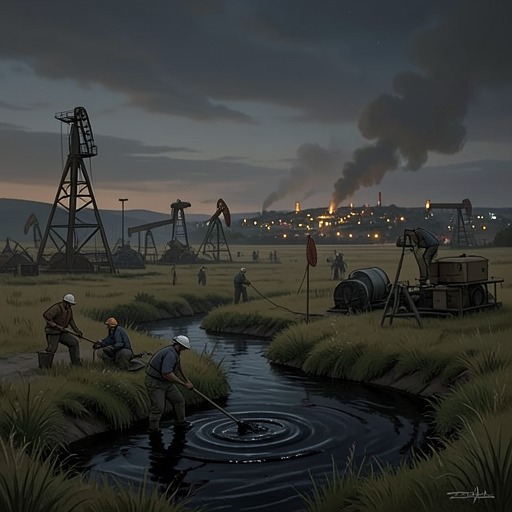
As leases opened to white prospectors, drilling made the reservation a landscape of intense labor and uncertain speculation. Workers lowered nitroglycerin torpedoes into wells and detonated them underground; the blasts sometimes brought ancient spear or arrowhead fragments to the surface. Wooden derricks rose above the fields, while crews used their own specialized slang. Some prospectors drilled dry wells, called dusters, and left in disappointment. The contrast was stark: an oil claim could promise immense returns, but many attempts produced nothing.
A major eruption in 1917 made the scale of the resource visible. On Lot 185, less than half a mile from Lot 50, Frank Phillips and his workers were drilling when the derrick trembled and the earth burst open. A black column of oil surged into the air; a driller pulled Phillips off the platform just in time. In 1920, E. W. Marland discovered the Burbank field, where a new well produced 680 barrels in its first twenty-four hours. Osage spectators gathered to watch gushers, careful not to create a spark as oil rose sometimes a hundred feet above the rigging. They celebrated the spectacle even as its dark spray coated fields, flowers, workers, and onlookers.
Royalties, Auctions, and Boomtown Wealth
The boom’s income flowed through quarterly payments to members of the tribal roll. Initially worth only a few dollars, the checks rose into the hundreds and then thousands as production expanded. In 1923 alone, the tribe received more than $30 million, an amount the book equates to more than $400 million today. The Osage were considered the wealthiest people per capita in the world. Public attention fixed on this prosperity, often presenting it as a startling contradiction to stereotypes of Indigenous poverty rather than as the result of Osage mineral rights and collective resource ownership.
The oil economy also remade nearby settlements. Gray Horse was among the older communities; Fairfax had nearly fifteen hundred residents, and Pawhuska, capital of the Osage Nation, had more than six thousand. The streets drew cowboys, fortune seekers, bootleggers, outlaws, marshals, financiers, and oil magnates. Cars raced along paved horse trails, while restaurants, opera houses, and polo grounds accompanied the growing commerce. The boom’s fortunes were visible in the new activity of these towns, but the gains and the risks did not fall evenly across the community.
Lease auctions concentrated the competition. Held about four times a year under the supervision of the United States Department of the Interior, the auctions had begun in 1912. Only part of the underground reservation was open to drilling, and bids for a single lease—typically covering 160 acres—rose sharply. Oil barons arrived in luxurious railcars at Pawhuska, where the press announced their visits as major events. In good weather, auctions took place beneath the Million Dollar Elm, a large tree on a hilltop; Osage attendees, including Mollie Burkhart, watched alongside local businessmen and outside investors. The spectacle joined tribal mineral wealth to a rapidly expanding commercial world, even as the auctions made the value of each lease a matter of intense public competition.
Memory and Continuing Significance
The boom’s significance in the book extends beyond the moment of extraction. Its wealth arose from rights the Osage had fought to preserve, while its development unfolded against a history of forced land cessions, coercive schooling, and policies designed to divide tribal territory. Oil enriched the community, but it also made Osage wealth a visible object of outside attention and intensified the stakes around mineral leases and inherited interests.
The book’s later return to the region shows how the violence associated with this wealth remains part of community memory. At the Osage Nation Museum, a panoramic photograph from a 1924 ceremony had a section removed; the missing panel showed William K. Hale. The image had been taken out not to forget the murders, but because the community could not forget them. Kathryn Red Corn also helped recover and bury Anna Brown’s skull, which had been retained after her death. These acts of remembrance, alongside the June I’n-Lon-Schka ceremonial dances held in Pawhuska, Gray Horse, and Hominy, show a community preserving history and tradition in the aftermath of the boom and the violence it accompanied. The oil period is therefore not simply a story of sudden riches: it is also a history of contested rights, imposed change, and the Osage effort to keep their land, memory, and community in their own hands.