Osage oil prosperity and decline
Killers of the Flower MoonOsage oil prosperity and decline describes a reversal in which mineral wealth, preserved through a hard-won agreement, made the Osage famous for extraordinary oil revenues but also drew settlers, speculators, and exploiters into the community. The oil boom reshaped the reservation’s economy and landscape; its benefits, however, were unevenly controlled, and the fields that had transformed the region would eventually yield far less. The history of the boom is therefore inseparable from the struggle over who could control Osage land, income, and future.
Land, allotment, and mineral rights
The oil wealth emerged after a long history of dispossession. The Osage were forced to cede nearly a hundred million acres of ancestral land and ultimately took refuge in a 50-by-125-mile area in southeastern Kansas. In 1870, after being expelled from their lodges and seeing graves plundered, they agreed to sell their Kansas lands to settlers for $1.25 an acre; settlers had also massacred several Osage. Later, the federal allotment campaign threatened to divide the reservation into individual parcels and open the remaining land to outsiders. The policy aimed to replace communal life with private property, a change that would make Indigenous land easier to acquire. Negotiations led by Bigheart and John Palmer shaped a different outcome for the Osage. Rather than divide the land among allottees and open the remainder to settlement, the agreement allocated it only among tribal members, increasing each allotment from 160 acres to 657. Crucially, it reserved the oil, gas, coal, and other minerals to the Osage Tribe. That provision protected a source of wealth beneath the surface even as the land above it was divided. The Osage knew that some oil lay under the reservation, but the scale of the resource was not yet apparent. A discovery made after an Osage man showed John Florer, the trader in Gray Horse, an oily sheen on a creek eventually led to drilling leases; by the time of allotment, several small wells were operating.
Gushers and the lease economy
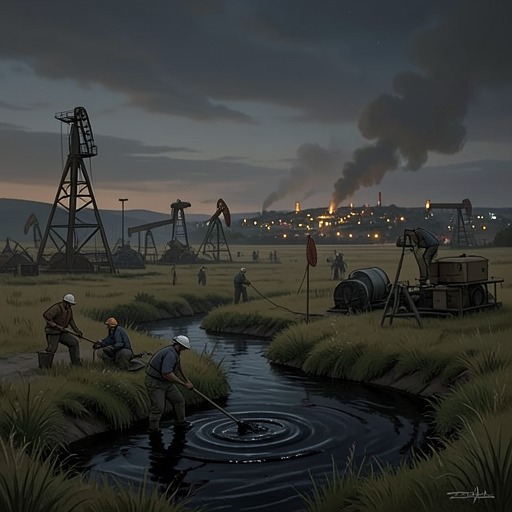
The scale of the oil boom became unmistakable in 1917. On Lot 185, less than half a mile from Lot 50, Frank Phillips and his workers were drilling when the derrick began to tremble. The ground rumbled, workers ran, and Phillips was pulled from the platform just before oil burst from the earth in a black column. Subsequent discoveries brought further displays of abundance. In 1920, E. W. Marland found the Burbank field, where a new well produced 680 barrels in its first twenty-four hours. Osage spectators flocked to see gushers, watching oil rise as much as a hundred feet into the air. Its spray coated fields and flowers and smeared the faces of workers and onlookers; people nevertheless celebrated, hugging and tossing their hats. The oil economy was organized around leases as well as wells. Beginning in 1912, auctions overseen by the United States Department of the Interior were held about four times a year. Only part of the vast underground reservation had been opened to drilling, yet bidding for a single lease, typically covering 160 acres, climbed to extraordinary levels. In good weather, the auctions took place on a Pawhuska hill beneath the Million Dollar Elm tree. Osage people, including Mollie Burkhart and Ernest Burkhart, attended alongside oilmen and local business figures. Every three months, prominent oil barons—including E. W. Marland, Bill Skelly, Harry Sinclair, and Frank Phillips—arrived in luxurious railcars. The spectacle made the auctions a public emblem of the money moving through the region, while the reserved minerals ensured that the underlying resource belonged to the Osage Tribe.
Wealth and the machinery of extraction
The boom generated striking fortunes, but oil income also created opportunities for fraud. As Tom White investigated the movement of money from Osage headrights, he found guardians and administrators who used the system to exploit the people whose interests they were meant to protect. Some bought goods for their wards from their own businesses at inflated prices: one guardian bought a car for $250 and resold it to his ward for $1,250. Others steered business to favored stores and banks for kickbacks, claimed to buy homes for Osage wards while acquiring them for themselves, or stole outright. A government study estimated that guardians had taken at least $8 million directly from restricted Osage accounts before 1925. These abuses were not confined to a few isolated guardians. White’s account presents the exploitation as an organized local economy in which prominent businesspeople, ranchers, lawyers, politicians, lawmen, prosecutors, and judges could participate in or conceal the diversion of Osage wealth. Some officials and guardians acted in the tribe’s interests, but the system also empowered people with local influence to profit from Osage assets. The oil boom thus brought wealth into Osage County while exposing Osage income to an elaborate network of control and theft. The murders investigated by White unfolded amid this contest over wealth, including the struggle surrounding headrights and inheritance; prosperity did not shield Osage families from violence or from the institutions that restricted their control of property.
Depletion and the end of the boomtown era
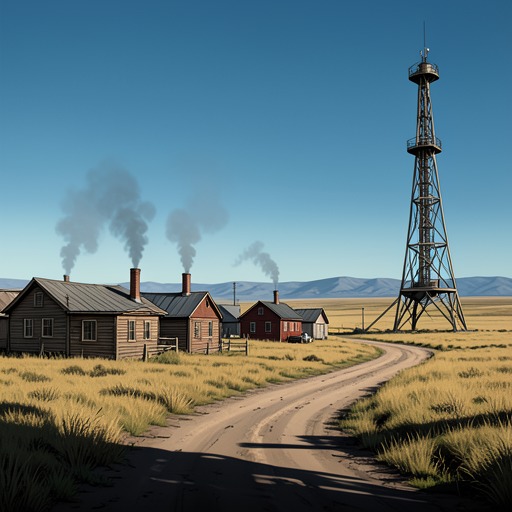
The decline came through falling oil prices and the gradual depletion of the fields. During the boom, a barrel of oil had reached more than $3; in 1931, the price fell to 65 cents, and an annual headright payment dropped below $800. Margie Burkhart later described how the wells that had once been audible in Gray Horse stopped pumping. The Great Depression further weakened Osage fortunes already reduced by guardians and thieves. Across the region, boomtowns faded, and Gray Horse lost most of its former settlement. More than ten thousand wells remain scattered across the reservation, but they are generally low-producing stripper wells, each yielding fewer than fifteen barrels a day. At an oil-lease auction in Tulsa in 2012, three leases sold for less than $15,000 in total. The remnants of the boom are also visible in the changed landscape. Petroleum companies and forests of derricks disappeared as the fields were depleted; railroads, outlaws, and many boomtowns vanished with them. Whizbang, once a boomtown, survives only as stone ruins in grass. In Pawhuska, abandoned buildings remain alongside a courthouse, restaurants, and the institutions of a continuing Osage community. The shift from oil abundance to depletion was not a clean break: Margie, who inherited a little more than half a headright from her father, still receives quarterly payments from the mineral trust. In recent years those checks have usually amounted to a few thousand dollars, helpful but not enough to live on.
Continuing resources and remembrance
The Osage have developed other sources of revenue. Seven casinos built on their territory generate tens of millions of dollars for the Osage, helping fund government, education, and health-care benefits. They were formerly called the Million Dollar Elm Casinos, a name that carried the oil boom’s most recognizable local symbol into a new economic era. The Osage also recovered at least part of the oil funds mismanaged over decades by the federal government: after an eleven-year legal battle, the government agreed in 2011 to settle an Osage lawsuit for $380 million. The boom’s legacy is measured not only in property and revenue but also in what the community continues to remember. In 2012, the author visited the Osage Nation Museum and saw photographs of allotted tribal members, including Mollie Burkhart with her sisters and portraits of people killed during the Reign of Terror. A panoramic photograph from a 1924 ceremony had a section removed because it showed William K. Hale; the Osage had not removed his image in order to forget the murders, but because they could not forget. That encounter joins the history of oil wealth to the family losses and community memory that survived its rise and decline. The fields and boomtowns diminished, but the Osage remained, preserving community institutions and seeking both economic resources and a truthful account of what the oil era cost.