Osage relations with the United States government
Killers of the Flower MoonOsage relations with the United States government were shaped by a recurring conflict: federal authorities claimed to act as protectors and partners while imposing land loss, assimilation, and financial control. Osage leaders nevertheless negotiated to preserve collective mineral rights, securing a source of wealth that the government’s later restrictions could not make freely available to its owners.
Diplomacy and territorial dispossession
By the seventeenth century, the Osage claimed a territory extending from what is now Missouri and Kansas through Oklahoma and west toward the Rockies. After the United States acquired the Louisiana Territory in 1803, President Thomas Jefferson described the Osage as a great nation and, at an 1804 White House meeting, addressed their chiefs as his children and promised friendship. Within four years, however, the government compelled the Osage to relinquish territory between the Arkansas and Missouri Rivers. An Osage chief said the people had no choice but to sign a treaty or be declared enemies of the United States.
The cessions continued over the next two decades, taking nearly a hundred million acres and leaving the Osage in a 50-by-125-mile area in southeastern Kansas. In 1870, after being expelled from their lodges and seeing their graves plundered, they agreed to sell their Kansas lands to settlers for $1.25 an acre. The agreement did not protect them from violence: impatient settlers massacred several Osage and mutilated their bodies. An Indian Affairs agent questioned which side should be called savage, but the government’s role in dispossession continued.
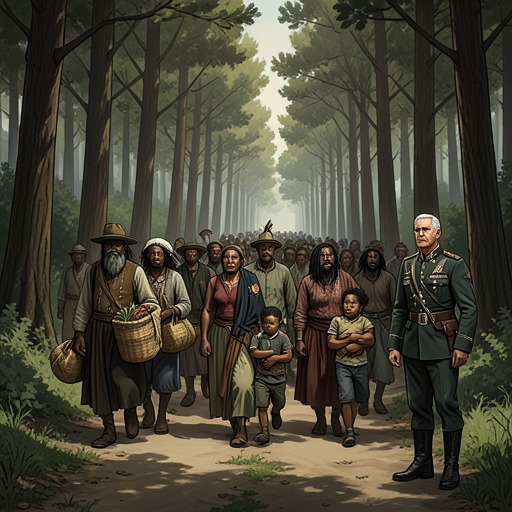
Seeking a new homeland, the Osage considered buying nearly 1.5 million acres from the Cherokee in what was then Indian Territory. The land was hilly and regarded by many white observers as poor for cultivation, a quality Osage leaders believed might deter further encroachment. The Osage bought the territory for seventy cents an acre and began their exodus in the early 1870s. The departure meant leaving children’s graves behind; after the journey, the community established camps including Pawhuska, where the Office of Indian Affairs built a field office, and Gray Horse, where Lizzie and Ne-kah-e-se-y settled. Forced migrations and disease had reduced the Osage population to an estimated three thousand, about a third of its size seventy years earlier.
Allotment and a negotiated mineral estate
In the late nineteenth century, federal assimilation policy joined land seizure to schooling and private-property reform. In 1894, when Mollie Burkhart was seven, her parents were told to enroll her at the St. Louis School in Pawhuska. They were warned that refusal would mean the government withheld annuity payments, leaving the family without support. The policy of allotment promised to divide the reservation into 160-acre parcels for individual tribal members and open the remainder to settlers. It was intended to dismantle communal life and make Indigenous land easier to acquire.
The Osage delayed allotment longer than other tribes in Indian Territory, gaining leverage as officials pressed to establish the state of Oklahoma. George Bigheart sent John Palmer to Washington to monitor the negotiations. The resulting agreement improved on the standard allotment formula: instead of 160 acres, each Osage member received 657 acres, and the agreement reserved the oil, gas, coal, and other minerals to the Osage Tribe. This arrangement avoided a land run on Osage territory, though white buyers could seek to purchase the surface allotments.
When Oklahoma entered the Union in 1907, Osage members could sell surface land in what had become Osage County, but the mineral trust remained under tribal control. No one could buy or sell a headright; it could only be inherited. The Osage headright system thus preserved a collective claim beneath land that had been divided and made alienable. As oil development expanded, that underground estate produced immense income, but it also made the administration and distribution of Osage wealth a new field of federal and local power.
Guardianship and restricted wealth
Federal control over Osage property rested on a racialized classification system. The Department of the Interior could deem Indigenous people incompetent and appoint financial guardians; in practice, appointments were almost always determined by blood quantum. Full-blooded Osage were invariably assigned guardians, while mixed-blood people rarely were. The system made the people whose mineral rights had survived allotment dependent on appointed managers to access much of the money those rights generated.
In 1921, Congress tightened that control. Osage people with guardians became restricted and could withdraw only a few thousand dollars a year from their trust accounts. The limit applied even when families needed funds for education or a sick child’s hospital care. Mollie Burkhart, classified as full-blooded, was subject to the restriction; at least her husband, Ernest Burkhart, was her guardian. The contrast was stark: the tribe retained the minerals, but many of its members could not freely use the proceeds.
The government’s system also created opportunities for private extraction. As federal investigators followed the flow of oil money, they found guardians buying goods for their wards from their own businesses at inflated prices, steering clients toward stores and banks in exchange for kickbacks, claiming to buy property for wards while acquiring it themselves, or stealing outright. One guardian bought a car for $250 and resold it to his ward for $1,250. A government study estimated that guardians had taken at least $8 million directly from restricted Osage accounts before 1925. The abuses were not simply individual misconduct: prominent businessmen, ranchers, lawyers, politicians, lawmen, prosecutors, and judges could all participate in or facilitate the system known as Indian business.
Community memory and the continuing relationship
The book’s account of this relationship extends beyond the period of federal land and financial policy. In 2012, a reporter seeking information about the murders visited the Osage Nation Museum and met its longtime director, Kathryn Red Corn. Photographs of allotted Osage members included Mollie Burkhart and Lizzie, as well as people who had become victims of the Reign of Terror. A panoramic photograph taken at a 1924 ceremony had a panel removed; the missing image showed William K. Hale. The Osage had removed his likeness not to erase the murders, but because the community could not forget them.
The work of recovering that history depended on Osage descendants and community members who shared family knowledge and helped guide what could be told. Red Corn explained that the violence had taken mothers, fathers, siblings, and cousins, and that the pain remained. The reporter also learned that Anna Brown’s skull, once retained by an undertaker and given to bureau agents for analysis, had been recovered and buried with her other remains at a quiet ceremony. These acts of remembrance place Osage people not merely as subjects of government records, but as custodians of family histories and participants in deciding how the past is represented.
The relationship therefore remains visible in both its institutional legacy and the community’s efforts to preserve its own account. The government’s promises of friendship, protection, and citizenship repeatedly accompanied coercive policies; Osage negotiation protected mineral rights, while federal restrictions and guardianship limited the use of their wealth. Against that history, archival recovery, family testimony, and the return of human remains show an ongoing insistence on Osage authority over memory and belonging.