Osage removal from Kansas to Indian Territory
Killers of the Flower MoonThe Osage removal from Kansas to Indian Territory was not a single departure so much as a new stage in a long dispossession. After earlier forced cessions had driven the Osage into a confined area of southeastern Kansas, they sold that land in 1870 and purchased a new homeland from the Cherokee. Their early-1870s migration brought them to a place they hoped would be harder for white settlers to covet, but it could not undo the losses already suffered or guarantee that their land and autonomy would remain secure.
The Loss of Kansas
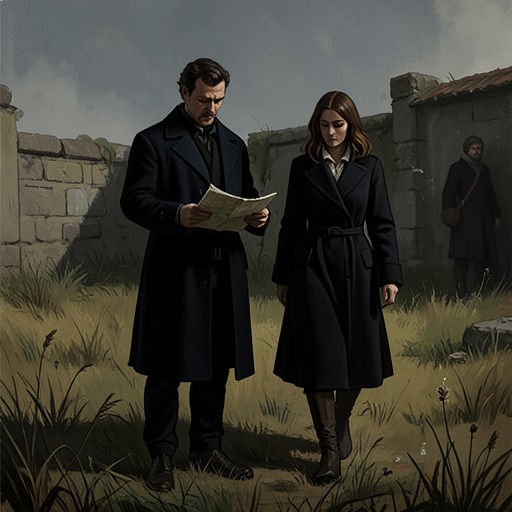
The migration followed decades of pressure to surrender Osage territory. Within four years of the United States’ Louisiana Purchase, the Osage had been compelled to relinquish land between the Arkansas and Missouri Rivers. Over the next two decades they ceded nearly a hundred million acres of ancestral territory, eventually taking refuge in a tract in southeastern Kansas measuring about fifty by 125 miles. That refuge, too, was soon under pressure.
In 1870 the Osage agreed to sell their Kansas lands to settlers for $1.25 an acre. The agreement followed expulsion from their lodges and the plundering of their graves; it did not put an end to violence. Impatient settlers had already massacred Osage people and mutilated and scalped their bodies. The contrast between a formal sale and the violence surrounding it makes clear how limited the Osage’s control over their departure had become: legal transactions unfolded alongside the seizure of homes and desecration of the dead.
Choosing a New Homeland
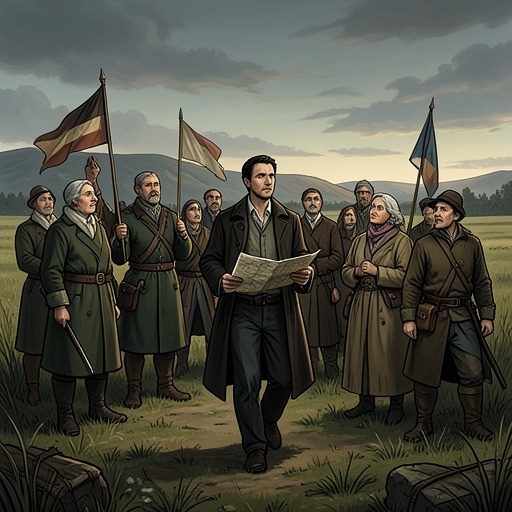
In search of somewhere to live, the Osage considered buying nearly 1.5 million acres from the Cherokee in what was then Indian Territory, south of Kansas. The region had itself become an endpoint on the Trail of Tears for tribes expelled from their homelands. White observers disparaged the area as rocky and unsuitable for cultivation. To the Osage, those same qualities offered a measure of hope. At a council meeting, Wah-Ti-An-Kah argued that the hills might deter white settlement and the intrusion of settlers who would eventually demand the Osage land.
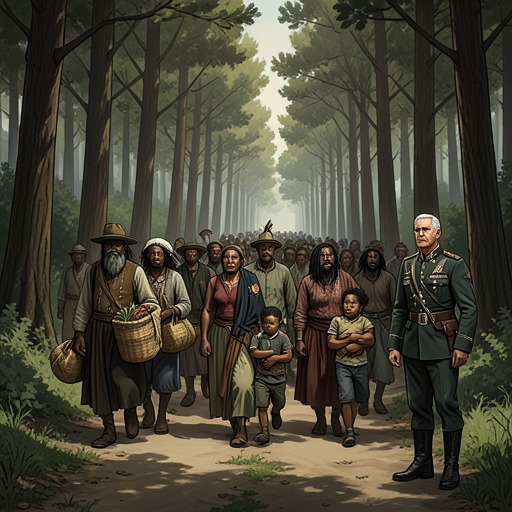
The Osage bought the territory for seventy cents an acre and began their exodus in the early 1870s. The price and purchase marked an exercise of decision-making, but the journey also meant leaving behind the graves of their children and relatives. A witness remembered the cries of elders, especially women, as the people departed. The new homeland was chosen strategically; the departure was nevertheless a profound separation from the places where the community had lived and buried its dead.
Settlement and Loss
After completing the journey, the Osage established several camps. Pawhuska, capital of the Osage Nation, became the most significant settlement; an imposing sandstone field office for the Office of Indian Affairs stood on a prominent hilltop there. Gray Horse, farther west, began as little more than a cluster of newly built lodges. Lizzie and Ne-kah-e-se-y, who married in 1874, settled at Gray Horse, making the new territory the setting for the next generation of family life.
The move did not reverse the damage wrought by repeated forced migrations and diseases including smallpox. One estimate placed the Osage population at about three thousand, roughly a third of its size seventy years earlier. An agent of the Office of Indian Affairs described this diminished population as the remnant of a people who had once held the region. The removal thus carried two histories at once: the effort to establish a community in a new place, and the severe demographic loss that had made relocation necessary.
For a time, buffalo hunts preserved a connection to an earlier way of life. The Osage pursued the animals for food, but also for the memories and practices associated with the past. A white trader who accompanied them recalled older men gathering around campfires to recount stories of war and the hunt. These accounts do not erase the upheaval of removal; they show how communal memory continued in the new homeland, even as the conditions that sustained the old life had been disrupted.
The Continuing Contest over Land
The move to Indian Territory did not end federal efforts to remake Osage life or open land to outsiders. In 1894, when Mollie was seven, her parents were ordered to enroll her at the St. Louis School in Pawhuska. They faced the threat that the government would withhold annuity payments if they refused. The separation of a child from her family was one expression of a broader assimilation campaign, which gathered force as officials pressed for allotment: dividing the reservation into individual parcels and opening the remainder to settlers.
The Osage negotiated a different outcome from the one imposed on many other tribes. In the 1906 agreement, the tribe secured allotments for its members rather than opening surplus land to a land run, increasing each individual allotment from 160 acres to 657. The agreement also reserved the oil, gas, coal, and other minerals to the Osage Tribe. That provision preserved a collective claim to resources beneath the surface even as the land above it was divided. The reservation of mineral rights was a consequential defense of Osage interests, not an end to outside control: subsequent federal policies placed many Osage under white financial guardians and restricted their access to their own trust funds.
The book’s later account returns to removal through the evidence and memories that survived it. Its reporter drew on archival records and interviews, including conversations with Osage descendants of those affected by the Reign of Terror. At the Osage Nation Museum, a panoramic photograph from 1924 had a panel removed because it showed William K. Hale; the missing image testified not to forgetting, but to the community’s continuing memory of violence. Kathryn Red Corn told the reporter that the pain endured because so many Osage had lost close relatives. The annual I’n-Lon-Schka dances in Pawhuska and Gray Horse, among other communities, preserve traditions and bring Osage together. In this account, the early-1870s migration is therefore both a defining rupture and part of a longer history of survival, memory, and continuing claims to land and community.