Roaring Twenties
Killers of the Flower MoonThe Roaring Twenties frames the book’s contrast between public alarm over Osage wealth and the extravagance of the oil boom around them. Rather than treating lavish spending as an Indigenous peculiarity, the account places it within a decade of conspicuous consumption—and sets the press’s caricatures against the fortunes and reversals of powerful white oilmen.
A decade of conspicuous consumption
The book situates Osage spending within a wider culture of excess, invoking the Roaring Twenties as a period of extravagant display. Some Osage spending, it notes, may have reflected ancestral customs that connected generosity on a grand scale with tribal stature; many Osage also invested their money skillfully. Those details complicate the press’s tendency to reduce Osage wealth to supposed improvidence.
The comparison is not abstract. E. W. Marland, the oilman who found the Burbank field, first built a twenty-two-room mansion in Ponca City, then left it for a still larger residence. Modeled inside on the Palazzo Davanzati in Florence, the new house had fifty-five rooms, including a ballroom with a gold-leaf ceiling and Waterford crystal chandeliers; it also contained twelve bathrooms, seven fireplaces, three kitchens, and an elevator lined with buffalo skin. Outside were a swimming pool, polo fields, a golf course, and five lakes with islands.
The unequal scrutiny of wealth
While journalists circulated stories of Osage extravagance, the scale of Marland’s own display makes the contrast difficult to miss. He defended spending money to buy and build, without apology. The book’s juxtaposition reveals how similar signs of wealth could be framed differently: Osage prosperity drew alarm and mockery, while a white oilman’s opulence appeared as the expression of individual ambition.
The press’s account of Osage wealth also left out important context. It rarely acknowledged either prudent investment or the possibility that conspicuous generosity carried meanings rooted in Osage custom. By placing those omissions beside Marland’s mansion, the narrative challenges the assumption that excess was uniquely Osage, and draws attention to who had the power to define whose wealth counted as extravagance.
Boom and reversal
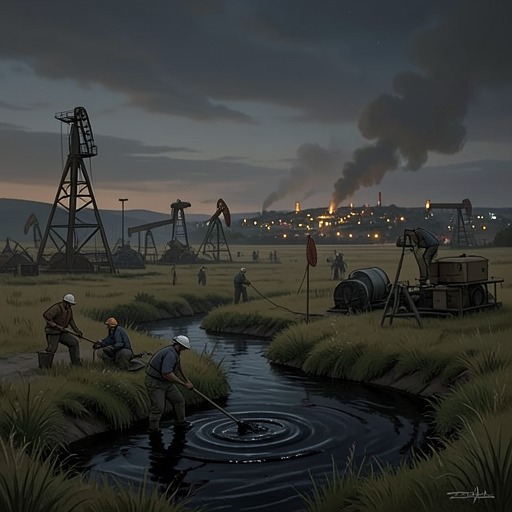
Marland’s fortune did not hold. Within a few years, he could no longer afford the mansion’s lighting bill and had to leave it. After entering politics, he failed to find another gusher. His architect later remembered him sitting dejectedly on a nail keg northeast of town as men worked a portable drilling rig in the rain, hoping to find oil. Another famed Oklahoma oilman also spent through a fortune—$50 million—and ended destitute.
These reversals sharpen the decade’s irony: conspicuous wealth did not guarantee lasting security, even for the men who profited from oil. In the book’s account, the Roaring Twenties therefore supplies both a historical setting for competing displays of prosperity and a measure of their unequal public interpretation.