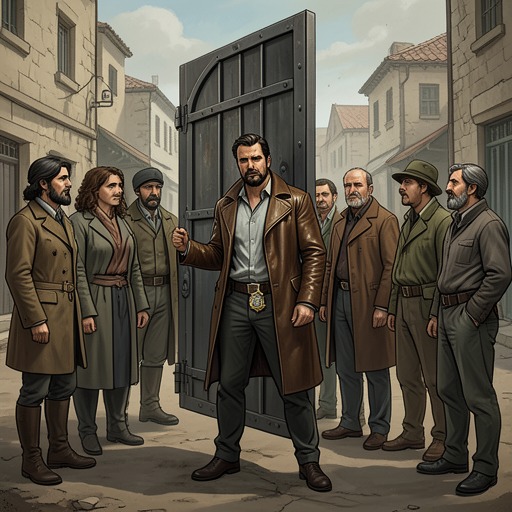
Robert Emmett White
Killers of the Flower MoonRobert Emmett White was a Texas sheriff whose work placed the law, in all its force and human complexity, inside his family home. His example formed the setting in which his son, T. B. White, first encountered crime and punishment—not as abstractions, but as daily realities with consequences for both prisoners and those who pursued them.
Identity and Early Formation
Born in Tennessee, Robert Emmett White moved to central Texas at eighteen, in 1870. He married Maggie four years later, and they made a living herding cattle and growing what food they could in the hill country outside Austin. Their son T. B. White was born in 1881, the third of five children. The nearest school was a one-room building three miles away, a walk the children made together; among them were their youngest brother, Doc White, and their older brother Dudley White, to whom T. B. White was especially close.
When T. B. White was six, his mother died, apparently from complications after childbirth. Robert Emmett White was left to raise five children, all younger than ten. In 1888, townspeople urged him to run for sheriff of Travis County. He won, and the family moved into a house adjoining the Austin jail, which Robert Emmett White oversaw. For his children, the jail’s barred windows, stone passageways, and tiered cells became part of home: T. B. White could look from his bedroom window into the corridor and see the cell doors. In his father’s first year as sheriff, the jail held nearly three hundred prisoners, among them murderers, thieves, burglars, and people classified as mentally ill.
The Sheriff’s Methods and Restraint
A jail riot in which five men were badly injured hardened Robert Emmett White into a firm, sometimes unyielding sheriff, but not an indifferent one. He made arrests without brandishing his six-shooter and treated prisoners in the same manner whether they were Black, white, or Mexican. When he heard that a mob was preparing to lynch a Black prisoner, he went out to stop it. He also refused to place young, nonviolent prisoners among older, more dangerous convicts. With nowhere else to keep them, he sometimes brought them into his own house, where they lived alongside his children; one girl stayed for weeks, though T. B. White never learned why she had been jailed.
The work that T. B. White watched was practical and relentless. With criminology still primitive, Robert Emmett White took his gun, questioned witnesses, mounted his horse, and pursued suspects, sometimes sending out a pack of bloodhounds. He could be called away at any hour, even on the Sabbath. In 1892, when T. B. White was eleven, a family man was shot while riding his horse. Robert Emmett White found trampled earth and a burned ammunition wad thirty paces from the body, where the killer had stood. The hounds followed a trail back to the dead man’s house; witness inquiries then revealed that the killer was the victim’s own son. The pursuit that began with physical traces ended in a family crime.
Not every chase ended in capture. Weeks later, Robert Emmett White pursued a man accused of raping a woman who had been dragged from her buggy in broad daylight, but the fugitive escaped despite the grueling chase. Such failures weighed on him: when a suspect remained at large, he withdrew into himself, and a reporter observed that the fugitive occupied his thoughts day and night. For T. B. White, the sheriff’s calling thus joined method to burden—the search for evidence and the inability to set it aside when it led nowhere.
Violence, Vigilance, and the Executioner’s Duty
The danger of the sheriff’s work reached into his family’s life. Each time Robert Emmett White rode into the dark after a fugitive, his children faced the possibility that he might not return. A desperado once held a gun to his head, and at the jail a prisoner stabbed him from behind. T. B. White saw the knife protruding from his father’s back and blood on the floor before Robert Emmett White subdued the attacker. The scene remained with his son, joining the law’s duty to a question of whether a violent offender could be forgiven after nearly killing someone he loved.
In January 1894, Robert Emmett White’s office required him to carry out an execution, the county’s first in a decade. The condemned man, Ed Nichols, was nineteen, Black, convicted of raping a girl, and maintained his innocence while hoping the governor would grant a reprieve. Robert Emmett White had a carpenter build the gallows beside the prison’s southern wall, the only place with enough ceiling height. Nichols’s cell stood ten feet away; as the carpenter sawed and nailed the boards, the condemned man could hear the gallows taking shape. Robert Emmett White repeatedly tested the apparatus with sacks of sand, intent on making the execution swift. When the governor rejected Nichols’s final appeal, Robert Emmett White told him the decision. Nichols was praying; though he tried to remain calm, his hands trembled. He asked to be clean-shaven and dressed in a fine black suit for his appointment with death, and Robert Emmett White promised to honor the request.
The Questions He Left His Son
Robert Emmett White did not theorize about the law, but the life his son watched raised questions that no arrest or execution could settle. Some prisoners seemed irredeemably wicked, others ill, and still others driven to desperate violence before becoming penitent. The family’s Baptist preacher taught that everyone was a sinner, even the man charged with upholding justice. T. B. White spent much of his life trying to understand these contradictions. His father’s example offered no easy division between innocence and guilt: it joined humane treatment of prisoners and resistance to mob violence with the duty to execute a condemned man. That tension made the law, for the boy raised beside the jail, not merely an authority but a difficult moral problem.