Texas Rangers
Killers of the Flower MoonThe Texas Rangers are presented as both a formative law-enforcement institution and a force in the violent transformation of the frontier. The book traces their influence through the careers of Tom White and his brother Doc, whose experience as Rangers later informed their work in the Bureau of Investigation. It also reaches further back, connecting the Rangers to the development of the repeat revolver and to the changing balance of power between settlers and Indigenous peoples. In this account, the Rangers’ legacy is not simply a tradition of rugged individual lawmen: it is a history in which practical skill, violence, and expanding federal law enforcement meet.
Frontier Service and White’s Formation
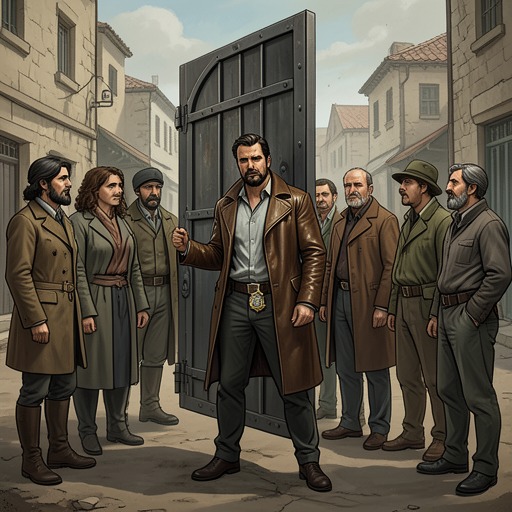
Near the turn of the century, Tom White served in the Texas Rangers, spending much of his life on horseback across the southwestern frontier. He tracked fugitives, murderers, and stickup men, carrying a Winchester rifle or a pearl-handled six-shooter. That experience formed the practical foundation of his later work: when the Bureau of Investigation recruited him in 1917, he had already spent years pursuing criminals in dangerous conditions.
White’s Ranger background belonged to a particular kind of law enforcement. He had no formal training as an officer, but had learned through service and sharpened his ability to recognize patterns and connect scattered facts. He had also experienced gunfights. Yet his familiarity with armed violence did not make him eager to use it: he took pride in never having killed anyone, and was wary of the thin line he perceived between a good man and a bad one. His example complicates the image of the frontier lawman as merely a gunfighter. The Rangers’ methods and dangers formed part of White’s inheritance, but so did his restraint.
That inheritance influenced White’s transition into federal service. He wanted to enlist in the army during World War I, but a recent surgery prevented it; joining the Bureau became a way to serve his country. It also offered a place in law enforcement as the older frontier world was disappearing. The Bureau’s work was different from Ranger service: agents were supposed to gather facts, had no power of arrest, and were not authorized to carry guns. White’s earlier experience remained relevant, however, especially when an assignment threatened to become dangerous. He sometimes carried a six-shooter despite Bureau rules, refusing to let the new institution’s restrictions erase the risks he understood from the frontier.
The Revolver and the Frontier’s Balance of Power
The book’s history of the Rangers reaches back to their role in the adoption of the repeat revolver. In 1844, Rangers testing a Colt five-shooter overcame a larger Comanche force. The encounter helped persuade a Ranger to tell Samuel Colt that improvements could make the weapon the most effective of its kind. With that Ranger’s input, Colt designed a six-shooter; its cylinder bore an image of the Rangers’ victory over the Comanche.
This account makes the weapon part of the Rangers’ institutional legacy, not just an accessory to individual skill. Rangers had long been outmatched by warriors able to release a barrage of arrows while lawmen reloaded single-shot rifles. The repeat revolver altered that disparity. The book describes the six-shooter as a weapon that helped irrevocably change the balance of power between the Plains tribes and settlers. Its engraved battle scene made that history visible on the weapon itself: technological innovation, Ranger experience, and settler victory were bound together.
White’s later practice with his revolver supplies a personal echo of that history. To improve his aim, he shot at moving creatures, including rabbits, buzzards, and prairie dogs. He concluded that accuracy mattered more than being the fastest to draw. Doc likewise dismissed popular legends about Western gunmen as exaggerated and emphasized marksmanship over speed. Their experience reflects the Rangers’ practical world of armed encounters, while also narrowing the popular myth of the quick-drawing lawman to a more disciplined, less theatrical skill.
The Rangers in the Bureau’s “Cowboys”
Tom White’s younger brother, Doc, was also a former Texas Ranger and later joined the Bureau of Investigation. He was gruff and hard-drinking, carried a bone-handled six-shooter and a knife in his boot, and was described by a relative as rough and ready. The brothers belonged to a small group inside the Bureau known as the Cowboys: frontier lawmen working within an agency that was beginning to impose a more standardized professional identity on its agents.
The book emphasizes the contrast between those two worlds. Bureau agents were expected to be fact-gatherers, and the organization’s rules limited their arrest and gun-carrying powers. White, meanwhile, had learned law enforcement on the frontier, where fugitives could be tracked on horseback and an officer’s own safety was at stake. He struggled with newer scientific methods such as fingerprint analysis, but his strength lay in investigation: discerning connections and turning dispersed facts into a coherent account. His Ranger background was therefore not a complete substitute for Bureau procedure; it was a different kind of expertise that the agency still needed.
When White later assembled a team for the Osage murder investigation, he selected agents with the capacity to operate in dangerous country, shadow suspects, maintain cover, and handle weapons if necessary. Among those he recruited was a stocky former Texas Ranger whom a superior considered best suited to situations involving danger. The choice shows how Ranger experience remained useful within the Bureau even as the organization modernized. White did not assign Doc to the team. Since their Ranger service, the brothers had avoided working the same cases, so that their family would not risk losing both of them at once.
Institutional Legacy
The book presents the Texas Rangers through a bounded but consequential set of connections: frontier pursuit, armed conflict, the adoption of the revolver, and the careers of men later recruited by the federal Bureau. It does not treat Ranger experience as a simple badge of competence. The six-shooter’s history points to the consequences of technological advantage in the struggle between settlers and the Plains tribes, while White’s reluctance to kill shows that life within a culture of armed enforcement could also produce restraint and moral unease.
The Rangers’ continuing significance in the narrative lies in the passage of their skills and habits into a changing law-enforcement system. White and Doc carried frontier experience into an agency whose rules, investigative methods, and professional expectations were still developing. Their presence among the Bureau’s Cowboys marks a transition rather than a clean break: the federal institution could demand reports and scientific methods, but for dangerous fieldwork it continued to rely on men formed by older, less standardized traditions.